Berlin Brands Group, now valued at $1B+, raises $700M to buy and scale merchants that sell on marketplaces like Amazon

Berlin Brands Group (BBG) — one of the new wave of e-commerce startups hoping to build lucrative economies of scale around buying up smaller brands that sell on marketplaces like Amazon and using technology to run and scale them more efficiently — has picked up a big round of funding to fill out that mission. The startup has closed a round of $700 million, comprising both equity and debt, which it will use in part to continue building its fulfillment and logistics infrastructure, as well as its tech platform, and in part to buy more companies.

BBG confirmed that the investment — one of the biggest to date in the space — boosts its valuation to over $1 billion.

Bain Capital is leading the equity portion of this round. The deal will also see it buy out a previous investor, Ardian, for an undisclosed amount that is separate to the $700 million raise.

This funding round is the second announced by BBG this year. In January it announced it would be investing $302 million off its own balance sheet for M&A, and in April it announced a debt round of $240 million. This latest $700 million is different in that it includes the equity component alongside the equity.

BBG got its start initially developing its own products and selling them on Amazon and other marketplaces — founder and CEO Peter Chaljawski was a DJ in a previous life and started with a focus on audio equipment he developed for himself.

Over time, he saw an opportunity to diversify that into a wider consolidation play, where BBG would also acquire and merge third-party brands into its business, tapping into the opportunity to provide the owners of the third-party businesses an exit route and bring those smaller brands more scale, more marketing nous and more tech to improve the efficiency of their operations.

Today the mix totals 3,700 products and 14 own brands, including Klarstein (kitchen appliances), auna (home electronics and music equipment), Capital Sports (home fitness) and blumfeldt (garden). BBG says it has access to some 1.5 billion e-commerce customers across various marketplaces where it sells goods in Europe, the U.K., the U.S. and Asia. Notably, unlike many others in the same space as BBG, it is focused on more than Amazon, with some 100 channels in 28 countries.

That list of “many others in the same space” is a long one and seemingly growing by the day. Yesterday, two of them — Heroes and Olsam — respectively raised $200 million and $165 million. Others leveraging the opportunity of consolidating merchants that sell via Fulfillment by Amazon include Suma Brands ($150 million), Elevate Brands ($250 million), Perch ($775 million), factory14 ($200 million), Thrasio (currently probably the biggest of them all in terms of reach and money raised and ambitions), Heyday, The Razor Group, Branded, SellerX, Berlin Brands Group (X2), Benitago, Latin America’s Valoreo and Rainforest and Una Brands out of Asia.

As more startups enter the fray, battling to buy the best of the third-party brands will become more of a challenge, and so the backing of Bain should help BBG shore up against that competition.

“With Bain Capital’s commitment and the additional funding secured, we have set our next milestone on our path to building a global house of brands,” said Chaljawski in a statement. “This allows us to tackle strategic goals of acquiring and developing brands globally, as well as the operational and logistical expansion. Bain Capital’s experience working with founders worldwide will help us continue our evolution as a leading e-commerce company in scaling brands.”

“BBG is a disruptive leader in the rapidly changing consumer goods space. Their ability to develop and scale brands that meet current consumer trends through their highly efficient e-commerce platform gives the company tremendous growth potential in a fast-growing market,” added Miray Topay, MD at Bain Capital Private Equity. “We have partnered with many founder-led management teams and look forward to helping Peter and his team achieve their goal of becoming a global leader in consumer e-commerce”.



from eCommerce – TechCrunch https://ift.tt/3kHmLrP
via IFTTT

Forum Brands secures $100M in debt financing to acquire more e-commerce brands

Forum Brands, an e-commerce acquisition platform, announced today that it has secured $100 million in debt funding from TriplePoint Capital.

The financing comes just just over two months after the startup raised $27 million in an equity funding round led by Norwest Venture Partners.

Brenton Howland, Ruben Amar and Alex Kopco founded New York-based Forum Brands in the summer of 2020, during the height of the COVID-19 pandemic. 

“We’re buying what we think are A+ high-growth e-commerce businesses that sell predominantly on Amazon and are looking to build a portfolio of standalone businesses that are category leaders, on and off Amazon,” Howland told me at the time of the company’s last raise. “A source of inspiration for us is that we saw how consumer goods and services changed fundamentally for what we think is going to be for decades and decades to come, accelerating the shift toward digital.”

Since we covered the company in June, Forum Brands says it has acquired several new brands, including Bonza, a seller of pet products, and Simka Rose, a baby-focused brand specializing in eco-friendly products. Simka sells in the U.S. and the EU and is an example of how Forum is expanding globally, Amar said.

Howland and Amar emphasize that the Forum team continues to focus on quality over quantity when evaluating potential acquisitions. Although they meet with 15-20 founders a week, they are selective in which companies they choose to acquire.

“We continue to be a quality-first buyer, and not quantity-driven,” Amar said, noting that the company will still help a company build its brand even if it does not yet meet Forum’s quality threshold or if the founders are just not yet ready to sell.

The new funds will be used to, naturally, acquire more e-commerce companies. As part of the debt financing, Sajal Srivastava, co-CEO and co-founder of TriplePoint Capital, will be joining Forum’s board of directors.

“We are impressed not only by Forum’s long-term strategy and ability to leverage technology and deep collective e-commerce and M&A experience but also by how Forum cultivates relationships with their sellers both before and after partnering with them,” he said in a written statement.

At the time of its June raise, Forum had about 20 employees. As of today, it has about 40.

Forum’s technology employs “advanced” algorithms and over 100 million data points to populate brand information into a central platform in real time, instantly scoring brands and generating accurate financial metrics.


from eCommerce – TechCrunch https://ift.tt/3DEoRBC
via IFTTT

Goodcall picks up $4M, Yelp partnership to answer merchant inbound calls

Even without staffing shortages, local merchants have difficulty answering calls while all hands are busy, and Goodcall wants to alleviate some of that burden from America’s 30 million small businesses.

Goodcall’s free cloud-based conversational platform leverages artificial intelligence to manage incoming phone calls and boost customer service for businesses of all sizes. Former Google executive Bob Summers left Google back in January, where he was working on Area 120 — an internal incubator program for experimental projects — to start Goodcall after recognizing the call problem, noting that in fact 60% of the calls that come into merchants go unanswered.

“It’s frustrating for you and for the person calling,” Summers told TechCrunch. “Every missed call is a lost opportunity.”

Goodcall announced its launch Wednesday with $4 million in seed funding led by strategic investors Neo, Foothill Ventures, Merus Capital, Xoogler Ventures, Verissimo Ventures and VSC Ventures, as well as angel investors including Harry Hurst, founder and co-CEO of Pipe.com, and Zillow co-founder Spencer Rascoff.

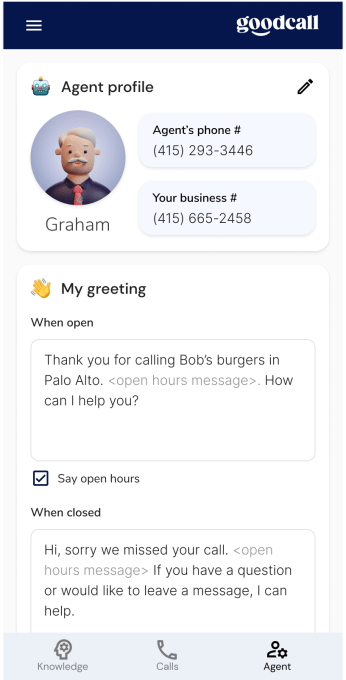
Goodcall mobile agent. Image Credits: Goodcall

Restaurants, shops and merchants can set up on Goodcall in a matter of minutes and even establish a local phone number to free up an owner’s mobile number from becoming the business’ main line. The service is initially deployed in English and the company has plans to operate in Spanish, French and Hindi by 2022.

Merchants can choose from six different assistant voices and monitor the call logs and what the calls were about. Goodcall can also capture consumer sentiment, Summers said.

The company offers three options, including its freemium service for solopreneurs and business owners, which includes up to 500 minutes per month of Goodcall services for a single phone line. Up to five additional locations and five staff members costs $19 per month for the Pro level, or the Premium level provides unlimited locations and staff for $49 per month.

During the company’s beta period, Goodcall was processing several thousands of calls per month. The new funding will be used to continue to offer the free service, hire engineers and continue product development.

In addition to the funding round, Goodcall is unveiling a partnership with Yelp to tap into its database of local businesses so that those owners and managers can easily deploy Goodcall. Yelp data shows that more than 500,000 businesses opened during the pandemic. The company pulls in from Yelp a merchant’s open hours, location, if they offer Wi-Fi and even their COVID policy.

“We are partnering with Yelp, which has the best data on small businesses, and other large distribution channels to get our product to market,” Summers said. “We are bringing technology into an industry that hasn’t innovated since the 1980s and democratizing conversational AI for small businesses that are the main driver of job creation, and we want to help them grow.”


from eCommerce – TechCrunch https://ift.tt/3t5hzlj
via IFTTT

Web building platform Duda snaps up e-commerce cart tool Snipcart

Duda announced Wednesday that it acquired Canada-based Snipcart, a startup that enables businesses to add a shopping cart to their websites.

The acquisition is Palo Alto-based Duda’s first deal, and follows the website development platform’s $50 million Series D round in June that brings its total funding to $100 million to date. Duda co-founder and CEO Itai Sadan declined to comment on the acquisition amount.

Duda, which works with digital agencies and SaaS companies, has approximately 1 million published paying sites, and the acquisition was driven by the company seeing a boost in e-commerce websites as a result of the global pandemic, he told TechCrunch.

This was not just about a technology acquisition for Duda, but also a talented team, Sadan said. The entire Snipcart team of 12 is staying on, including CEO Francois Lanthier Nadeau; the companies will be fully integrated by 2022 and the first collaborative versions will come out.

When he met the Snipcart team, Sadan thought they were “super experienced and held the same values.”

“We share many of the same types of customers, many of which are API-first,” he added. “If our customers need more headless commerce, they can build their own front end using Snipcart. Their customers will benefit from us growing the team — we plan to double it in the next year and roll out more features at a faster pace.”

The global retail e-commerce market is estimated to grow by 50% to $6.3 trillion by 2024, according to Statista. Duda itself has experienced a year over year increase of 265% in e-commerce sites being built on its platform, which Sadan said was what made Snipcart an attractive acquisition to further accelerate and manage its growth that includes over 17,000 customers.

Together, the companies will offer new capabilities, like payment and membership tools inside of the Duda platform. Many of Duda’s customers come with inventory and don’t want to manage it on another e-commerce platform, so Snipcart will be that component for taking their inventory and making it shoppable on the web.

“Everyone is thinking about how to introduce transactions into their websites and web experiences, and that is what we were looking for in an e-commerce platform,” Sadan said.


from eCommerce – TechCrunch https://ift.tt/3juGziN
via IFTTT

Royal Mail Changes to Service Ts&Cs

Royal Mail Changes to Service Ts&Cs

There are some Royal Mail changes coming from the 1st of October to their service terms and conditions which you’ll want to be aware of. you can keep up to date with all updates on the Royal Mail website.

Changes to items sent via Royal Mail 24 and 48

From the 1st of October 2021, customers posting via Royal Mail 24 and Royal Mail 48 will be required to provide an accurate weight and pre-advice for each item, unless they are using Royal Mail’s Basic Barcode solution or are a flat rate customer.

(A flat rate is a standard charge calculated by Royal Mail based on your posting profile for each Royal Mail 24 and Royal Mail 48 item where such standard charge applies for a fixed period of time.)

Changes when sending items to the Isles of Scilly via Royal Mail Tracked

From the 1st of October 2021, postcode areas TR21-TR25 in the Isles of Scilly will be added to the delivery aim exclusion list for Royal Mail Tracked 24 and Royal Mail Tracked 48 services.

Hopefully marketplaces will clock this change and not hold you to the same delivery expectations as for the rest of the country.

Changes to Royal Mail Business Collections – Monthly Payments

Royal Mail changes to how the handle late payments for Business Collections service mean it’s best to pay on time!

From the 1st of October 2021, for customers paying for their collections on an agreed monthly fee basis, failure to make payment for two or more consecutive months will result in a mandatory move to payment by Direct Debit or an Annual Payment account.

If a customer is unable or unwilling to move to the new payment method, then this will result in a termination of their collection service.

Changes to Royal Mail Business Collections – Pro Rata Refunds

From the 1st of October 2021, any customers who meet the required spend criteria and are successful in their application for a free business collection will be entitled to a pro-rata refund for their collection fees.

The pro-rata refund will be calculated from the date on which you meet the qualifying spend criteria.

The post Royal Mail Changes to Service Ts&Cs appeared first on Tamebay.


from Ecommerce – Tamebay https://ift.tt/3yKm721
via IFTTT

The Derwent Group to host InPost lockers

The Derwent Group to host InPost lockers - White City Retail Park

InPost is expanding fast in the UK and have announced their first commercial real estate partnership with The Derwent Group, as they continue their expansion in the UK, such as their site at White City Retail Park in Old Trafford (pictured above) and Liverpool Shopping Park .

The new partnership will see InPost Lockers installed at key locations across the The Derwent Group portfolio, including their shopping centre and major retail park sites in the North of England.

The network of lockers will play an important role in bringing extra convenience to the sites as people start to step out again after months of coronavirus curbs — providing local communities visiting and working at the retail and business parks with a quick, convenient and greener way to collect, return and send parcels.

The new amenities will go some way towards greening the surrounding communities by taking vans off the road and, by extension, reducing local traffic congestion. Lockers will reduce last mile deliveries locally and have the potential to lower CO2 emissions by two thirds compared to home deliveries.

“Our partnership with The Derwent Group marks another significant milestone for our rollout of lockers in the north of England. With life returning to normal, the introduction of lockers to The Derwent Group’s sites will provide local communities with genuine convenience — offering the population a really easy way to collect deliveries and return items as part of their daily shopping trips or when popping out for lunch when at work. And by taking vans off the roads, they will reduce last mile deliveries locally and help to create greener communities.”
– Jason Tavaria, CEO, InPost UK

“Introducing InPost UK lockers to our schemes enables us to further serve our local communities by offering people a complementary service that is a genuinely convenient, and easily accessible way to collect deliveries and return items 24/7 as part of their existing daily routines. Lockers also have a key role to play in creating greener communities by reducing last mile journeys and emissions — with the potential to lower CO2 emissions by two thirds compared to home deliveries in urban areas and reduce local congestion significantly. We are looking forward to working with InPost UK across our retail and business parks.”
– Peter Gilliland Head of Property Management, The Derwent Group

The post The Derwent Group to host InPost lockers appeared first on Tamebay.


from Ecommerce – Tamebay https://ift.tt/3zAiexL
via IFTTT

Trustshare runs escrow infrastructure as a service to facilitate online sales

Meet Trustshare, a London-based startup that is working on escrow infrastructure for online classified, B2B marketplaces, trade directories and more. It’s a white-label platform that can be integrated with online marketplaces in just a few lines of code.

If you’ve ever tried to sell something expensive on the web, you know that it’s hard to know for sure that you’re not getting scammed. For instance, that person that is trying to buy your old phone from you — should you send the phone first or ask the buyer to send the money first?

If a marketplace relies on Trustshare for payments, buyers first have to checkout and leave money into a dedicated transaction-based account. Trustshare can also handle identity verification steps, such as KYC and AML checks (Know Your Customer and Anti-Money Laundering). The seller can check the status of the funds. Once the buyer has received the product, they can release funds to the seller.

Behind the scenes, Trustshare generates a dedicated IBAN per transaction. Customers can deposit money using bank transfers or cards. In the U.K. and Europe, Trustshare takes advantage of open banking regulation so that users can connect to their bank account from the checkout flow.

If you don’t want to tweak your site’s code, you can also use Trustshare for offline sales and transactions that happen over email or messaging apps. The company lets you generate QR codes or payment links to initiate a payment.

The startup has raised an angel round from several business angels, such as Cazoo and Zoopla founder Alex Chesterman and Carwow founder James Hind. After that, Trustshare raised a $3.2 million seed round (£2.3 million) led by Nauta Capital.

Many companies could leverage Trustshare to launch their own marketplace as escrow payment is one of the biggest pain points. For instance, you can imagine luxury brands launching their own marketplaces of handbags and watches, new car marketplaces focused on one type of cars in particular, etc.

“Our 5 lines of code branded escrow checkout is taking many marketplaces, brands that consumers know and trust, transactional. Really, this is just the start. Our borderless escrow infrastructure is incredibly powerful, and we plan to launch new products including instant pay-throughs, baskets and projects to make payments as quick and easy as sending an email,” co-founder and CEO Nick Fulton said in a statement.

Trustshare is built on top of existing payment infrastructure. That’s why it supports 180 countries and 30 currencies already. The company’s initial clients include Watchcollecting, Bookabuilder and U.K. trade body FENSA’s Deposit Protection service.


from eCommerce – TechCrunch https://ift.tt/3kGrY35
via IFTTT

New Government – Labour Small Business Agenda

We’ve are all waking up to a new Government today, with the Labour party about to take control of the country and what should be top of your...