Showing posts with label eCommerce – TechCrunch. Show all posts

IFC set to invest $26M in Partech’s Africa Fund II

The International Finance Corporation (IFC), the private sector arm of Work Bank, plans to make an equity investment of up to €25 million ($26.43) into the Partech Africa Fund II (PAF II) by the Paris-based VC firm Partech. The IFC said in the disclosures that it’s eyeing a stake not exceeding 20%.

The agency said it will commit a further €15 million ($15.9 million) for future co-investment opportunities together with the Fund. The PAF II will invest in “seed to Series D rounds, and follow-on rounds in top portfolio companies,” according to records by the IFC. The investment is awaiting approval.

“IFC’s proposed investment in Partech Africa Fund is an equity investment of up to €25 million, not to exceed 20% of the total Fund commitment. In addition, IFC has proposed a separate co-investment envelope of up to €15 million on a delegated authority basis, to facilitate IFC’s ability to participate in potential future co-investment opportunities alongside the Fund,” the IFC said in the disclosure.

It is not immediately clear how much Partech was looking to raise, as the VC firm, one of the largest in Africa, declined to share specific details of the fundraising with TechCrunch.

However, it is expected to be larger than the Fund I, which closed at $143 million in 2019 and had the participation of the IFC and some other major institutions like the European Investment Bank (EIB), the Dutch Development Bank (FMO) and the African Development Bank Group – entities that are driving investment across the continent. The EIB and FMO plan to invest in this round too, with the latter considering injecting up to €25 million too.

The PAF II will be invested in early and growth tech startups across the continent, availing the much needed funding in the continent. Last year startups in Africa raised between $4.3 billion and $5 billion, and while this was great growth (almost double) from the previous year, it was still marginal when compared to other regions across the world. Such funds as the PAF are geared at closing this gap.

“IFC anticipates the project to increase access to equity alongside operational value add for startups across Africa. Access to venture capital in Africa remains low compared to most other emerging markets. The project is also expected to increase innovation in key markets across Africa through the support of market-disrupting digital business models,”the IFC said.

“In markets where investees grow rapidly and become sizable market players, innovation at scale can generate large impacts on a market by pushing traditional players to innovate and introduce digital solutions or reduce traditional incumbents’ market share,” the agency said.

Partech has 15 investments in nine countries across Africa, including Wave; a U.S. and Senegal-based mobile money service provider; Tugende, a Ugandan mobility-tech company, and Trade Depot, a Nigeria and U.S.-based company that connects consumer goods brands to retailers.


from eCommerce – TechCrunch https://ift.tt/LyODqVh
via IFTTT

Amazon gets into AR shopping with launch of ‘Virtual Try-On for Shoes’

Amazon is tapping into augmented reality in an attempt to appeal to sneakerheads shopping its site. The retailer this morning announced a new feature called Virtual Try-On for Shoes that will allow customers to visualize how a pair of new shoes will look on themselves from multiple angles using their mobile phone’s camera.

The company says the feature will help brands to better showcase their products while also informing customers’ purchasing decisions. The launch follows the rollout of other virtual try-on technology for athletic shirts this past April, as part of an update to its “Made for You” custom clothing service. In that case, however, the technology was rendering the shirt on an avatar that represents the customer’s body, based on their actual measurements, and doesn’t use AR.

The new AR try-on feature for shoes will initially launch in the U.S. and Canada in the Amazon shopping app on iOS. To use the feature, customers will tap on the new “Virtual Try-On” button below the product image on supported styles to get started.

At launch, try-on will be available across thousands of styles from brands including New Balance, Adidas, Reebok, Puma, Saucony, Lacoste, Asics, and Superga, Amazon says.

To try on the shoes, customers will point their phone’s camera at their feet and the AR shoes will appear. They can then use the included carousel to swap out colors of the same style of shoe without having to exit the experience. From here, shoppers can also snap a photo of their virtual try-on experience by tapping the “Share” icon. This lets them save the photo to their device and post to social media.

“Amazon Fashion’s goal is to create innovative experiences that make shopping for fashion online easier and more delightful for customers,” said Muge Erdirik Dogan, president of Amazon Fashion, in a statement about the new feature. “We’re excited to introduce Virtual Try-On for Shoes, so customers can virtually try on thousands of styles from brands they know and love at their convenience, wherever they are. We look forward to listening and learning from customer feedback as we continue to enhance the experience and expand to more brands and styles,” Dogan added.

The feature was previously in testing with select customers, Amazon notes, so some users may have access before now.

Image Credits: Amazon

Amazon has been fairly slow to embrace AR technology for online apparel shopping, despite increased competition from competitors in this space. In the past, it’s seen AR as more of a tool or toy. In years past, it has experimented with AR for furniture shopping, and has used AR for inconsequential features, like AR Stickers or to add AR features to seasonal shipping boxes.

Meanwhile, Big Tech rivals including Pinterest, Google and Snapchat have leveraged AR to allow shoppers to try on makeup, apparel and accessories. Snap recently expanded its investment in AR shopping with the introduction of tools that turn retailers’ photos into 3D assets and the launch of an in-app destination for AR fashion and virtual try-on called “Dress Up.” The company said that more than 250 million Snapchat users have engaged with AR shopping Lenses more than 5 billion times since January 2021.

Amazon’s top U.S. competitor Walmart also recently turned to virtual try-on with its March 2022 debut of an A.I.-powered try-on feature, “Choose My Model,” which was based on technology it acquired the prior year from the startup Zeekit. Here, Walmart shoppers can try on clothes in sizes XS through XXXL across virtual models ranging in height from 5’2″ and 6’0″. While that’s a more complex use of technology than Amazon’s virtual try-on of shoes, it does not leverage AR.

Asked if Amazon had any data that suggested virtual try-on actually increased conversions, an Amazon spokesperson didn’t have much to offer. They didn’t share any specific metrics and spoke only of how the feature was an “experiment” in making shopping easier. They also noted Amazon was experimenting in other areas, including virtually trying on eyewear and virtually trying on outfits on a personal avatar.


from eCommerce – TechCrunch https://ift.tt/Z8Rw1Mt
via IFTTT

Juni jumps on $206M to help e-commerce players manage their own money better

The e-commerce market is on track to pass $5.5 trillion in revenues this year, which speaks not only to how much consumers are shopping online these days, but also to how many businesses there are out there now selling to them. Today, a startup from Gothenburg, Sweden called Juni is announcing $206 million in funding — a $100 million Series B and a further $106 million in debt — to build out e-commerce-focused neobank, designed specifically to cater to that growing group of retailers with tools to help them run their business.

Mubadala Capital led the $100 million equity round, with previous backers EQT Ventures, Felix Capital, Cherry Ventures and Partners of DST Global also participating. Meanwhile, the $106 million in debt funding — which Juni will use to fuel its credit products — is coming from TriplePoint Capital.

Founded in 2020 and launched in 2021, Juni closed off its Series A only in October of last year (it raised $21.5 million in July and a further $52 million in October), but it’s been on a very strong pace of growth — “multiple hundred percent”, CEO Samir El-Sabini said in an interview. (It didn’t give actual customer numbers.) It’s not disclosing its valuation but sources close to the company tell me it is now in the region of $800 million. 

Most incumbent banks, and now a fair number of neobanks, target small and medium businesses as customers. But the gap in the market that Juni identified and built to fill is that the needs of e-commerce SMBs, and those doing business online in general, are unique among them.

E-commerce businesses have potentially huge incoming and outgoing sums in their accounts, and that money does not necessarily come in a consistent stream. They likely do business in multiple geographies and multiple suppliers. And in addition to potentially selling across a number of platforms and marketplaces (all of which also add complexity to the finances and managing them), they use a number of other digital tools both to sell, and to run and to help grow their operations.

El-Sabini, who co-founded the company with CTO Anders Orsedal and Jonathan Sanders (who is no longer with the company but remains a ‘silent partner’ El-Sabini said), all had track records of working in digital businesses where they saw, not just for themselves but their customers, an opportunity to build a bank that took all of that into account (so to speak) and built a financial management service that fit those dynamics. 

So around basic banking, Juni’s credit cards and capital advance/cashback services (which is where the debt funding will be put to use), accounting, and analytics are all optimized for the kind of incomings and outgoings e-commerce companies have. The platform includes some 2,400 integrations with tools (and the data that those tools generate) that companies might potentially use for their accounting, their digital advertising, their payments on websites, and more.

And while that sounds like a very large product with a lot of tentacles, Juni has actually narrowed its scope in the last year. The company initially launched catering to both e-commerce retailers and digital marketers, since the latter group also has a lot of similar dynamics, spending money in multiple jurisdictions and leveraging a variety of marketing and advertising tech. Now, it has shifted its target customer, and the tools it’s building, more specifically to the e-commerce vertical and the marketing that they undertake.

“We are focusing on e-commerce companies,” El-Sabini said. “However marketing is an important function in all e-commerce companies.”

The company launched during the pandemic, which was a windfall of sorts: there were suddenly a lot more consumers buying a lot more online, and e-commerce companies were scrambling both to connect with and sell to those audiences without going bust, so having a banking partner that could assist in that was partly what drove such strong growth for Juni.

Interestingly, and as you might expect, that need doesn’t go away as the pandemic subsides. Growth is definitely now slowing down in that sector (dropping by at least four percent globally and continuing that way for the next few years, says eMarketer) and so e-commerce companies have to manage that, too.

“The cost base is generally under pressure, and we can offer credit with great insights into our customers’ forecasting, so they understand the cash flow,” and cash flow is king for these customers, he continued. “Something that we also see is fear in the markets. So if you can have a partner that is long term and can help you and understand your position that is obviously very important. We want long relationships with our customers.”

Abu Dhabi’s Mubadala Investment Company, the parent of Mubadala Capital, is a prolific fintech investor (it has backed Brex, SpotOn, GoCardless, and many others), and Fatou Bintou Sagnang, the partner who led the investment, said that she and the firm evaluated a number of other players in the banking space focusing on SMBs before coming to invest in Juni.

“It started with looking at SMBs and fintech enablement and we were looking for companies that fit that thesis,” she said in an interview. “We like companies that use tech in smart ways to decrease costs.” She said they spent more than nine months getting to know the young Juni and liked its focus on e-commerce. “We actually see a lot of parallels with Brex in the US. We came in with some experience doing this for sectors, and our thesis is that the next iteration in fintechs challenging incumbents will be more verticalization.” 


from eCommerce – TechCrunch https://ift.tt/6SujHQL
via IFTTT

Departing Amazon exec Dave Clark to head logistics startup Flexport

Dave Clark, the former Amazon consumer chief, will take over as CEO of freight forwarding and customs brokerage startup Flexport starting September 1, 2022.

Clark resigned from his role as CEO of Amazon’s worldwide consumer division on Friday. His last day at the big tech company will be July 1, after which time he’ll join Flexport as co-CEO alongside current leader Ryan Peterson. Peterson, who founded the $8 billion-valued supply chain startup in 2013, will step into an executive chairman role six months after Clark joins, according to the current CEO.

Clark’s new role is a sign that Flexport is hoping to move from buzzy startup to a major player in logistics on scale with other legacy companies. Peterson’s recent tweet suggests as much.

“During his 23-year tenure at Amazon, [Clark] worked his way from Amazon’s MBA rotational leadership program all the way to CEO of Worldwide Consumer. In the process, he and his team built much of their legendary fulfillment, logistics and transportation network,” tweeted Peterson on Wednesday. “Flexport is on its way to becoming one of the world’s most important technology platforms for supply chain and logistics. Given the scale of the opportunity ahead of us, Flexport doesn’t need another executive. We need another entrepreneur.”

Flexport offers digital freight forwarding and other software tools to manage supply chain with clear visibility, order management, help dealing with customs, carbon offsets, cargo insurance, trade strategy advice and more. Oh, and of course, reams and reams of data to help make the startup itself better while improving the capabilities of customers.

Flexport has raised more than $2 billion from major investors, including SoftBank, Shopify, Peter Thiel’s Founders Fund and Andreessen Horowitz.


from eCommerce – TechCrunch https://ift.tt/c6ynfIh
via IFTTT

New report examines Africa’s growth in the digital economy and VC investment landscape

A new report from Endeavor Nigeria reveals that Africa’s digital economy and tech ecosystem is set to experience exponential growth periods. The report is dubbed “The Inflection Point: Africa’s Digital Economy is Poised to Take Off.” 

It highlights important events in the continent’s tech ecosystem until this point, compares its journey with other emerging markets and provides guidance into the opportunities within various sectors. The report, which included analysis from McKinsey & Company, says its assertions are backed by an acceleration in strong market fundamentals and the impact of the pandemic. 

The market size of Africa’s digital economy is massive and, if projections go as planned, should top $712 billion by 2050. The dynamics that play into this forecast, asides from the impact of COVID, include a youthful population (the youngest globally), rising smartphone adoption and internet penetration which has led to a burgeoning tech ecosystem backed by local and international VC dollars.

While many publications and reports have done an excellent job of describing the opportunities that abound on the continent, a few stakeholders like Endeavor believe a more precise picture needs to be painted.

New York-based Endeavor is a global community of “high-impact” founders across almost 40 underserved markets in Africa, Asia, Europe, Latin America, and the Middle East. The firm also has a fund, Endeavor Catalyst, which has backed many unicorns outside the U.S. and China. 

“From my conversation with many entrepreneurs, we kept hearing the same thing: while we talk about the African story and opportunity, not everyone has the African context,” Tosin Faniro-Dada, the managing director and CEO of Endeavor Nigeria, said to TechCrunch on a call.

“Entrepreneurs will say to me, ‘when we have to go beyond our local markets and walk into rooms to meet investors in San Francisco, New York and London, most of them don’t even know what we’re talking about; they don’t understand the African opportunity.’”

The organization’s report intends to shed more light on Africa’s market dynamics. For investors, it hopes to help them build local market intelligence. And though they are inclined to follow the money, Endeavor wants them to look beyond usual market opportunities and map out exit pathways.

Here are a few interesting points from the newly-launched report.

Africa’s digital opportunity

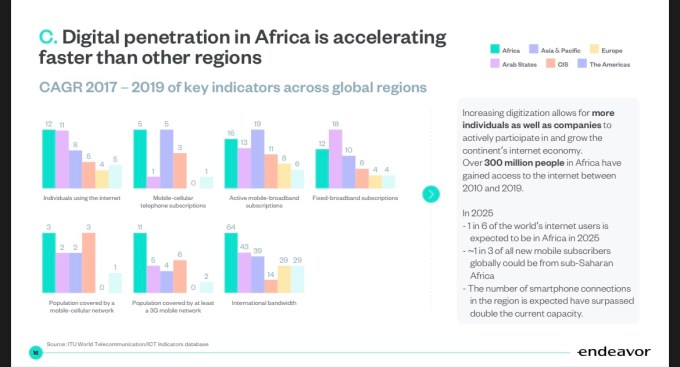
The continent’s $115B digital economy is in its early phases. For instance, 33% of individuals use the internet compared to a global average of 63%. The report also pinpoints other metrics such as fixed- and mobile broadband connections and mobile cellular network coverage.

Much of the growth so far has been concentrated in four key markets: Nigeria, South Africa, Kenya and Egypt. These markets make up 32% of Africa’s population, 51% of the continent’s mobile network connections, 50% of its professional developers and 51% of its GDP.

Africa’s GDP has tripled since 1990; it recorded a 4% CAGR compared to Europe’s and Latin America’s 1.7% from 2010 to 2019. The report also stated that Africa is also recording faster growth in consumer spending than most other regions: 9.4% CAGR from 2018 to 2023 compared to Eastern Europe’s 6.9%, Asia Pacific’s 6.8%, Western Europe’s 4%, North America’s 3.5% and Latin America’s 2.8%. 

“By 2030, Africa is expected to have a total of $2.5 trillion in consumer expenditure from over 1.7 billion consumers,” the report said.

On talent, Endeavor’s report says 2 of the top 5 fastest growing markets for GitHub contributions are in Africa: Nigeria and Egypt. According to the report, African developers created 40% more open-source repositories on the software engineering marketplace in 2019 than in 2018 – recording a higher growth percentage than any other continent globally.

Other statistics include job projections from various channels: 44 million jobs if internet penetration reaches 75%, 3 million jobs from online marketplaces by 2025 and 1.7 million jobs due to Google’s $1 billion investment in the continent. 

The continent’s investment story

The report first highlights the growth of venture capital on the continent over the past six years; within this period, African startups have grown 18x. From 2020 to 2021, it grew 2x faster than global startup funding, it said. 

Endeavor also highlights the widely believed theory that Africa lags other emerging markets such as Latin America and Southeast Asia by five years. According to the firm, the continent’s funding trajectory from 2015 to 2020 is akin to Southeast Asia and Latin America’s 2010 to 2015 periods. “Going forward, Africa’s trajectory looks in line with SEA and faster than Latin America,” it said.


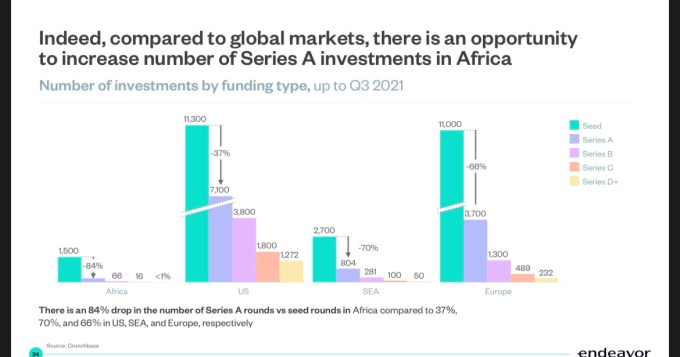
But as more global investors pay attention to Africa’s technology scene and local investors step up their game, what’s becoming evident is a shortage of capital in the early-growth stages, particularly around Series A investments. According to the report, there is an 84% drop in Series A rounds vs seed rounds in Africa. This is compared to 37%, 70%, and 66% in the U.S., Southeast Asia, and Europe. There’s an opportunity here for local funds to invest above seed rounds, for larger Africa-focused firms to double down on Series A and for global funds to go lower than Series B, C and D.

The report also highlights how it’s taking less time for the continent to mint unicorns, the increase in mega rounds, liquidity events and exits (examples exist of local and international acquisitions, traditional IPOs and SPACs).

Sectoral transformation

There are five main sectors in Africa’s startup landscape: financial services, commerce, transport, healthcare and education. Endeavor’s report describes why these sectors are vital to Africa’s growth, the various pain points startups try to address and how they go about it by providing a ‘wedge’ — like an entrance to the market — and building around this wedge to offer more services that address other consumer and business needs. Some examples highlighted in the report include M-Pesa in fintech, Yoco in commerce, Kobo360 in transport, Helium Health in healthcare and uLesson in education.


At the end of the report, Endeavor takes an individualistic perspective and deep dive into Africas largest markets, emphasising what makes each country stand out. It calls Nigeria Africas largest internet economy and South Africa the continent’s most inclusive internet country. It describes Egypt as having one of the most diverse landscapes of digital businesses and lauds Kenyas internet economy for contributing the most to Africa’s GDP.

“The data gathered in this report is clear – Africa is the next digital growth frontier,” said Faniro-Dada. “The combination of our young and digitally savvy population, an emerging technology ecosystem, and the impact of the COVID-19 pandemic on behaviours is set to trigger an inflection point in our digitization journey. We have been excited by the increased levels of funding that our entrepreneurs are attracting, but we want to make it even easier for more investors to bring out their cheque books to catalyze the growth that we believe is pending”.


from eCommerce – TechCrunch https://ift.tt/PGm1Hvq
via IFTTT

TechCrunch+ roundup: 11 PLG tactics, addressing copycat stigma, ‘unicorn glut’ theory

Imagine a world where founders boasted about how much growth they’ve driven, as opposed to their fundraising prowess.

The ability to raise capital is less impressive than finding sustainable ways to build a base of paying customers. The right coaching and a strong network can help many entrepreneurs land a sizable seed round, but that money reflects investor confidence, not market demand.


Full TechCrunch+ articles are only available to members
Use discount code TCPLUSROUNDUP to save 20% off a one- or two-year subscription


In a post for TC+, Curtis Townshend, senior director of growth at OpenView, shares 11 product-led growth tactics that foster “customer acquisition, retention and expansion.”

After surveying 14 public B2B software companies, Townshend says firms that built for discoverability and deployed usage-based pricing had a median growth rate of 141%, compared to 21% for traditional SaaS.

These companies were also much more efficient with regard to the Rule of 40 and retaining revenue. “Across the board, the variance in metrics is stark,” says Townshend.


The TechCrunch+ team is growing!

Tomorrow at 8 a.m. PDT/11 a.m. EDT, we’re hosting a Twitter Space with new contributors who are covering climate, crypto, venture capital and more. To join the chat, follow @techcrunch on Twitter.

Have a great week,

Walter Thompson
Senior Editor, TechCrunch+
@yourprotagonist

Fighting the “copycat” stigma in SaaS: 3 tricks that work

Dalmatian dog startled by white dog wearing hoodie with with spots, pretending to be a Dalmatian

Image Credits: Gandee Vasan (opens in a new window) / Getty Images

Years ago, I found myself at a party with someone who was wearing the same sweater, jeans and shoes, down to the manufacturer. We looked like we’d stepped out of a clothing catalog.

At first, it was funny. And then, as other guests made endless jokes, it became annoying. We spent most of the evening avoiding each other, and I couldn’t wait to leave.

Startups that lack the first-to-market advantage face a similar conundrum, according to Sachin Gupta, CEO and co-founder of HackerEarth, who shares three ways “brands can push back against the stigma of being a copycat platform.”

The “unicorn glut” theory of startup misery

Tech’s rolling green meadows are seeing fewer new unicorns, but the slowing venture market suggests that past mega-deals are making it harder for early-stage startups to raise funds.

“The biggest issue in venture today isn’t interest rates, revenue multiples or any of that,” posted SaaS investor Jason Lemkin on Twitter yesterday.

“We’ve seen that all before … what’s new-ish (at least since 2001) is the massive overhang of growth investments that will take startups years to grow into,” he wrote.

Via The Exchange, Alex Wilhelm agreed with Lemkin’s assessment:

“The unicorn glut is compounding the unicorn traffic jam, and as far as the eyes can see, the great majority of private-market value is frozen.”

Armed with experience, insurtech MGAs are paving the way for insurtech 2.0

3d rendering of Maze, Labyrinth. Footpath, Choices, Problems,Strategy Concept. Staircase.

Image Credits: akinbostanci (opens in a new window) / Getty Images

Innovation has long been a part of insurance: Managing general agents were a result of insurers requiring agents far afield to have a measure of independent underwriting and servicing ability.

Now, new insurtech startups developing MGAs are using the lessons learned by their predecessors to make the industry more sustainable, writes Dave Wechsler, who leads insurtech investing at OMERS Ventures.

“MGAs are correcting course, and the new crop of challengers are going in with new principles based on this knowledge.”

To better manage cybersecurity risk, extend zero-trust principles to third parties

Metallic chain connected by a red knotted rope, representing third party cybersecurity risk

Image Credits: cybrain (opens in a new window) / Getty Images

When it comes to cybersecurity, it’s no longer enough to just have your own house in order — 81 individual third-party incidents led to more than 200 publicly disclosed breaches and thousands of ripple-effect breaches throughout 2021, according to a report by Black Kite.

Companies must also asses the cybersecurity risk of third-party vendors before they sign agreements, writes Saket Modi, the co-founder and CEO of Safe Security.

“Businesses should establish zero-trust principles for all vendors, assess risk across external and internal assets with inside-out assessments and measure cyber risk in real time.”


from eCommerce – TechCrunch https://ift.tt/w7N3nma
via IFTTT

Nfinite bags $100M to give e-commerce 3D flare

When buying online, you don’t get the opportunity to pick up items and look at them, but nfinite is working to change the way products are visualized online so they seem more real.

The company, headquartered in France, has developed a SaaS-based visual e-merchandising platform with tools for creating 3D images for e-commerce. Based on nfinite’s performance in the past year, this is an area ripe for both e-commerce and venture capital investors.

Here’s why: the company grew 10 times in annual recurring revenue in the last year and was adopted by three of the world’s top five global retailers, Alexandre de Vigan, nfinite founder and CEO, told TechCrunch. And, the company announced $100 million in Series B funding Tuesday, which quickly follows a $15 million Series A round announced in February.

The new round was led by Insight Partners and included participation from existing investor US Venture Partners and gives nfinite a total of $130 million in venture-backed funding since the company was founded in 2017.

Back then, de Vigan and his team started the company to provide better online visual experiences for real estate, creating computer-based imagery to sell apartments. A year later, they realized there was a bigger market in e-commerce and shifted focus there to increase traffic and sales. So instead of showcasing an apartment, its imagery was used for pieces of furniture. Over the next couple of years, nfinite scaled its platform through different industries and officially launched the version it is today in 2021.

De Vigan explained that with e-commerce forecasted to grow 50% to reach sales of $7.4 trillion in the next four years, the only touchpoint is product visualization.

“Consumers want more and more, yet e-commerce customers struggle with legacy static photos,” he added. “We set out to build a SaaS e-merchandising platform to create unlimited visuals via a desktop so you can showcase your products. Our mission is for shoppers to have a better understanding of the product and more assurance to shop online.”

He went on to say that a photo is “frozen in time,” it can’t be updated or customized, but through the use of computer-generated imagery, it can be made into 3D so that it can be a living visual that is both customizable and updatable.

For example, you can take a sofa, showcase it in a living room and then change the background for the season or target it toward trends. The impact is better imagery to drive more metrics of the product, meaning more conversion and less rate of return, and saving money for customers. De Vigan estimates, on average, double-digit savings and an improvement in metrics for its e-commerce customers.

In addition, nfinite is also providing visual assets that are compatible with both web2 and Web3 applications so as the future potential of the metaverse is realized, e-commerce customers will already have that capability.

Now that the company has laid the foundation on how to automate 3D imagery on scale, de Vigan intends to deploy the new funding into scaling nfinite’s sales and marketing teams. The company started in Europe with half of its R&D and marketplace in France and now its customer-facing operations are in the U.S. In 2021, the company didn’t have any customers in the U.S. and now the region accounts for 80% of the company’s revenue and 40% of the logos.

The company’s employee base grew to 100 from 40 a year ago, and de Vigan is planning to have 250 employees over the next 12 months. It also is delivering hundreds of thousands of images that will be in the millions in the next few years.

“E-merchandising is the next revolution of e-commerce for us, and therefore, the next phase is to scale within that category in the U.S., Europe and Asia so we become the standard,” he added.

Meanwhile, other companies have also found some venture capital love for their approaches to merchandising. For example, Lucky raised $3 million for its plug-in-play API for Shopify businesses while Singapore-based Trax took in $640 million in Series E funding for its technology to manage store shelves.

As part of the investment, Rebecca Liu-Doyle, managing director at Insight Partners, has now joined the nfinite board.

“nfinite is redefining the e-merchandising space with a platform that enables high quality visual content to be produced at scale—and the largest, most innovative online retailers are already taking note,” she said in a statement. “The company has incredible growth potential and we couldn’t be more excited to partner with Alex and the nfinite team to help them bring it to fruition.”


from eCommerce – TechCrunch https://ift.tt/5fktMQ7
via IFTTT

Etsy is launching a purchase protection program, investing $25M to cover refunds in some cases

Online marketplace Etsy is launching a new Purchase Protection program for buyers and sellers on its platform, the company announced on Monday. Starting August 1st, buyers on Etsy will be eligible to receive a full refund for purchases that don’t match the item description, arrive damaged or don’t arrive at all.

The company says it also plans to invest at least $25 million per year into the the purchase protection program to cover refunds on behalf of sellers for qualifying orders up to $250, at no additional cost to sellers. Etsy notes that the investment will enable sellers to keep their earnings from sales when things happen outside of their control.

“Easy issue resolution is a critical part of the e-commerce shopping experience, and our new Etsy Purchase Protection program aims to help make shopping on Etsy even more worry free,” said Etsy COO Raina Moskowitz in a statement. “This program will help buyers feel more confident when they shop from small businesses on Etsy, while we invest directly in our sellers to provide them an important layer of assurance.”

Etsy says today’s announcement is based on feedback from both buyers and sellers on its platform. The company also says it plans to continue to invest in product and customer service. Etsy previously announced that it expects to invest more than $50 million to enhance customer support. The company plans to grow its support team by more than 20%, improve its live chat support and reduce response times.

The launch of the purchase protection program comes a few months after more than 14,000 Etsy sellers went on strike as the platform increased its transaction fees from 5% to 6.5%. On its website, Etsy says the increased fee supports its plans to make “significant investments in marketing, seller tools, and creating a world-class customer experience.”


from eCommerce – TechCrunch https://ift.tt/t5ziMHb
via IFTTT

Dave Clark, the longtime head of Amazon’s consumer division, departs

Amazon today announced that Dave Clark, CEO of the company’s worldwide consumer division, will step down after 23 years in the position. In a note to leadership, Amazon CEO Andy Jassy said that Clark’s last day in the office will be July 1.

“[W]e still have more work in front of us to get to where we ultimately want to be in our consumer business. To that end, we’re trying to be thoughtful in our plans for Dave’s succession and any changes we make. I expect to be ready with an update for you over the next few weeks,” Jassy wrote in the note, which was shared on the public About Amazon blog this morning. “While change is never easy, I’m optimistic about the plan that the consumer team has built and have confidence that if we stay focused on executing it, we’ll deliver the right experiences for customers and results for the business.”

Clark joined Amazon’s operations pathways program in May 1999 after graduating with an MBA from the University of Tennessee. He played an increasingly large role across the company, starting as an operations manager in Kentucky, growing to a general manger in the Northeast, stepping up to lead worldwide operations, and then eventually leading all of worldwide consumer. Clark was a major proponent of Amazon’s $775 million acquisition of warehouse robot maker Kiva in 2012, and headed teams that designed several generations of fulfillment centers and built out Amazon’s transportation network, among other accomplishments.

It’s unclear why Clark might’ve left so suddenly. In the blog post, Jassy claims that the decision was Clark’s own and that Clark intends to “pursue other opportunities.” Just two years earlier, Clark replaced Jeff Wilke as chief executive of Amazon’s retail business, which encompasses the retail website, Amazon’s physical stores, Amazon Prime, and the growing logistics empire that stocks and deliver items.

“I am a builder at heart — it’s what drive me … As much as I have loved the ride, it is time for me to say goodbye to start a new journey,” Clark said in an internal email that he also published to Twitter. “For some time, I have discussed my intent to transition out of Amazon with my family and other close to me, but I wanted to ensure the teams were setup [sic] for success. I feel confident that time is now.”

Perhaps telegraphing the resignation, Clark and his wife reportedly sold their home in Medina, a Seattle suburb, last fall ahead of a move to Dallas, Texas. Amazon is headquartered in Seattle.

Clark was celebrated within Amazon for dramatically expanding the company’s logistics operations, but his governance of the company’s warehouses became the subject of media — and regulatory — scrutiny. Multiple outlets reported that Clark led Amazon’s push to persuade the U.S. Postal Service to install a controversial temporary mailbox outside Amazon’s warehouse in Bessemer, Alabama, during a union election in 2021. Clark also spearheaded the creation of an internal social media program that would let Amazon employees recognize co-workers’ performance with “shout-outs” but which banned words like “union,””pay raise,” “living wage,” “grievance,” and “diversity.”

Clark has repeatedly sparred with opponents on Twitter, including comedian John Oliver and Senators Bernie Sanders (I-VT).


from eCommerce – TechCrunch https://ift.tt/xW1kI8g
via IFTTT

The delivery market is coming down from its pandemic highs

During the pandemic, delivery startups — whether focused on groceries, essentials, or takeout — became the darling children of venture capital firms. Early on, mandates and closures put up barriers to physical shopping, but as time went on, customers became more used to the idea of shopping for everything from toilet paper to rotisserie chicken online. In a 2021 survey from Coresight Research, nearly two-thirds of U.S. consumers — 60% — said that they were buying groceries online, up from 36.8% in 2019.

Delivery companies old and new reaped the benefits of the changed landscape. In 2020, a 500% increase in order volume drove Instacart’s revenue to $1.5 billion — attracting $1 billion in capital at a $39 billion valuation in 2021. On-demand grocery delivery startup Groillas nabbed $290 million at a $1 billion valuation that same year. Within the span of a few months, Berlin-based instant grocery startup Flink secured $750 billion at a $2.85 billion post-money valuation, while Gopuff, a U.S.-based rival, raised $1 billion on a $15 billion valuation.

According a report from AgFunder, total venture investment for “e-grocery” companies reached $18.5 billion in 2021. Between 2020 and 2022, investors poured more than $5.5 billion into New York City-based instant delivery companies alone, a separate analysis found.

The boom continued into early 2022, with startups like Getir, Zapp, and Zepto raising mammoth rounds. But there’s signs of a correction. Instacart, citing “market turbulence,” last month slashed its valuation by 40% and slowed hiring. Publicly traded DoorDash and Deliveroo have seen their stock prices fluctuate wildly over the past year. (DoorDash executed a $400 million stock buyback program in May.) Gorillas, Getir, Zapp, and Gopuff are among other delivery startups that have let go staff in recent months, despite fundraising. Some have been forced to shut down entirely, like Fridge No More, 1520, and Buyk.

The delivery sector can’t be painted with a broad brush, necessarily. But — taken together — the developments suggest that the pandemic period of rapid growth is coming to an end.

“Some [delivery startups] are most certainly safe — especially the ones with positive unit economics,” Matt Birnbaum, the former head of talent acquisition at Instacart and now a talent partner at Pear VC, told TechCrunch via email. “The good delivery companies can slow their spend in growth areas like hiring and marketing and become profitable almost immediately. The companies that are in the most danger are the ones who don’t have a clear path to profitability in the short or medium term. As access to capital has become more constrained, so has the appetite for growth at all costs.”

Craft Ventures partner and co-founder Jeff Fluhr, the ex-CEO of StubHub, didn’t mince words about the delivery market’s woes. (Craft Ventures has invested in several delivery startups, including Shef, which enables home cooks to sell their food for delivery.) He blamed “ultra-fast delivery” marketplaces — i.e., those promising food, drinks, and household items delivered in roughly 30 minutes or less — for dragging the overall segment down with low or negative gross margins, owing to the “very high” human labor expenses relative to the margin from product and transaction fees.

“The fast delivery space is the epitome of exuberance of 2021: investors were pouring money into cash guzzling companies with flimsy business models,” he told TechCrunch in an email interview. “Fast delivery companies are capital-intensive. They require local infrastructure, local people, and local operations which are expensive to build out. As a result, all of these companies have been incinerating boatloads of cash over the past 12 to 24 months as they’ve expanded to new geographic markets. Of course consumers like the instant gratification of a pint of ice cream in 15 minutes, so revenues grew quickly, driven by a great consumer experience and word-of-mouth virality. Investors followed the growth paying no attention to the potential for profitability. But the notion that a startup can deliver on that promise profitably is a pipe dream.”

To Fluhr’s point, even for firms that buy goods at wholesale prices and sell them at a markup (unlike, for example, Instacart and GrubHub, which act as an intermediary between storefronts and end-customers), ultra-fast delivery has sky-high operating costs. Jokr, a New York-based grocery deliver venture, was reportedly losing $13.6 million on just $1.7 million worth of sales in 2021. Delivery vehicles as well as contract labor, including drivers and those responsible for packing or picking orders, are an outsize line item — poor pay and benefits or no. So are the leased storefronts, warehouses, and fulfillment centers, called “dark stores,” that companies like Gorillas operate to meet their delivery pledges, which contribute to waste such as unsold perishables.

Buyt claimed to have roughly 800 dark stores in 25 cities at its peak. Getir has roughly 1,1000.

Rafael Ilishayev, Gopuff’s co-CEO and cofounder, told CNBC in May that the company’s business model is predicated on in-app advertising for brands and “making margins on products.” But promotions and marketing are eating away at these margins. According to The Wall Street Journal, Fridge No More spent $70 on advertising to win the average customer, an investment that resulted in a $78 loss for every customer that stayed from December 2020 through September 2021.

Birnbaum pegs the blame, too, on “reckless” hiring. During the pandemic, high-growth delivery companies adopted a “gotta-catch-’em-all” approach to hiring, he said, making headcount decisions with the goal of accumulating as many “assets” as possible. Instacart added hundreds of thousands of gig workers to meet the surging demand early in the pandemic — demand which has since dropped off.

“As companies look at their balance sheets, they’re focusing their bets and no longer need to hire at the same pace they’ve been hiring over the last few years; hence hiring freezes,” he said. “Companies that fail to adjust or don’t have adequate runway to support their current headcount are going to be in an entirely different situation.”

TechCrunch contacted a sampling of delivery companies to inquire about hiring status, including DoorDash, Delivery.com, GrubHub, Grab, Deliveroo, Just Eat Takeaway, and Delivery Hero. Several declined to comment or didn’t respond, but respective spokespeople for DoorDash and GrubHub said that the companies haven’t made any adjustments to their hiring plans.

“I think that, in general, it comes down to the model and whether it works or not full stop,” Rob Kniaz, a partner at Hoxton Ventures, told TechCrunch via email. Hoxton was an early investor in Deliveroo and recently led a funding round in Bother, a next-day delivery startup based in the U.K. “DoorDash seems to work by whacking on fees to all parties to cover the operation costs. The ‘quick commerce’ companies [like Gopuff] were competing on price and speed and have lower basket sizes to boot, so it’s much harder for them to reach a breakeven point. I think the model works where you can get away with very high margins and/or delivery fees, but this will never be an everyday, low-price model. It’s a luxury business in my opinion.”

A few surveys support the notion that delivery customers are a fickle bunch. One of the most pessimistic, out of Rensselaer Polytechnic Institute, suggests that over 90% of people who used online delivery services during the pandemic would likely revert back to their original way of shopping.

“When general market sentiment turned in the past few months, investors started scrutinizing profitability and cash flow. Investors who were once funding this segment are now rejecting it, full stop,” Fluhr said. “As these companies faced the reality in the past few months that there would be no more free money, they realized they needed to cut burn, extend their runway, and have the benefit of more time to figure out a business model with better unit economics. That’s why we’re seeing so many layoffs in the fast delivery space in particular … The layoffs and hiring freezes have really only just begun and will likely get worse before they get better.”

Pundits say it’s history repeating itself. In the ’90s, California-based Webvan, one of the first rapid grocery delivery startups, was briefly valued at $7.9 billion before going bust. Rivals Kozmo and Urbanfetch went out of business after losses mounted.

But compounding the challenges delivery startups today face is the wider economic downturn. Inflation continues unabated, driving up food, rent, and transportation costs. Supply chain disruptions threaten to delay the shipment of goods such as baby formula. And investors are increasingly wary of capital-intensive bets, preferring instead to put money toward segments like business software.

“If each delivery has negative unit economics, the only savior will be massive scale, which will drive down costs,” Phil Haslett, the co-founder and chief strategy officer at EquityZen, told TechCrunch via email. “Getting to massive scale requires massive amounts of capital. In the current market environment, that’s a tough sell to venture capital and growth equity investors.”

Consolidation is on the horizon — and indeed, has already begun. Just Eat Takeaway paid $7.3 billion for GrubHub. DoorDash bought rival food delivery app Caviar from Square and recently snapped up Wolt in an all-stock deal. In 2020, ahead of its purchases of grocery delivery startups Cornershop and Drizly, Uber finalized its acquisition of Postmates. And last year, Gopuff — which has a partnership with Uber — acquired Fancy and Dija.

Expect business models to change, too. Jokr and Buyk are introducing longer delivery times in order to fulfill more orders per drive. Before it went out of business, Fridge No More was looking to obtain a liquor license and invest in more private-label products for delivery customers. FastAF, a relative newcomer in the delivery space, specializes in high-priced and luxury items.

“The shifting of the goal posts will introduce discipline into this space,” Fluhr said. “Companies will need to figure out a model that works or else die. Most will die, but perhaps a few will land on a new model that balances the value prop for the consumer with a model that can actually generate a profit.”

Delivery companies could trim losses by increasing prices, selling their own brands, and driving up order sizes with pricier items like alcohol, investors say. Or they could invest in technology like robotics fulfillment, enabling couriers to carry more orders per trip.

“I think these models are reflective of the market in the sense businesses with tight or negative margins will be the first to take on water,” Kniaz said. “That said, I think there are other interesting models of distribution that are just taking off that have lower variable costs compared to guys on a scooter delivering a banana for £1. We’ve done a few things like PillSorted and Bother that actually make sense in a down market where value is a factor as well as convenience.”

Jon Carmel, a managing partner at MVP, an investor in DoorDash and Postmates, added: “When it comes to startup investing, we aren’t evaluating our investments by vertical alone. We can expect to see some consolidation in this space and some startups are going to fare better than others. But in the long term, the pandemic served to change consumer habits. People got used to ordering groceries during lockdown and now they recognize the importance of and financial value of the time they save by not going shopping. As far as differentiating delivery startups, we’re keeping an eye on delivery startups with strong e-commerce and advertising plays and startups whose base structure doesn’t rely on realestate plays, like renting out local warehouse space.”



from eCommerce – TechCrunch https://ift.tt/XowU5bL
via IFTTT
Athleisure icon Ty Haney raises $9.8M in fresh funding for her blockchain rewards startup

Outdoor Voices founder Ty Haney made a name for herself by making sportswear the hottest trend among non-athletes. Now, the 33-year-old entrepreneur is betting she can bring together another underrated duo — consumer brands and crypto.

Haney joined TechCrunch’s Chain Reaction podcast this week to talk about her latest venture, Try Your Best (TYB). The startup uses blockchain technology to help brands build customer loyalty without having to rely on buying up pricey ads on third-party social media platforms, Haney explained.

Brands use TYB, which is built on the Avalanche blockchain, to build their own on-chain communities of loyal customers, Haney said. Through TYB, these brands can reward their customers for participation in the community with virtual coins, similar to loyalty points, that they can redeem in exchange for physical products.

“We’re allowing brands to create an owned community channel, where they’re bringing in whatever amount of people from their existing audience into this channel,” Haney said. In contrast, when brands use platforms like Instagram to build communities, they don’t own the relationships with their customers and can be acutely affected by platform-wide changes to ad pricing and user interface.

On the Chain Reaction podcast, Haney announced for the first time that her new company was about to close its second institutional funding round. Since we recorded the episode, TYB has closed on the $9.8 million round with new investors Unusual Ventures and Sogal Ventures leading the funding alongside existing investor Castle Island, a spokesperson for the company told us.

Haney, who left Outdoor Voices in 2020 amid mounting losses and internal disagreements with the then-chairman of the company’s board, first launched TYB in pilot mode this past spring. TYB came out of the gates with $2 million in funding from blockchain-focused Castle Island, a relatively modest sum compared to the $60 million-plus in venture capital dollars Outdoor Voices raised since its inception in 2014. Haney has since commented on some of the lessons she learned from running Outdoor Voices in the past, saying that the company grew too fast and fundraised too quickly.

With TYB, Haney hopes to apply some of those lessons in building a new company that leverages her experience building strong relationships with customers. The platform has already debuted with a sold-out NFT drop for one of its partners, Joggy, a wellness brand launched by Haney herself that sells CBD-based wellness products. Each Joggy collectible sold for $250 to 500 founding customers total, Haney said. These 500 customers will have access to 5% of Joggy’s revenue as it continues to grow, and will eventually receive a free product and friends and family discounts, Haney said.

Haney designed these perks with a key takeaway in mind that she said she gleaned from her time running Outdoor Voices. “From a brand-building perspective, community really works,” Haney explained, but she added that most consumer companies don’t have the right toolkit to make the most of their community. At Outdoor Voices, managing thousands of customer relationships across a fragmented set of channels, including Slack, SurveyMonkey, and Google Docs, made the strength of the community difficult to measure and made customer feedback challenging to collect, she said.

The second big insight she’s bringing to her new startup is that traditional customer acquisition channels for consumer brands are too expensive and ultimately “not netting valuable customers.” Outdoor Voices recognized four times as much value from customers it brought in through high-touch, experiential strategies such as local events compared to online advertising, Haney added.

“[At Outdoor Voices], would spend 30 to 40% of our dollars raised directly to the big [social media] platforms. I think it makes much more sense to take, let’s say, 5% of that and distribute that directly to the people who are going to continue spending dollars at your brand,” Haney said. She learned that bringing customers into the product development process and letting them choose colorways and prints for the brand’s new designs often led to high-converting collection drops and resulted in the stickiness of its most popular styles, including the iconic Exercise Dress.

The community channels for each brand TYB works with will be exclusively available to customers who hold those brands’ NFT collectibles, Haney explained. Once customers are part of the community, they can earn loyalty points that work differently based on each brand’s preferences, such as Joggy’s revenue-based rewards program. TYB has also created a play-to-earn mechanism called a “rep card” wherein a brand can set a specific mission or goal for its customers to increase engagement and can reward them based on their progress towards that goal — for example, an athleticwear brand working with TYB could reward its customers for exercising seven days in a row, she said.

For now, Haney said TYB’s main focus is providing experiential features to its NFT collectible holders rather than expecting the assets to accrue value based on brand recognition alone.

“We are not optimizing for the flip or the secondary market of a collectible. We are really focusing on brands introducing collectibles that have utility. And so I intentionally use the word collectible, because I do know that NFTs kind of have baggage, and we do have to reintroduce what this technology can do that that people will be more willing to adopt,” Haney said.

TYB is working with 30+ brands in its pilot program, Haney said, including Hill House Home, creator of the viral “nap dress,” and jewelry company Vada. She added that the company has around 300 potential customers in its pipeline, which isn’t limited to just companies with a DTC model.

“There certainly are companies that already have a very enthusiastic, engaged fan base, and we’re starting there,” Haney said, noting that she wants the first few launches to achieve demonstrable success.

Unsurprisingly, Haney has her sights set on more ambitious long-term goals for TYB.

“I’m very passionate about bringing this younger, in particular, younger female audience into the web3 space because of the potential for real financial upside,” Haney said. “And for me, there’s no better way to do that than by the brands that they love.”

Chain Reaction podcast episodes come out every Thursday at 12:00 p.m. PDT. Subscribe to us on AppleSpotify or your alternative podcast platform of choice to keep up with us every week.


from eCommerce – TechCrunch https://ift.tt/dBeZklm
via IFTTT

How to improve retention, growth marketing’s golden metric

Imagine being able to acquire users for just a few cents. Sounds like a dream come true to any growth marketer, doesn’t it? Now, imagine the same scenario with the worst retention rate possible, and it quickly sounds like a nightmare.

Whether you’re a construction company, software startup, or Fortune 500 company, retention is a key metric across customers, employees and partners.

Growth marketing isn’t the silver bullet to solving retention, but there are definitely some tactics that can be implemented to help improve it.

Let’s dive in.

Growth and product

Within a company the growth and product teams should fit like a glove. While at Postmates, I saw first-hand how a well-oiled machine could work together to tackle customer conversion and retention. We used to hold weekly meetings between teams to address conversion rate trends and customer stickiness between growth media.

I believe the three key foci for growth and product should be:

  • Enhancing measurement capabilities
  • Channel-specific landing pages and/or flows
  • Testing new products and initiatives

A consistent issue and theme that I’ve seen cause countless headaches across startups is the lack of measurement capability. Measuring conversion volume accurately is paramount for all companies. Otherwise, efforts become inefficient.

It would also be naive to think that measurement is a set-it-and-forget type of task. Measurement should be approached as a constant work-in-progress, as channels and the privacy landscape are constantly evolving.

It’s imperative to constantly analyze the sources driving growth at a detailed and bottom-of-funnel level.

Working in step with the product team on specific growth campaigns will help you personalize initiatives, measure them accurately, and increases the chances of success. Imagine having a specific funnel for visitors who are net-new versus re-targeted. Or, how about having different landing pages just for influencers? These are just some of the examples of the tests that the growth and product teams should be performing.

Whenever a new product, feature or promotion is launched by the product team, the growth team should be the first ones to get their hands on it. All campaigns from the lifecycle and the paid acquisition teams will be the first touchpoint for customers, so ensuring there’s understanding between these two teams is crucial.

If the growth and product teams work in lockstep and prioritize the key foci mentioned above, you’ll see huge leaps in retention.

Channel effectiveness

When I was working on fleet (or driver) acquisition at Postmates, we went from budgeting using simple methodology to measuring channel effectiveness on an LTV and retention basis. How long did our drivers stay on the platform, if they were acquired from Google as opposed to Facebook?


from eCommerce – TechCrunch https://ift.tt/Plzv4wW
via IFTTT

Amazon is launching an invite-based ordering option, starting with the PS5 and Xbox Series X

Amazon is launching a new invite-based ordering experience for high-demand, low-supply products. The company told TechCrunch that the purpose of the new option is to help prevent inventory shortages and price gouging caused by robot traffic for high-demand items with limited quantities. Amazon says its goal is to ensure that genuine customers are able to purchase these sorts of products. The new program is launching in the United States, starting with PlayStation 5 and Xbox Series X game consoles sold and fulfilled by Amazon.

“We work hard every day to provide customers with low prices, vast selection, and fast delivery,” said Llew Mason, the vice president of consumer engagement at Amazon, in a statement to TechCrunch. “This includes developing a shopping experience where customers can purchase the items they’re interested in without having to worry about bad actors buying and reselling them at a much higher price.”

The new ordering option will allow customers to request an invitation to buy high-demand items from the product detail page, at no additional cost. Any customer with an Amazon account can request an invitation to purchase the item, which means that you don’t need a Prime account to send in a request.

An image provided by Amazon shows that items that are part of the program will have a notice indicating that they’re “available by invitation.” The product page will also note that it’s a “high-demand item with limited quantities” and that Amazon “won’t be able to grant all requests.”

In order to ensure that genuine customers receive invitations to purchase, Amazon will remove bot-like submissions and send invitations to remaining customers. The company will verify genuine customers by looking at a number of factors, including the account’s prior purchase history and when the account was created. If the customer’s invitation to purchase is granted, they will receive an email with instructions on how to purchase the item.

The email will detail how long you have to complete the purchase. It will also include a link to the item so you can place the order. Once you’re taken to the product page, you can add the item to your cart or select “Buy now.” The product page will also show you how many hours and minutes you have before your invitation expires. Amazon will grant more invitations to purchase as it receives more units of that item in stock.

Amazon says that although bad actors make up a small percentage of activity on its marketplace, it’s committed to preventing them from negatively impacting the shopping experience for users. The new ordering experience should give Amazon customers a better chance at getting their hands on high-demand products with limited quantities because it aims to eliminate bad actors who buy products and then resell them at higher prices, which has been happening with gaming consoles over the past years.

The new ordering option is available starting today for the PlayStation 5 in the United States, and will be available for the Xbox Series X in the next few days. Amazon plans to expand the program to other countries and products in the future.


from eCommerce – TechCrunch https://ift.tt/2eoHZhN
via IFTTT

New Government – Labour Small Business Agenda

We’ve are all waking up to a new Government today, with the Labour party about to take control of the country and what should be top of your...