Showing posts with label Blog – Unbxd. Show all posts

Unbxd launches a multilingual search for eCommerce enterprises!

Alex (French): Bonjour

Fredrik (German): Guten Tag

Spata (Spanish): Buen Dia

Patricia (Italian): Buona Giornata

Mareek (Bahasa): Selamat Siang

And there would be an endless confusion and chaos if the conversation goes on like this forever. It would simply mean no conclusion and end-result despite the fact – all of the above mean the same “Good Day!”

Well, there are two sides to this game. The game of Communication! One is speaking which is the easier bit to do. You and I can choose to speak in our own language (which we are most well versed with). The other side of the game is – listening. But listening is of no use if we are not able to comprehend and understand what the other person means by what he or she is saying. This communication becomes complex and tedious to manage when it comes to eCommerce enterprises and search on their platforms.

Why?

Because shoppers will continue to speak (read search) in their own native language. A matter of habit and instinct. But not all the eCommerce enterprises are custom-built to understand the searches being made in their native language. This means lost business opportunity. In today’s competitive world, no eCommerce can afford to not have a multilingual capability. Still so, only a handful of eCommerce enterprises are able to offer mature and fully functional multilingual search capabilities.

We at Unbxd have been powering 200bn interactions with over 100bn searches for all eCommerce enterprises (across verticals and geographies – 40+ countries) put together. Many of them have multiple sites built specifically to cater to the demands of the indigenous shoppers in that particular geography.

When we talked to them about the search, navigation and relevance solution for these sites (other than English), we realized there was a huge business potential these eCommerce enterprises were losing to unavailability of a search engine that could listen, understand and interpret the search queries in the native language. This gap can be attributed to multiple factors:

  1. Unavailability of a fully functional multi-lingual site-search
  2. Resistance to having multiple site-search solutions for multiple sites
  3. Lack of a cost-effective or Value-for-money search solution
  4. Missing multilingual capabilities in primitive technologies such as ElasticSearch/SOLR

We started engaging with our eCommerce customers to understand their business needs and what they were looking for when they wanted to deploy a multilingual site-search solution. And today we can only be happy while delivering to their business needs and announcing the launch of our multilingual Site-Search solution.

Our multilingual Site-Search solution can understand the search queries made by your end-shoppers in 10 different languages viz: French, Spanish, German, Italian, Portuguese, Swedish, Dutch, Polish, Danish, Bahasa (adding the capability for Arabic and Russian soon).

This would mean any eCommerce store having its business across any part of the world where the above languages are primary languages can go live with Unbxd Site-Search without having to worry for a native search solution.

In terms of how does this work – an eCommerce will only have to provide the catalog in the native language and Unbxd will ensure that:

  1. The Search platform understands the catalog in the native language
  2. The Search platform is fully capable of understanding the search queries in the native language

Once the catalog is uploaded and the feed is indexed, your customers can come, search and browse for the products they want to buy in their native language. eCommerce will not have to worry about the loss of information that would have otherwise happened while using a translator to fix the problem.

What would this mean for eCommerce enterprises?
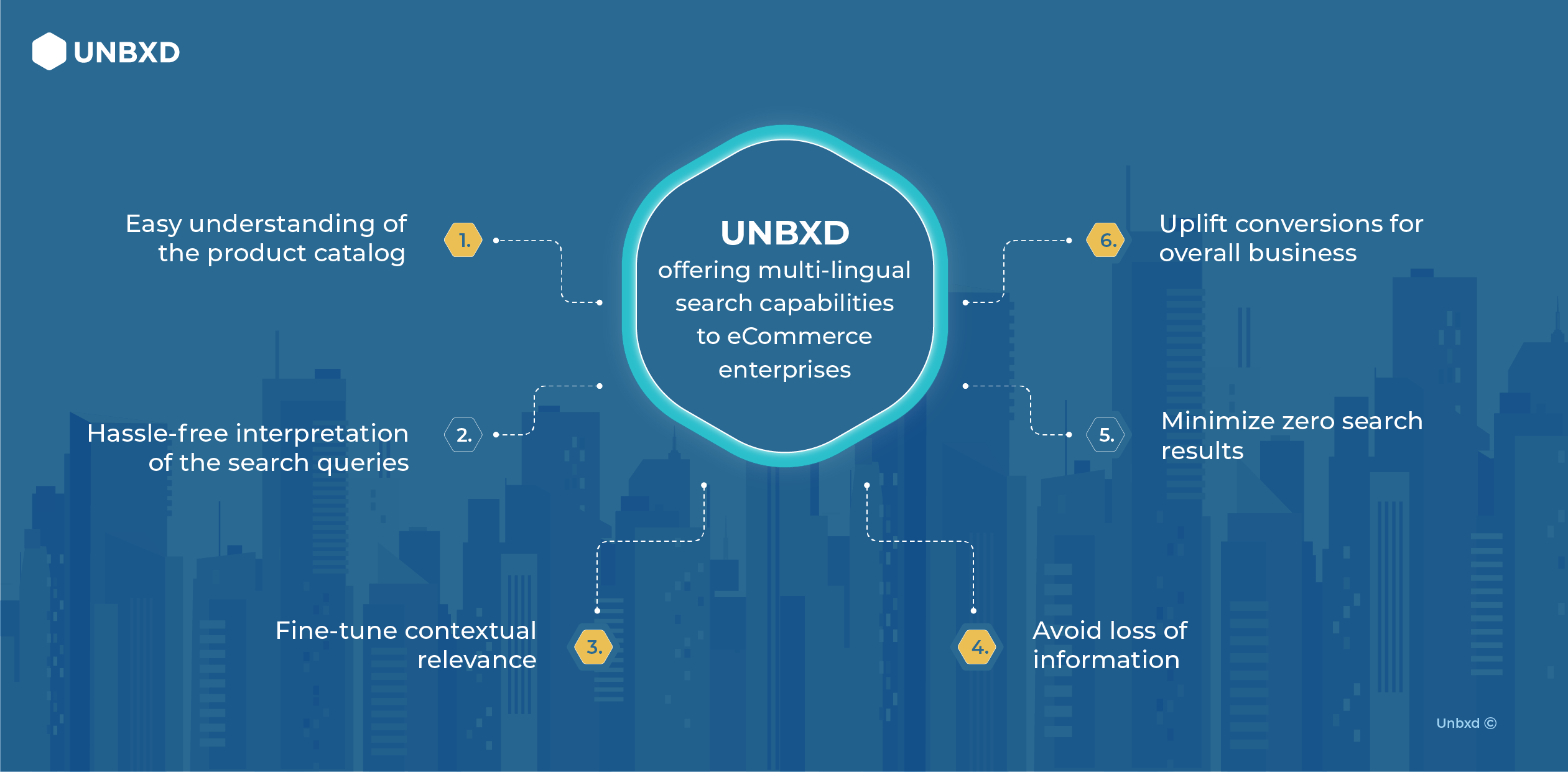
Business Benefits of a Multilingual Site-Search solution

Unbxd offering multilingual search capabilities to eCommerce enterprises would mean:

  1. Easy understanding of the product catalog in the native language
  2. Hassle-free interpretation of the search queries in the native language
  3. Fine-tune contextual relevance and showcasing products that shoppers are most likely to buy
  4. Avoid loss of information in translation because of in-built stemming and tokenization techniques
  5. Minimize zero search results due to poor understanding of the search query
  6. Uplift conversions for overall business (because of a better understanding of shoppers’ intent and ability to show products with a higher likelihood of purchase)

Overall, with efficient multilingual capabilities on the online store, eCommerce enterprises are more likely to enhance the on-site shopping experience for their shoppers across the globe. This would mean more shoppers, higher conversion rates, high customer satisfaction, and stickiness and thus increased customer lifetime value.

We have built this capability keeping in mind the global retailers who would want to go global with their products and offerings. And also considering boutique businesses who are selling indigenous stuff under single brand name in respective geographies. From small to big enterprises that plan to offer its products and services across multiple geographies should find this multilingual Site-Search truly useful and beneficial for their business.

In case you are an existing customer of Unbxd reading the blog here, please drop a mail to your customer success manager right away to go live! If you are new here looking to find the right search solution that can cater to your global business demands, feel free to write to us at sales@unbxd.com and we would be happy to walk you through the entire process of going live with Site-Search that is multilingual and can udnderstand the search queries in the native language!

The post Unbxd launches a multilingual search for eCommerce enterprises! appeared first on Unbxd.



from Blog – Unbxd https://ift.tt/2JOq4va
via IFTTT

The State of ecommerce during COVID-19

Social Distancing. Lockdown. Work From Home. Non-Essential Businesses Shut. No public gathering – the world went under a complete halt, almost, as soon as the COVID-19 took over the world in its grip. Let’s admit, we didn’t see that coming!

Over the last couple of weeks, the COVID-19 has forced many retailers and brick and mortar stores to shut and go non-operational. More and more cities (and today as you read this piece), almost the entire world is encouraging citizens to stay indoors. This has spurred a drastic shift in the ways you and I are buying stuff. It has not only changed how we are buying but also what and when we are buying. The virus got all of us to reassess our priorities and buying trends.

We started seeing the spike in the overall eCommerce activity starting 1st Week of March. Not did we know then that what was a regional emergency in China would take the form of a global pandemic and worldwide shutdown. This caused a surge in online shopping and bulk-buying across the globe.

Unbxd powers eCommerce Search and product discovery across verticals for more than 1300 eCommerce sites in 40+ countries across the world. And over the couple of last few weeks, we closely monitored how eCommerce started to react to this world-wide pandemic and how it is going to shape itself in the times to come.

The data and insights below might as well prove useful to you in re-assessing your business priorities and be prepared for the future.

Overall eCommerce

We compared the data from the same time in the previous year 2019 to March 2020 and as well for week-on-week eCommerce activity. The charts below illustrate how the following metrics saw an increase:

  1. Site Traffic
  2. Search Traffic
  3. Transactions
  4. Conversion
Overall eCommerce (Week-on-Week)

We can clearly see, consumers across the globe resorted to online search and buying to address their needs. Search traffic went up by 3% approximately and transactions went up by 3.3% starting 2nd week of March in comparison to 2nd week of February. Such fast was the reaction of the end-consumers to their shopping needs.

Overall eCommerce (Y-o-Y)

If you have a look at the Y-o-Y data, it is startling to see that for a 6.4 % increase in search sessions, transactions went up by 11.7%. Clearly, the on-site traffic and searches are being made with higher intent and likelihood of purchase.

eCommerce by Geography

We furthered our analysis splitting the eCommerce activity for geography.

eCommerce by Geography

Clearly, the APAC and ANZ regions saw a huge spike in the number of transactions being done online due to being affected by COVID-19 first. This also reflects end-consumers pre-empting the lockdown and shutdown and resorting to stocking up stuff and essentials at their homes. 

ANZ observed 13.88% uptick in online traffic and 26.42% surge in search sessions and 51.08% increase in the online transaction for the corresponding searches made. Similar trends imply that likelihood of a purchase per search session is extremely high during such times of pandemic and crisis. 

With 4.14% surge in search traffic and 38.66% spike in transactions, we observed similar trends in APAC as in ANZ. However, on the contrary, we saw a dip in the overall online traffic for APAC.

US eCommerce traffic on the contrary didn’t see similar levels of spike in either of the parameters. Site traffic went up by 3.06% , search traffic by 0.57% and online transactions went up by 1.61%. Read for more eCommerce trends in US.

eCommerce by Verticals

eCommerce by Verticals

Fashion and Apparel has taken a big hit with overall site traffic seeing a dip of 8.25%, search traffic being down by 7.7% and online transactions being down by 11.04%. However, this also might as well indicate that when things are back to normal, end-consumers are going to binge-shop on these sites as a part of Retail-therapy to overcome what the world has witnessed.

As expected, Food and Grocery (under essential services) saw an increase of 55.19% in the site traffic, a whopping 188.7% increase in the search traffic and 304.94% increase in online transactions for the corresponding searches. This is a direct reflection of how end-consumers resorted to online stocking of the food and other essentials as soon as the lockdowns and shutdowns were announced. 

B2B surprisingly saw an increase across parameters – in the Site traffic by 41.25%, search traffic by 38.51% and transactions by 38.68%. This behavior can be a result of the future shock proofing to maintain the stock supply in case of snipping of the supply chain across the globe in times to come. 

Lastly, we saw a very similar pattern in the Mass Merchants (as that of B2B) attributed to the same reasons – the fear of not maintaining enough stock when the markets open and return to normal. It saw 14.91% surge in site traffic, 4.87% increase in search traffic and an uptick of 13.79% in online transactions Y-o-Y.

Conclusion

Clearly the first reaction of the end-consumers during the times of COVID-19 (or for that matter any crisis time like these in future, God forbid) is to leverage the online channels for buying and stocking up stuff. The essentials and consumables will be the first ones to start observing this change of online shopping behavior. Sectors which are heavily dependent on the supply chain and dependency on the other geographies might as well see a surge in their online business pertaining to future shock-proofing. Luxury, Fashion, Apparel and other non-essential would take a back seat for the times of the crises. However, this leaves this sector with a scope to prepare for the times when things get back to normal.

During these times of crises, most of the world resorts to online channels for surfing, buying and making decisions; with the higher intent or likelihood of purchase. We could infer that from high transactions per search being made. Under such circumstances and to future proof your business, it will be essential that businesses and enterprises are prepared to provide a seamless on-site shopping experience to the end-consumers and shoppers.

Wishing for the world to heal and a speedy recovery from the world epidemic!

The post The State of ecommerce during COVID-19 appeared first on Unbxd.


from Blog – Unbxd https://ift.tt/3dSspTZ
via IFTTT

Delivering personalized shopping experience for your shoppers

With million online websites selling tonnes of products, why do you think they will be attracted to try yours?

Better UI?

Better product display?

A plethora of different products?

An amazing product follow-up?

Good return policies?

But is that enough?

People even buy from sites where one or many of these attributes are missing. Then what keeps them buying from that eCommerce store??

The reason is showcasing the right products at the right time as per the shopping affinities of the shoppers, c,  which we call Personalization in eCommerce.

As the term in itself talks much, personalization is almost like the Gettysburg Address. It should be for the people, by the people, and of the people. People = Shoppers, in this case. Shoppers in all ways have developed an affinity to the sites that recommend products based on their behavior. We all know the AI works wonders behind the screen but for a shopper who doesn’t care much about the backend is always amazed by ‘How does the site even know what I want’.

To make sure you amaze your customers every single time they log in to your site and make them keep coming back, LISTEN TO THEM.

How is AI beneficial in personalization?

Now, it wouldn’t happen in the old traditional ways to know your million customers by either talking to them one on one or texting them to know them better. So, it is necessary to let the technology do the talking.

With every industry, since AI has taken over almost everything, it is time to know your shoppers an inch more by reading their scattered data.

The data availability is extreme. The end consumers who shop online are numerous in numbers, their shopping affinities and behaviors are being studied, and a large pool of data points are obtained post-analysis. Now, if you assume for once with such an immense market presence by the customers it is hard to segregate their accounts and activities, then that is true.

Enters Machine Learning!

Machine Learning Techniques are here to make a difference in ways where the customer is the hero and users form the biggest human pyramid. Let’s see what you need to do to engage customers!

Their online footprints need a lot of hand-garnering and nit-picking to deliver exactly what they want. This evolution has promised a lot of ‘to the point’ results and tired of endless scrolling that is exactly what companies should do.

Advanced ML techniques adapt a regressive approach to creating a platform where it is all about experience and engagement. In such a case, ML excels at pattern recognition and AI concentrates more on creating recommendation engines.

We surely do this for our eCommerce friends with such regression techniques by applying the Hybrid recommendation system.

What is Hybrid Recommendation System

With a Hybrid recommendation system, you can generate and provide suggestions by combining two or more recommendation strategies.

After applying such techniques all you need is more consistency to maintain those data fragments and form actual data points. Problems like cold-start and data sparsity still exist which are solvable by providing optimized automated solutions. With Machine Learning As A Solution (MLaaS), the market is soon going to make almost $7.6 Billion by the year 2023.

But how do you truly personalize the experience for your shoppers?

Personalization Tips

Tip 1: Personalize your Email Marketing Strategy

Imagine, when you walk out of an online store after looking at the products and instantly you receive a mail with specially tailored discounts for you around those products.  It is nothing like the traditional mail marketing where organizations use the same email marketing templates to reuse and reuse until we exhaust the same pattern and gain no insights out of it. 

But, what if those same mailers were in fact catered to each and every customer as if they were talking to you? 

Tip 2: Provide user-specific Product Recommendations

No one would want to waste their time juggling through a million products when all they want is a blacktop that they had already searched the last time.

Based on the data study, if you feel the shopper has already searched for ‘Black Nike Shoes’, then when they open the site window, recommend them Nike products or black products. Because both attributes specify their affinity to color: black and brand: Nike. This not only hooks the shopper interest but also shortens the path-to-purchase

Tip 3: Personalized Homepages

Well, the maximum traction that you can avail from the shoppers is when you provide their last searched products, suggested products from their past search history, or recommended products based on both their behavior and the site behavior, on the HOMEPAGE: the first thing they see when they land on your site.

Many of our customers have tried and tested this with the Unbxd Personalized Recommendations engine seeing a whopping 20% increase in conversions on the landing page. If you would be interested in testing the same for your eCommerce store, please write to sales@unbxd.com

Tip 4: Divide the traffic

No! We are not talking about the diversion of traffic but the segregation of customers based on their shopping intensity and behavior. Segregate them if they are existing customers or the non-returning ones.

Technically, in ideal situations, you should focus 60% on the ones that keep returning by offering them special coupons for being a loyal customer or provide them other loyalty points to create a trust base.

Focus the other 40% on the ones that may or may not return. Send them personalized emails where you talk to them about their leftover products in the cart or their search history so that they believe that you do care about them. In either way, it is a win-win!

Tip 5: Track the Geolocation

A person in the US wouldn’t want to know the prices of ‘Nike Slippers’ selling in the UK . They would care more about the products that are specific to their region. Tracking the right location and targeting them with specific marketing campaigns and pricing should be a no-brainer.

With these 5 tips, you are going to level up the market for sure in your favor. Shaping the right personalization strategy, importing the right product recommendations, and integrating all the methods in place, you are making it easier for you and your shoppers to make the right choice.

Unbxd deals with providing such amazing personalization experiences by integrating to your eCommerce site and letting your shoppers take a recliner seat while they buy their choicest products from your eCommerce store! To know more, contact us: support@unbxd.com.

The post Delivering personalized shopping experience for your shoppers appeared first on Unbxd.


from Blog – Unbxd https://ift.tt/2wT5Z45
via IFTTT

Automating manual daily workflows with Unbxd PIM

In a world where everything is moving online, moving online itself has got its own challenges and more so for eCommerce enterprises, where the workflows to take products live to the site and in front of shoppers is not only a lengthy manual process but a tedious and a complex exercise.

The eCommerce has to ensure that the product catalog is in the format of the system that is going to be used to publish the catalog to the storefront. It also has to ensure that brand individuality is maintained while doing so. Similarly, a retailer or an aggregator has to manage the data sent from different vendors and distributors and normalize the catalog content to be fed into their own eCommerce system.

Taking a closer look at the roles of a category manager, we see that it is not as easy as it sounds. Upon receiving the catalog data from various vendors, the manager needs to filter all the products coming from different sources to their assigned category of products. This has to be done regularly post-import of the vendor data into the PIM system. This becomes more complex if the category manager needs to filter the catalog content by missing values and assign tasks for these products to different team members to fill in the missing property values.

Another challenge is the bulk editing of all the products with respect to making brand or retailer-specific content, issuing warning triggers, or usage guidelines. And all of this has to be done on a daily basis.

The most challenging job in the life of an eCommerce store manager is synchronizing the catalog content like price, inventory and other product information at periodic intervals or based on changes in the PIM system to all other systems. Imagine the inventory needs to be updated on different systems every 15 mins to update messaging about low inventory products or deriving the discounted price of the products based on the other product properties dynamically.

All these challenges make the process of taking the product to market challenging and cumbersome. It needs an automated set of procedures that makes cross-team collaboration, editing and fixing the feed and catalog upload easier and faster.

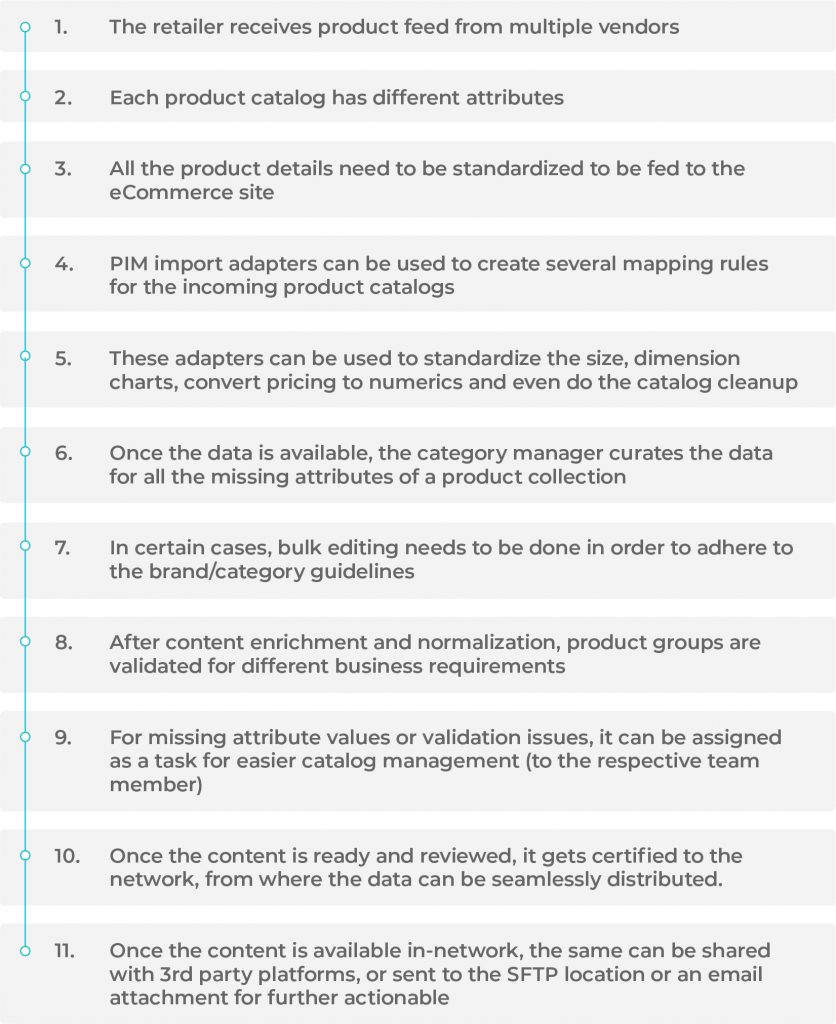
To elucidate this, we have enlisted all the steps starting from uploading the catalog to getting the products live on the eCommerce store.

List of Steps from uploading catalog to taking products to the eCommerce store

All these above-listed steps can be automated within the PIM using the PIM Workflow module. And that is what we have been building diligently so as to ease this entire process of catalog upload and taking the product to the eCommerce site. 

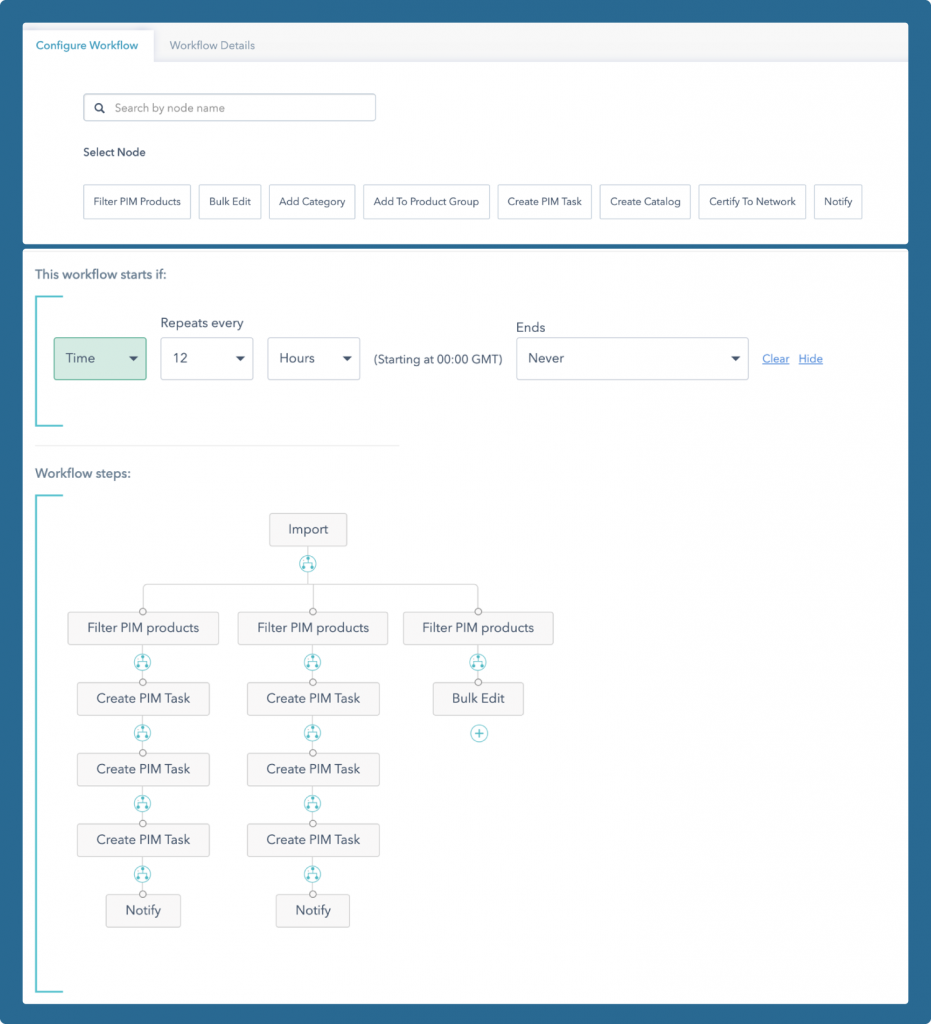
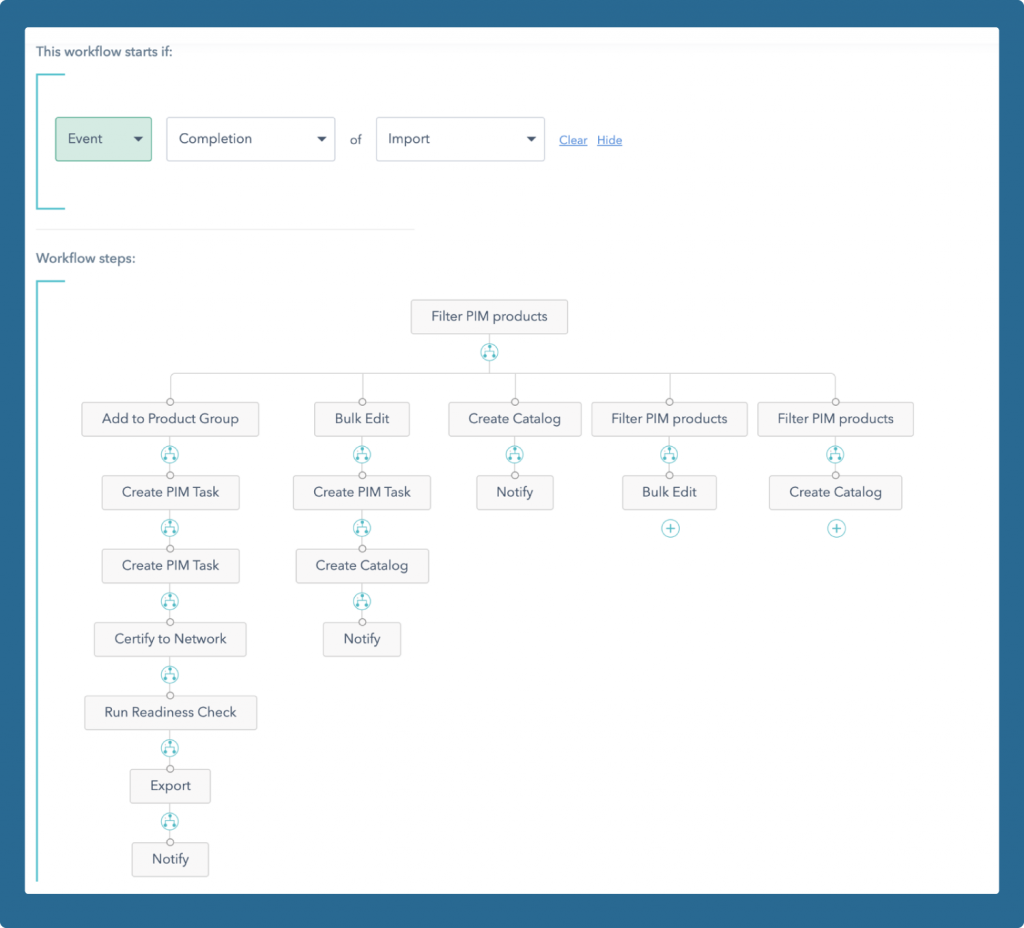
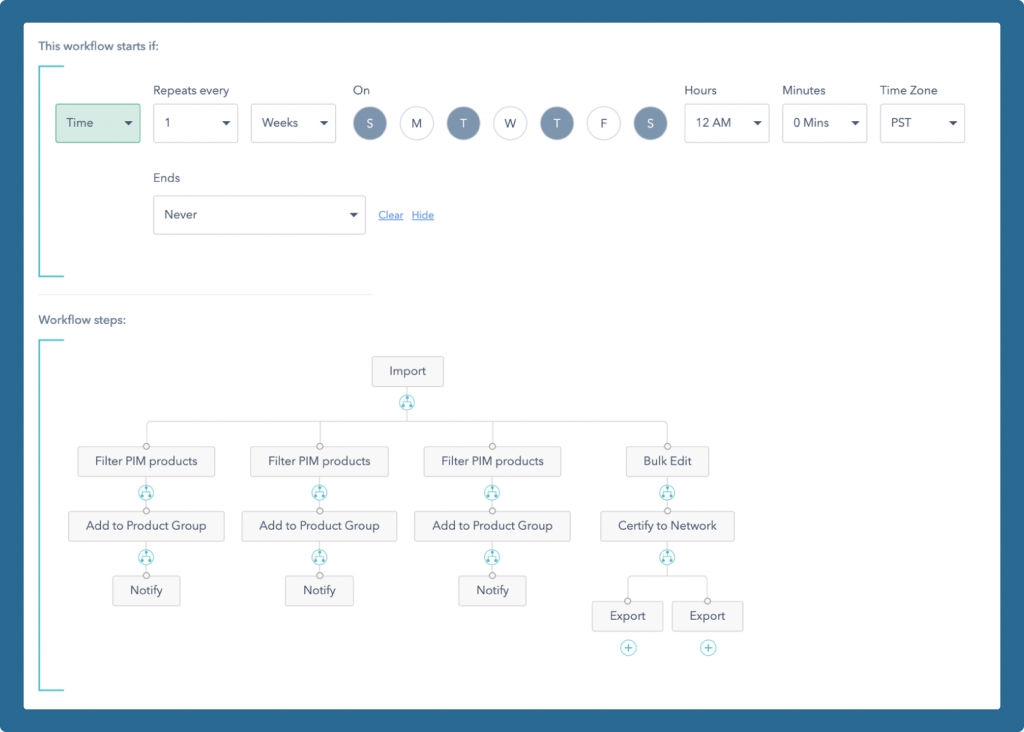
The Workflow module of Unbxd PIM allows users to define workflows based on time intervals as low as 15 mins duration up to a month duration. PIM workflow also allows actions to be defined over system events such as import completion, task completion, or other predefined event listeners.

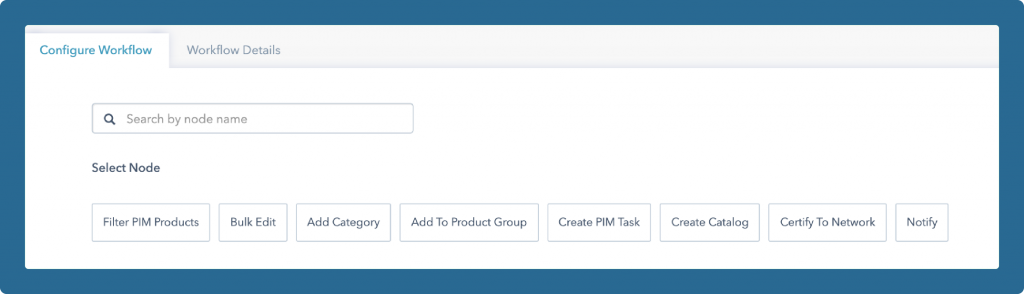
The user needs to configure the steps required as per the business requirements and can also verify it by triggering it manually. Each of the nodes in the workflow is dynamically decided based on the previous workflow step. This allows a streamlined step of actions to be taken which would make sense in the real world. PIM workflow allows configuring parallel paths after any node. This allows users to have multiple actions to be automated post-import process or task nodes. The user can perform product filtering based on missing values or a specific category or vendor attribute and take necessary actions like bulk editing assigning a task for a specific user role group. And all the actions enlisted above.

The PIM Workflow module allows you to track the activity logs of all previous successful and failed workflows. The workflow can be set to run for a specific number of iterations or till a specific date to automate specific tasks during sales periods or for different campaigns.

Configure Workflows


Creating tasks for 2 category managers
Create tasks process for 2 category managers of an eCommerce store and set up the workflow for each one of them


Filter products based on a brand or category or vendor based collection


 Import products from vendors SFTP location over periodic intervals
Import products from vendors SFTP location over periodic intervals

How our customers are using these workflows for making their life hassle-free?

These workflows (as depicted above)  have enabled one of our Customers to automate the process of picking different vendor catalogs and inventory files. They used the system to pick product information from SFTP location every 15 minutes. Importing the data using predefined adapters does necessary data clean up and deduplicates the products based on SKU, MPN, UPC and creates a new SKU value if the product is a new product.

Once the products are imported the workflow certifies the products to the network and sends a signal to Search PIM App to pull the latest products updated in the last 15 minutes based on a reference id and further upload these products to Unbxd Search system. Thus avoiding any manual intervention for automating the vendor inventory sync between Unbxd PIM and Oracle platform (OIC and OCC) along with handling the business rules related to the new products coming into the system.

Similarly, the entire workflow setup enables our customers to automate the daily mundane tasks with little to zero effort (and Zero manual intervention). The business guidelines which need to be followed for new product arrivals or for any missing attribute of products can be automated using workflows. The end to end product import and export from multiple vendor systems to different customer sites can be automated by a one-time effort. And for any unforeseen scenarios during this workflow executions, if the situation is, the concerned User will be notified for the failure of a node or upon completion via emails.

We are currently focused on making Digital Asset Management a seamless experience for all eCommerce customers (across all verticals) alike. We are adding more event listeners to the list, along with the ability to perform more curated actions, and property transformations so as to make this process super simple and super-fast for eCommerce sites.

The post Automating manual daily workflows with Unbxd PIM appeared first on Unbxd.


from Blog – Unbxd https://ift.tt/2UfTNnb
via IFTTT

How AI-model Named Entity Recognition makes search more relevant?

Query understanding is a very important part of the journey from the time a user makes a query to the point search results are shown. A typical  search engine involves 3 phases: 

  1. query expansion (in native query language), 
  2. getting results with query criteria,
  3. scoring results.

Precision and recall are then derived from scoring and query expansion phases.

Understanding the query intent in an eCommerce search system can be quite challenging due to the varying nature of the products being sold in an eCommerce store across verticals. This wide spectrum of the eCommerce domain makes it very important for us to consider user actions (clickstream) for a specific query, specifically for head queries.

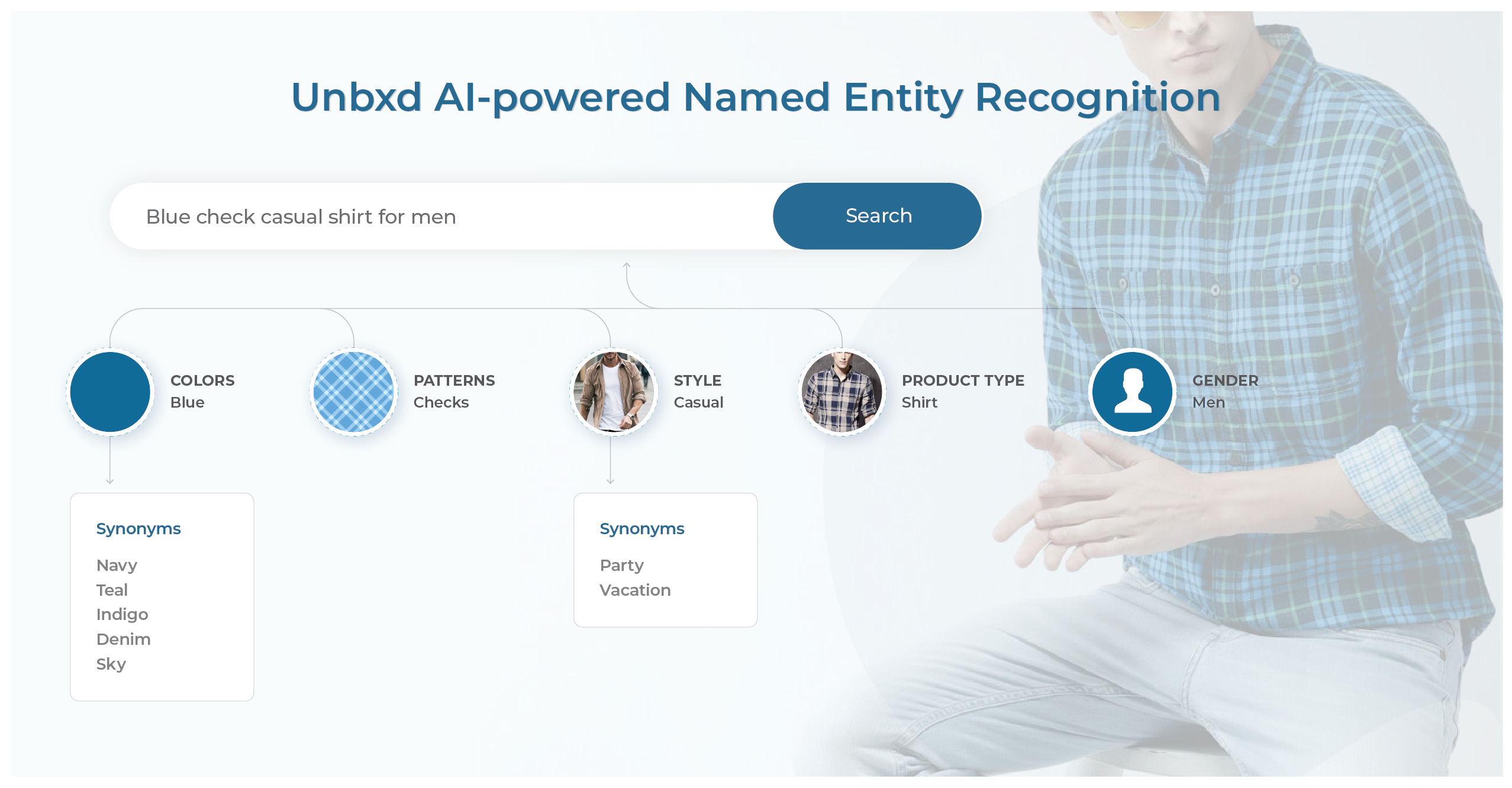
One of the most common ways to understand query intent is Named Entity Recognition (NER, as we call it) Consider a query blue check casual shirt for men, entity recognition for this query would be blue_color check(s)_pattern casual_style shirt_type for_other men_gender.

This is how AI-model Named Entity Recognition works for the search queries in a contextually relevant system

NER enables us to perform contextual query expansion which can be then fed to our search engine for culling out a more precise and relevant set of results as compared to the traditional query expansion. The most common ways of query expansion include using generic synonyms, antonyms, spell checks which apply to all the entities/attributes. One of the basic disadvantages of this approach is the expansion of ambiguous entities like a cap which can be a sleeve type for queries like cap sleeve dress and type for other queries like a cap for full sleeve dress.

Query expansion without using NER and entity specific synonyms can totally change the meaning of above queries for example:

cap sleeve dress will become 

(cap | cap_synonyms_fashion)  (sleeve | sleeve_synonyms) (dress | dress_synonyms). 

However, if we were to use NER and entity-specific synonyms it would be 

( cap sleeve | cap_sleeve_sleevetype_synonyms)  (dress | dress_product_type_synonyms) 

where cap_sleeve_sleevetype_synonyms is a synonym for cap sleeve specifically in the context of sleeve type and so on.

So without contextual query expansion, we would end up showing results for caps along with the dress. However, with NER we would show results for dresses that have cap sleeves which was the user intent.

The above-mentioned approach involves two important processes:

  1. Entity Recognition
  2. Query Expansion using entity synonyms

While entity extraction is not an easy problem to solve, query expansion can also be very complex. To keep things simple we will not consider dependent entity synonyms like what should be relevant product types when sleeve type is a cap or vice versa. There can be a lot of heuristics to do this.

We can have two approaches to entity recognition:

  1. Simple Entity recognition models
  2. Joint models for Entity recognition and user intent (product type(s) or category)

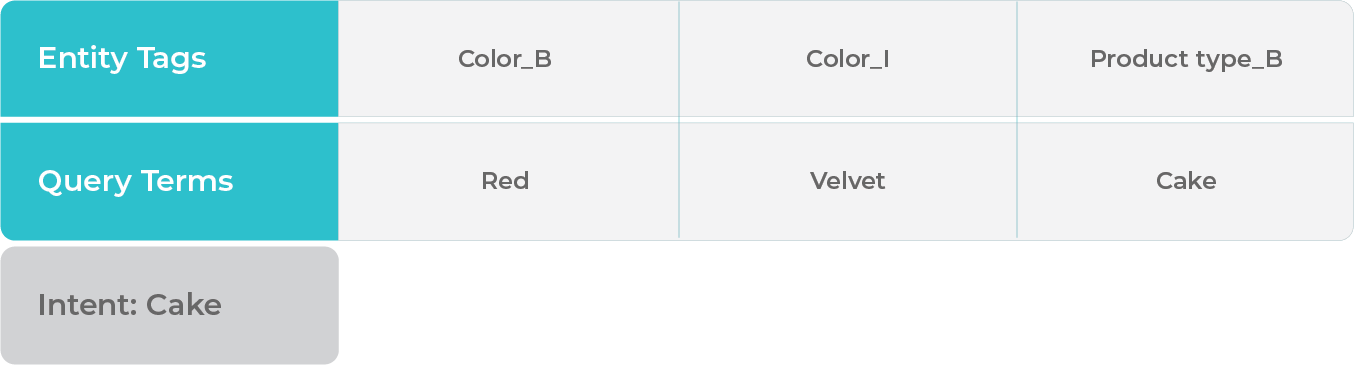
Both the approaches require the following data sets – Training data:  Training data for entity recognition would be a user query tagged with all its entities and user intent. For example, data for red velvet cake would be:

AI model -Named Entity Recognition

Needless to say, all the entities would have some score associated with them that comes out of clickstream. This score signifies the importance of each attribute for a query and finally for the whole data set i.e customer catalog.

Training data can be handcrafted or auto-generated, at our scale we prefer to go with auto-generated. Following are sources we choose to go with:

    1. Catalog data (product data)
    2. Clickstream data (user actions (click/cart/buy) for a specific query and a product)

We combine clickstream and catalog data to come up with impression scores for each query based on which we decide if data set for that query qualifies for the training data set.

Above mentioned approach is used to generate NER tags for the historical queries of the customer and then we generalize this understanding via a machine-learned (ML) model so that given new queries, the model can make entity and intent prediction for various phrases in the query.

NER is a natural language processing problem which involves sequence-to-sequence labeling, where given training data is of the following format.

NLP labelling for Named Entity Recognition

Input sequence is the query terms and output includes are the corresponding entity tags and the query intent. We learn a model such that for new input query terms the model outputs the predicted entity tags and the query intent.

  1. Conditional Random Fields (CRF): CRFs are a class of statistical modeling methods and take context (neighboring tags) into account when predicting a tag. The features used to generate this are mainly the current word, next/previous words, labels of next/previous words, prefix/suffix of the words, word shapes (Digits/Alphabets, etc), n-gram variations of all these. While this ensures we consider the context to predict more relevant tags it also needs enough training data set to produce good recall.
  2. Recurrent Neural Networks and Convolutional nets based models: We tried out a variety of neural network-based models for sequence tagging search queries. Transition learning can be simply understood as a state machine kind of approach where the input sequence passes through multiple states and decision is made at each state to generate the label for that state. It takes considerable large training time and the performance optimization might require good enough infrastructure but we were able to achieve state of the art performance (> 99.9 % F1 scores) for these models. These models include the following:
    1. bidirectional LSTM networks (BI-Long Short Term Memory [1])
    2. Bi-LSTM with char CNN
    3. Bi-LSTM networks with a CRF layer (BILSTM-CRF)
    4. Bi-LSTM – CNN – CRF with the intent prediction

Each of the above models has its advantages and shortcomings, while one model might work for short queries,  others may be suited for different types of queries. We, therefore, go with an ensemble approach that considers all the model outputs and chooses the best entities for a given query.

We have built models for two types of data sets:

  1. Domain-specific Models: Domain/vertical specific models are the ones where we have identified a set of common attributes/entities for that vertical. We try to fit all the queries for that vertical on it. It makes it easier for us to enable default relevance for a customer. However there are cases where a customer could belong to a subset of a vertical or a combination of verticals, these are the cases we might not see a good performance from generic vertical-specific models.
  2. Customer Specific Models: These are the datasets that do not fit into a certain vertical or have attributes that are uncommon. A few challenges which occur while building such models are catalog quality, getting training data for uncommon attributes.
    1. Catalog Enrichment: Some of the customer catalogs are not very clean/structured. This is where we do catalog enrichment to include additional attributes that describe the product in a more structured manner. Catalog enrichment in itself is a very interesting and challenging problem. Once catalog enrichment is done, our NER models start performing well.
    2. Attribute selection for recognition

We have designed our model training pipeline in such a way that automated feedback is captured based on model training frequency. Models are retrained when we have good enough differential clickstream data. Since we use our NER model output to score the search results, feedback is captured in the clickstream, which is then used to retrain the models. And all of this is a continuous process.

We keep running EDA and internal a/b tests to determine the accuracy and performance of our NER models. This exercise also helps us decide the training frequency of these models. We also keep adding models based on the latest enhancements in the natural language domain (and processing techniques). There have been significant efforts made towards generating contextual word embeddings (e.g: Elmo, InferSent, and BERT) which help us improve our NER models with each new version being pushed to production. In case you want to know more about the Entity Extraction and previous accomplishments, you can read our blog here.

The post How AI-model Named Entity Recognition makes search more relevant? appeared first on Unbxd.


from Blog – Unbxd https://ift.tt/2PZB9xi
via IFTTT

Unbxd Recommendations 2.0, more power to merchandiser and marketers!

Peter had come to this eCommerce store acme.corp looking for jogger pants for his newfound love for fitness. While he searched and browsed for the pants he was looking for, he was recommended more options that other users with similar shopping interests had viewed. This helped him choose from options he was more likely to buy from. As he landed on the product display page, he came across Bought also Bought suggestions. And he ended up adding a matching set of tees to his cart along with a pair of gloves. As he moved ahead to view his cart, he found a smart and chic duffle bag with a free sipper bottle under Complete the look recommendations.

While he had come to the online store to buy just jogger pants, he ended up buying more than what he needed but all that he could have wished for. And the eCommerce store ended up making more money per order.

Only if this could be true every damn time! Alas, it is not!

Recommendations – howsoever easy and integral it seems to the online shopping journey, in actual it is not. It needs a lot of data analysis and much more manual work to set things up and suggest relevant products to online shoppers across the shopping journey.

Every time, we talked to our customers – we could hear the challenges they were facing with enabling recommendation widgets on their platform (read eCommerce store) – despite it being a great tool to see a lift in conversions and Average Order Value.

How did it use to work earlier?

While everyone was convinced about the utility and value, recommendations brought to the product discovery journey, and we were seeing an exorbitant adoption rate for our offering – there were inhibitions regarding the complexity of changing and customizing the algorithms. This need for change meant external dependency on IT to learn (and unlearn) the existing logic and tweak the algorithms as per the changing business needs, always. All this meant more delay in bringing merchandising changes alive in real-time.

We were all ears to these challenges being faced by our customers and we wanted to do something about the same – to make it super simple and fun to make recommendations a part of the product discovery journey for our customers and their shoppers.

What has changed now?

We, at Unbxd, took it upon us to design and device a Recommendations engine which is:

  1. 100% customizable – plug and play with various recommendation algorithms as per your business needs
  2. Zero IT dependency – let merchandisers and marketers be in more control of running the recommendations engine for your eCommerce store
  3. Faster Go-to-Market – with quick and easy onboarding and self-serve environment

What’s new in Recs 2.0?

With this new Unbxd Recommendations, we have ensured a faster go-to-market for the recommendations engine for an eCommerce store. It comes with power-packed features as listed below:

  1. Faster Onboarding and Go Live
  2. Strategy based pre-defined  Algorithms
  3. Custom Algorithms
  4. Hybrid Algorithms
  5. Preview Debugger
  6. Create experiences

Let’s have a look at this short video and experience the Recs2.0 (as we love to call it) before we jump into the details of each feature individually.

Faster Onboarding: All you have to do to get started is – upload your catalog through API to populate Unbxd Recs with the product feed instantly. With an intuitive interface, you will experience a seamless onboarding from start to finish to getting activated! (AJAX Integration – Coming Soon!)

Strategy based Algorithms: Unbxd will offer you 12 pre-defined algorithms suited to target shoppers across the shopping journey. This will allow you to personalize the recommendations based on popularity, the wisdom of the crowd, catalog, and the past activity of the shoppers. With this, you can shorten the time to purchase and achieve targeted upsell and cross-sell opportunities.

Custom Algorithms: As seen in the video above, your eCommerce team can create filter rules incorporating brand, price, category, and other product attributes. At the same time, fallbacks can be set in case of no matches, dynamic filters can be set to match the intent of the shopper at the time of the purchase. This will allow you to target multiple customer segments with different affinities.

Hybrid Algorithms: With this, you can combine multiple algorithms into a single recommendation widget. It implies you can always use a fallback option irrespective of the stage of the shopping journey. This feature allows you to utilize widget space effectively, and showcase a wider selection of products.

Preview Debugger: As the name suggests, you will be in a position to see the look and feel of how the recommendations widget (and products in the suggested slots) would look in real-time. It allows you to visualize and make any changes to the recommendations widget space before going live.

Create Experiences: Unbxd allows you to create a differentiated customer experience by swapping one algorithm with another. You can choose from a pre-defined set of algorithms or create a hybrid algorithm within a few clicks and custom-build the recommendation widget.

Now that we have seen all the magic Unbxd Recommendations can create, let us see what business impact can you see out of using this slick and smart offering of ours. 

Business Impact of Recommendations along the shopping journey

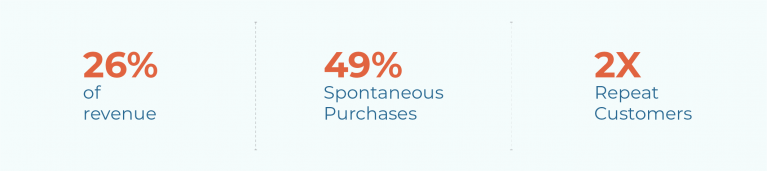
eCommerce visits where shoppers click on recommended products fetch 24% of orders and 26% of revenue. Enabling Recommendations on an eCommerce store results in 49% spontaneous purchases and these shoppers are 2x more likely to return to your eCommerce store. So, why not?

There are millions of products being suggested to millions of shoppers across channels including web and mobile. In this plethora of options, uniqueness and engaging with shoppers at 1:1 level remains the most challenging bit of the shopping journey. It demands from eCommerce stores to offer a contextual and behavior-driven product discovery and shopping experience. And this is where our new 2.0 version of Unbxd Recommendations comes in handy.

Unbxd Recommendations allows you:

  1. Establish contextual relevance and better product discovery experience – meaning the shoppers are able to find the most relevant products (the ones they are most likely to buy) with ease and fluidity
  2. More upsell and cross-sell opportunities – with 12 pre-defined algorithms, the ability to create custom and hybrid algorithms, you can now target various persona of shoppers with different affinities without any hassle
  3. Higher Conversion Rates – You can show relevant recommendations to both the new and repeat shoppers thereby increasing the likelihood to purchase and increase conversions
  4. Increased Customer Retention – By offering a differentiated customer experience, you actually motivate shoppers to keep coming back to you and hence increasing the overall customer lifetime value

We at Unbxd are constantly brainstorming, innovating and gravitating towards building the world-class products that mean more value for our customers. Unbxd Recommendations is an example in real-time. If you would like to enable recommendations on your eCommerce platform as well, feel free to write to sales@unbxd.com and we would be happy to assist you in the product walkthrough!

The post Unbxd Recommendations 2.0, more power to merchandiser and marketers! appeared first on Unbxd.


from Blog – Unbxd https://ift.tt/2Tnqey3
via IFTTT

New Government – Labour Small Business Agenda

We’ve are all waking up to a new Government today, with the Labour party about to take control of the country and what should be top of your...