Showing posts with label Ecwid | E-Commerce Shopping Cart. Show all posts

Inaugural Ecwid U.S. Small Business Holiday Forecast

In October, we surveyed our merchant community to hear exactly how they’re approaching the holidays — focusing on plans for online sales, digital tools, and asking what exactly a predominately online Black Friday looks like for local retailers.

While small business owners are hopeful for a successful holiday season, many are looking for the most efficient ways to offer perks, discounts, and seamless shopping experiences — without investing additional financial resources into flashy holiday offers.

In this report, we examine the insights from nearly 200 small businesses, whose owners shared their expected challenges, priorities, and plans ahead of the holidays. Looking back at the past several months of economic uncertainty, we share perspectives and actionable tips on how small businesses can prepare for the crucial weeks ahead.

Contents:

Surviving a Pandemic: The Impact of COVID-19 On Small Businesses

Pandemic buying habits have drastically changed how consumers shop, and how small businesses grow. When the pandemic began to spread within the U.S, 55% of small businesses believed it would take six months to a year before the U.S. business climate returned to normal.

Holiday season survey small businesses US Ecwid Ecommerce

Now that we’re more than six months into limited quarantines and reduced in-store traffic, small businesses are fighting to make it into the new year. We’re in the midst of one of the most important fiscal quarters for the nation’s small businesses. While the holidays provide a natural boost in consumer spending, this holiday season won’t look the same for struggling small businesses. Let’s look back at the last several months.

Going digital

With 75% of SMBs reporting that COVID-19 has negatively impacted their businesses, by necessity, 2020 became the year that SMBs got aggressive about e-commerce. The ones that adopted and innovated early enough are still around, but the fight is far from over. To not only survive, but grow their businesses, hundreds and even thousands of businesses migrated online, earlier this spring— accelerating existing pre-pandemic trends. In fact, our merchant community at Ecwid saw a 300% increase in new signups in Q2, compared to the same time last year. As they experimented with online channels, Ecwid merchants saw a 50% increase in sales.
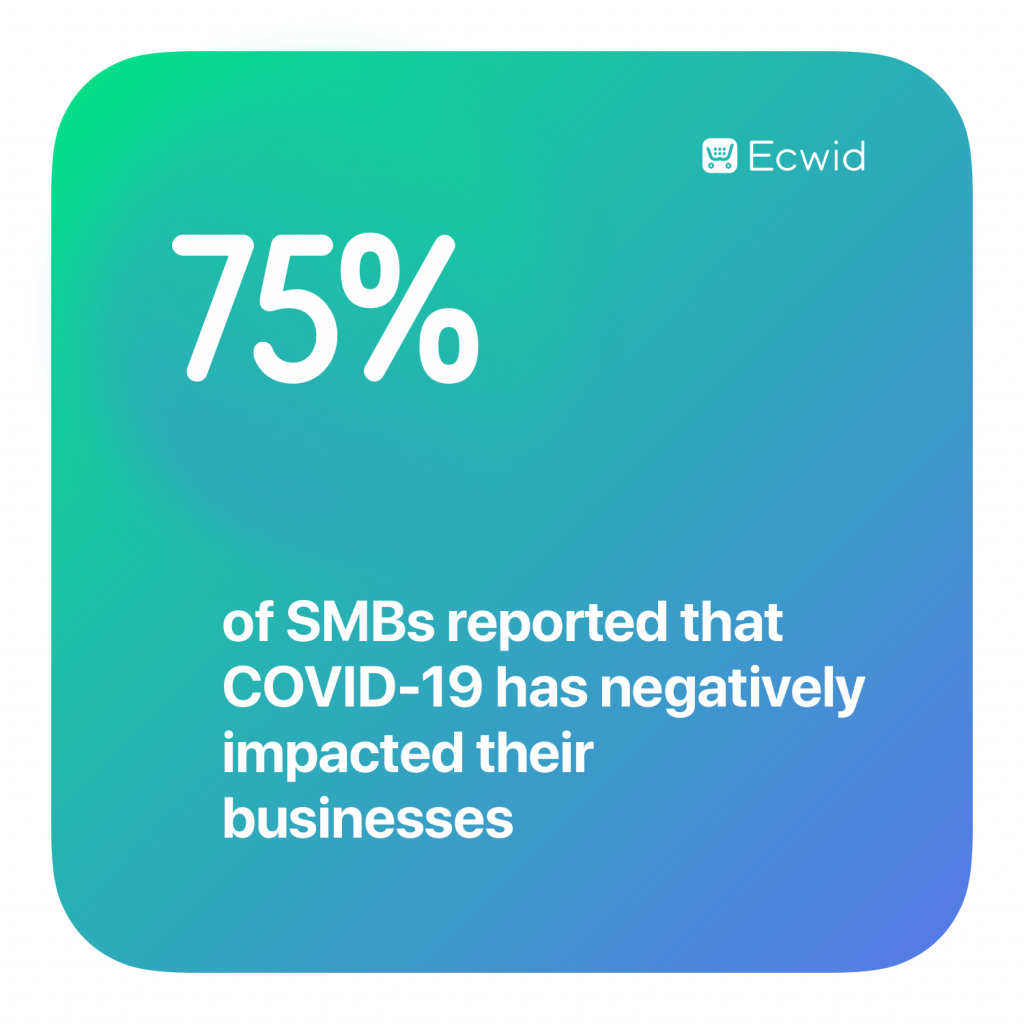
75% of SMBs reporting that COVID-19 has negatively impacted their businesses

Store and restaurant owners have leaned heavily into e-commerce— many for the first time. Beyond migrating their products to digital storefronts, some merchants have even adjusted their products completely: with restaurants selling dinner kits, and even in-demand items like toilet paper and hand sanitizer, business owners have had to think creatively to retain customers.

The standout trend for SMBs that is here to stay is curbside pickup. While buy online, pickup in store, or BOPIS, was already a growing retail trend, mandatory store closures led to the accelerated adoption of curbside pickup across the nation. On Ecwid, total U.S. sales fulfilled via curbside pickup increased by 388%, since the beginning of the year. While we saw the strongest peak of curbside pickup adoption in May, Q3 had about about 2/3 of that level. As holiday shopping continues, the high volume of curbside pickup will continue to spike in a U-shaped trajectory.
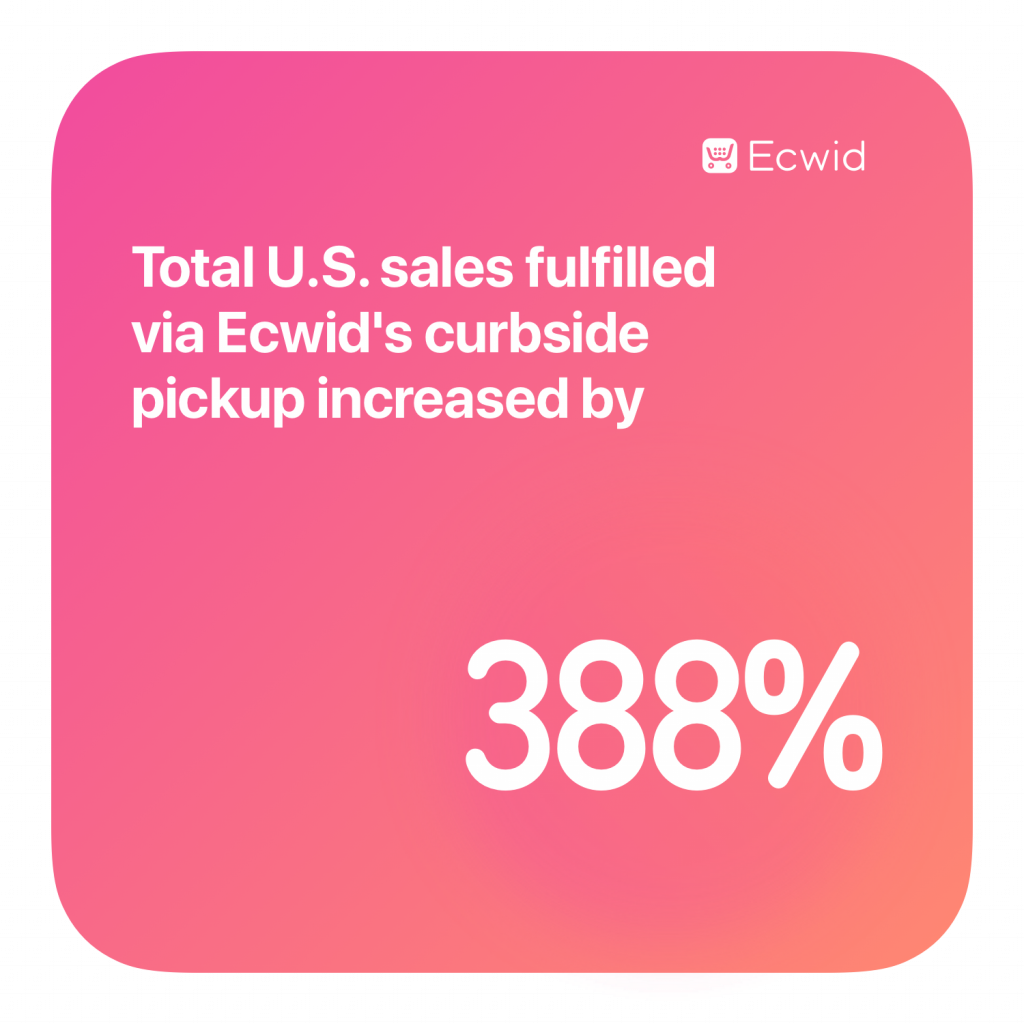
Holiday season survey 2020 Ecwid Ecommerce curbside pickup

Additionally, e-commerce features like gift cards and delivery have helped to ease the financial burdens faced by small businesses. Delivery, like curbside pickup, helped businesses fulfill orders at a time when in-store traffic was reduced or completely non-existent. Gift cards and vouchers enabled businesses to secure revenue in the immediate, even during times when services or goods were not available.

Success stories

Overall, Ecwid merchants saw a 114% and 71% YoY increase in orders and sales, respectively, during the first half of the year. From relying on social media— both paid and organic— to expanding physical storefronts in tandem with online momentum, here are a few merchants selling on Ecwid who have made the most of their interactions with at-home shoppers and the new buying priorities.

Julia Rose Boston stays social, but not distant, on Instagram:

During a time when in-person interactions are limited, brands have turned to social media to drive connectivity and reach consumers on their preferred platforms. Julia Carney is the brains behind luxury accessory and handbags company, Julia Rose Boston. With Humfrey Brandes, a senior product manager, they boosted her already established social media presence with a solid inventory management and sales foundation via her new online storefront.

By curating new collections, improving the check out experience, and using Instagram Stories to grab shoppers’ attention, Julia has been able to sustain her business selling new and pre-owned luxury goods.

Julia Rose Boston success story

Even while global supply chains impacted her pricing and procurement strategies, her team adjusted inventory to focus on more accessible stock. Her entire business is run on Instagram, and the majority of customers purchase on mobile. By connecting her social presence with her Ecwid storefront, Julia’s sales from April 2020 to June 2020 exceeded $3.5 million!

Julia relies on the personalized, not automated, customer interactions to foster relationships with customers.

Kissed By A Bee Brings organic growth to organic beauty:

Akilah Scott-Amos is the founder behind Texas-based, organic skincare and beauty business, Kissed By A Bee. After being laid off from a corporate role she held for many years, Akilah turned to ancestral herbalist practices learned from her family to launch her homemade skincare company.

Kissed by a Bee products

Prior to the pandemic, Akilah relied on trade shows and events to secure about half of her income, and reach customers outside of her immediate area. Following her final show in February, in-person events were cancelled, and Akilah turned to online sales to expand her reach nationally.

Kissed by a Bee stand at a market


Kissed by a Bee stand at a market

Known for her creative and eye-catching booth and tent designs, Akilah brings that same branding expertise to her online store. Without dedicating any of her marketing budget to paid social media, Akilah has seen a surge in business due to her marketing on owned channels— securing $80,000 in sales from April to June 2020. For the last six years, Akilah has worked out of her house, but recently expanded into a warehouse space that contains a small storefront. Now, she’s selling and growing across channels, online and in-store.

kissed by a bee in store

NanoSeptic cleans house selling sanitization tech:

NanoTouch Materials invented and manufactures a full line of NanoSeptic continuously self-cleaning surfaces.

NanoSeptic


Shop.nanoseptic.com

To accommodate the constant demand for their cleaning products, at the start of the pandemic, the NanoSeptic team added employees on a weekly basis— supporting those within the local workforce that had previously lost jobs due to pandemic-related closures.

The team automated multiple steps in the fabrication process— including the application of coatings, printing, cutting, counting, and sorting. NanoSeptic worked with their engineering company for two weeks to design and build an automated workflow for their manufacturing processes. Refining and building on to this system, the team expanded into a second automated line, focusing on NanoSeptic’s tubular door handle sleeves. And recently, they developed more automation to manufacture their new light switch covers. To support continued growth, the engineering company is currently building duplicates of all three manufacturing lines.

From February 2020 to March 2020, NanoSeptic saw a nearly 3000% spike in orders on their online store— with orders increasing almost another 60% and 100% in the following two months. By April, the order volume had increased so much that NanoSeptic was only able to keep the online store open for about two hours a day. While NanoSeptic actually had to limit store hours to best manage demand, they recouped enough revenue to begin the process of tripling their manufacturing facility in Forest, Virginia.

It’s Time to Reinvest In Our Small Businesses and Local Entrepreneurs

We’re at an inflection point for Main Streets across the nation. Because the pandemic accelerated so many digital trends for small businesses, it’s going to inform how they do business for months, and more likely, years to come.

Community support

Small businesses don’t just service communities, they are the community: local owners, staff, and shoppers are all impacted by the closures sweeping the small business sector. According to data from Yelp, 60% of pandemic-related business closures are now permanent. With community support, we can ensure those numbers don’t increase following the holidays.

When small businesses thrive, it’s felt across the economy. According to the U.S. Small Business Administration Office of Advocacy, SMBs have contributed to 65% of net new jobs created since 2000. Past recessions have shown us that while small businesses are usually the hardest hit, they are also some of the most impactful in influencing a recovery, by supporting local employment. In short, saving our post-pandemic economy is dependent on supporting small businesses today. Without the necessary SMB infrastructure in place in 2021, we can anticipate an even slower economic bounceback.

While new digital operations and limited government aid has helped to sustain small businesses in 2020, our small businesses need the support of local shoppers to help keep communities alive.

Bracing for winter woes

Pandemic buying habits and preferences are here to stay. Consumers and small businesses have grown accustomed to the ease-of-use and convenience of online shopping at the local level. Small businesses need to continue to meet the newly set expectations of their local shoppers, as they ramp up their holiday operations. That being said, many of the practices adopted during the spring and summer months of the pandemic will not be sustainable through the winter.

When you couple the cooling weather and the looming threat of a second COVID-19 outbreak, we have all the rationale we need to justify an aggressive holiday e-commerce strategy. More flexible solutions like outdoor seating and operations will become less popular once temperatures drop. That’s especially more likely in more pedestrian cities like New York.

This winter, small businesses are tasked with recreating the momentum and enthusiasm of the crucially important holiday season. Simultaneously, they are still combatting the economic effects of this year’s losses and staving off new ones. It’s a significant challenge, and, in order to rise to the occasion, small businesses nationwide will need to revamp their holiday strategies. Let’s take a look at how merchants selling on Ecwid plan to do just that.

Planning for the Holidays: Merchants Weigh In on Seasonal Strategies

Small business owners understand the significance of this holiday season on their ability to operate within the new year, but with limited budgets for holiday promotion, they need to be doubly thoughtful about holiday strategies. Here’s a glimpse at the numbers:

Small businesses see lasting effects of COVID-19 on holiday plans

Many new small businesses operating on Ecwid, seriously invested in e-commerce for the first time this year. Nearly half (49%) of our merchants surveyed built their online presence—shopping carts, marketplace integrations, and marketing tools— following the start of the COVID-19 pandemic.

For the businesses that were already online, they doubled down on online shopping. Now, more than three fourths (76%) of our merchants said that the COVID-19 pandemic affected their holiday plans, with 45% of those respondents saying the pandemic significantly impacted their holiday strategy.

45% of respondents saying the pandemic significantly impacted their holiday strategy

Outside of the economic implications of the pandemic, the impact of COVID-19 has left many retailers understaffed ahead of an expected surge in holiday sales. After the pandemic stalled global supply chains and distribution processes, small businesses have struggled not only to stock their virtual shelves, but also get products to shoppers quickly.

Ahead of what will be the busiest online holiday season yet, the shipping capacity shortfall between Thanksgiving and Christmas could average 7 million packages daily, according to ShipMatrix, Inc. With confidence in shipping timelines waning, more than half (55%) of merchants plan to move up shipping deadlines to account for delays. While both consumers’ and merchants’ expectations around shipping plummett, most small businesses (87%) do not plan to increase seasonal staff to fulfill online orders— signifying lower resources to manage holiday online orders.
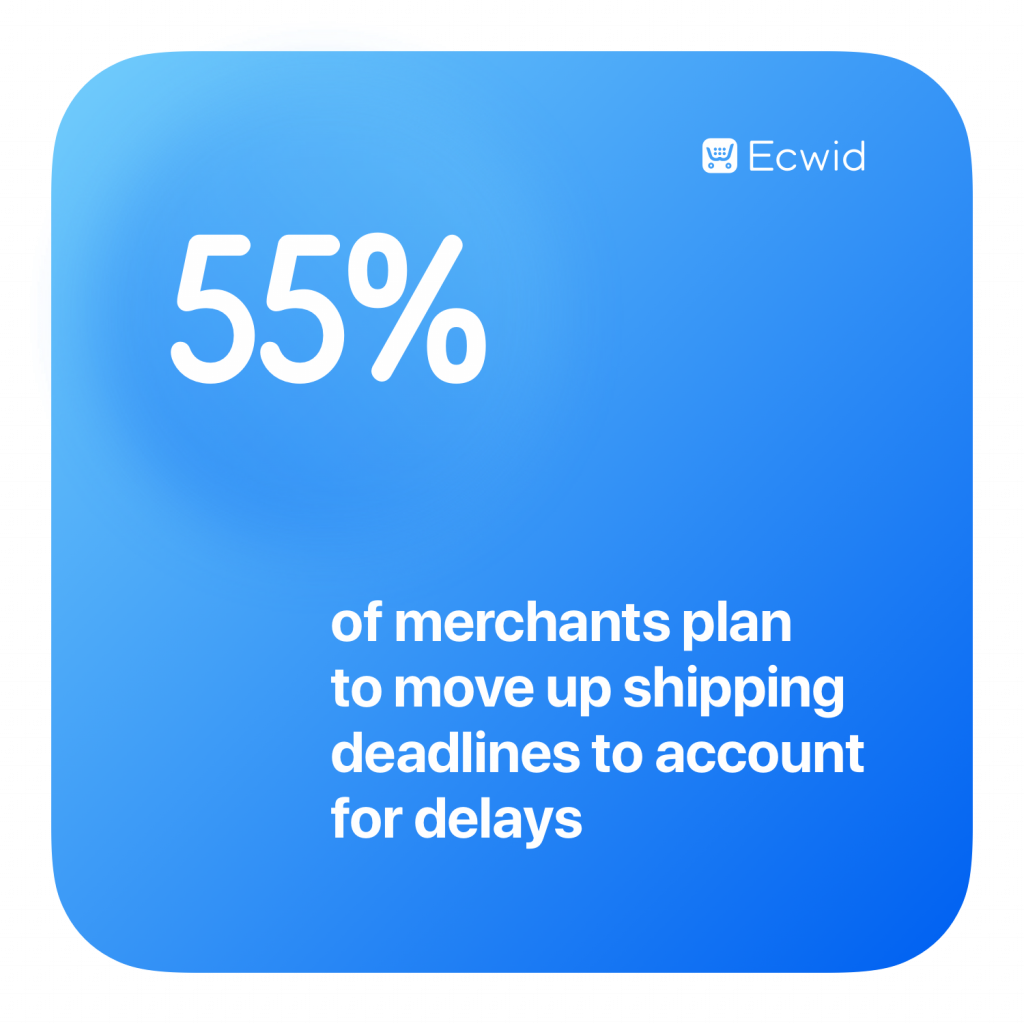
55% of merchants plan to move up shipping deadlines to account for delays

Take DIY Delish, a family-run brand of natural, dairy- and gluten-free cooking sauces, for example. They expect their line of simmer sauces to attract foodies and plant-based diet lovers, all season long. Based in Denver, DIY Delish already offers free shipping within Colorado. Founder Raj Harika shares that "For the holidays, we are working on special themed gift boxes, and will promote them across our social media and email marketing. We are giving people enough time and notice to buy these in advance." Whether it’s prep for a holiday dinner, or a gift for the amateur chef in your family, DIY Delish is getting ahead of chaotic shipping timelines.

87% do not plan to increase seasonal staff to fulfill online orders

Conservative discounts await Black Friday and Cyber Monday shoppers

Black Friday has always been a major shopping moment for big box retailers like Walmart, Target, and Best Buy; however, small businesses have struggled to compete with low prices. Instead, Small Business Saturday has created a space for local retailers during the unofficial kickoff to holiday shopping. This year Cyber Weekend will look different, given that holiday shopping began in early October.

Generally speaking, nearly half (44%) of consumers will start shopping earlier than last year, according to Listrak research. Based on current trends on Ecwid, apparel will lead holiday sales for small businesses through the holiday season, followed by food and beverage consumption— including restaurants and food delivery.

Merchants are planning for the bulk of their Black Friday and Cyber Monday sales to happen online, and are offering fewer in-store perks and experiences to drive online sales. In fact, only 15% of merchants expecting a spike in sales on Black Friday anticipate selling the majority of their products at their brick and mortar location.

Merchants who anticipate a spike in sales on Cyber Monday (85%) plan to sell the majority of their goods online. Additionally, merchants who anticipate a spike in sales on Small Business Saturday expect the majority of their sales to come online (78%) rather than through their physical stores (14%).

This year, 78% of our merchants surveyed plan to pursue sales or promotions for the holiday season. Specifically, half of our merchants plan to offer discounts for Black Friday and Cyber Monday, with 38% and 36% anticipating a spike in sales during that day. Nearly half (48%) plan to pursue Small Business Saturday promotions, and 41% expect a spike in sales on the day.

With fewer resources, we won’t see doorbuster deals from small businesses: less than 2% (1.6%) of merchants plan to offer deals greater than 50% off. Instead, many merchants (40%) plan to offer discounts between 11 – 25% off goods.

Holiday season survey 2020 small business discounts Ecwid Ecommerce

Of the merchants who anticipate a spike in sales on Black Friday and Cyber Monday, 53% and 50%, respectively, will offer discounts 11-25% off of regular prices. The percentage of merchants slips slightly for Small Business Saturday projections, with less than half (44%) of merchants anticipating a spike in sales on offering 11-25% off discounts.

Lastly, while the majority of merchants expect moderate discounts to drive a spike in sales, a minority (20%) plan to offer discounts on Cyber Monday without expecting an increase in sales. Holiday discounts have become a must-have to stay on consumers’ radar during the busy holiday season.

To meet consumer expectations for holiday deals around Black Friday and Cyber Monday, small businesses are offering small discounts to attempt to drive more traffic without cutting into important profit margins.

SMBs stick with the basics to drive holiday sales — leaving room for future tech innovation

Small business owners are caught in a tough dilemma: they need to offer exceptional and safe shopping experiences to gain enough revenue to continue into the new year, but they need to do so with very limited resources. To maximize their e-commerce and marketing strategies, small businesses are using tried and true practices to make the most of the holiday season.

Holiday season 2020 perks Ecwid Ecommerce

For instance, more mainstream perks like free shipping and a free gift with purchase lead the pack on holiday offers— with 44% and 40% of merchants planning to offer those, respectively. On the other hand, more expensive options like price matching (6%) and free returns (7%) are less popular among merchants, this year.

When it comes to driving in-store traffic, email (73%), organic social media (70%), and word-of-mouth (66%) are the top three advertising strategies for today’s merchants. While, merchants are also increasingly experimenting with paid social media (47%), free and owned channels drive outreach strategies.
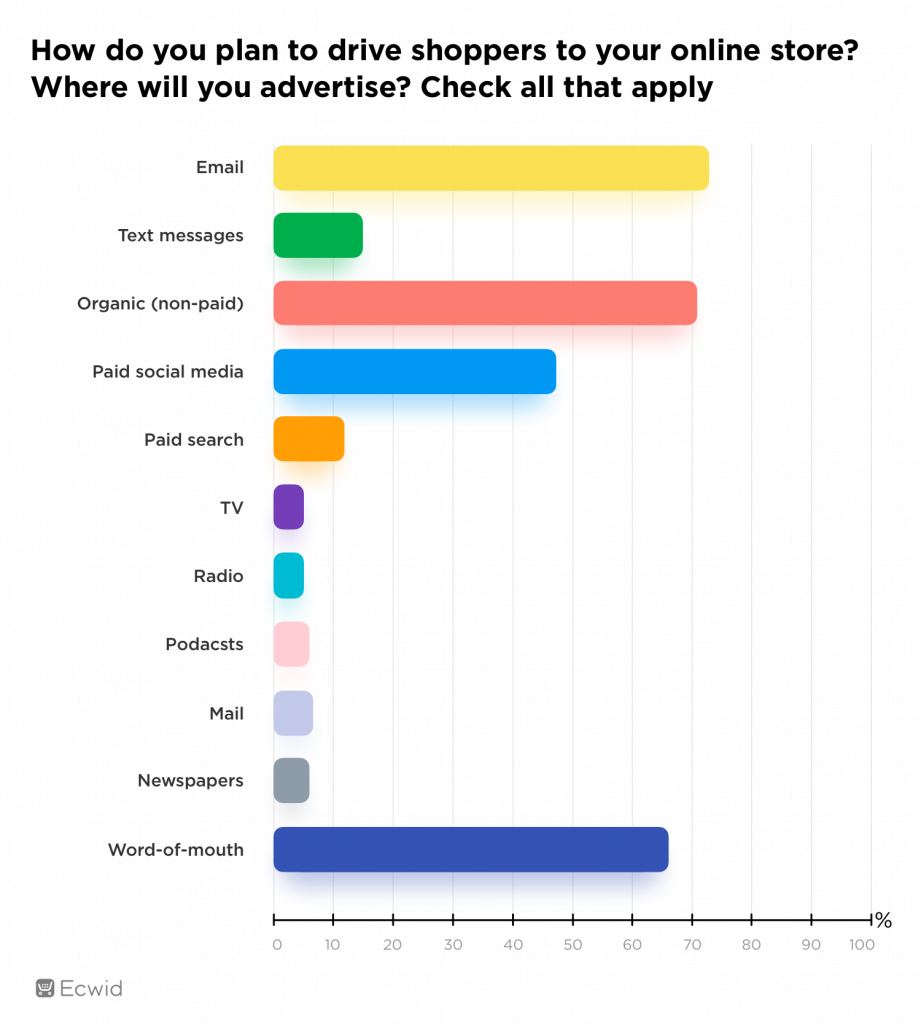
Holiday season survey 2020 Ecwid Ecommerce marketing and promotion

Overall, social media and large marketplaces still only make up a small portion of merchants’ primary selling channels— with 6% and 3% of respondents intending to sell the majority of their holiday products across each channel, respectively. We can expect small businesses to lean on essential services, and limited new digital tools, to reach shoppers.

Now, even the most reluctant small businesses understand how easy it is to sell online, but most still have a long way to go before they reap the full benefits of a comprehensive e-commerce strategy. For the small businesses that are able to expand their e-commerce offerings within the new year, we anticipate more experimentation with new payments options as well as e-commerce features.

Merchants are hopeful, but they’re not wearing rose-colored glasses

In October, the National Federation of Independent Businesses (NFIB) Optimism Index rose 3.8 points to 104.0 in September, which is a historically high reading. At the same time, the NFIB Uncertainty Index increased 2 points to 92, up from 75 in April. As small businesses maintain hope for the holiday season, there’s still a lack of clarity around what merchants can expect from upcoming sales.

Across Ecwid, the majority of our merchants expect to see higher sales during the holidays. Less than 10% of our merchants predict that sales will be significantly lower this season. Most merchants (30%) expect sales to be somewhat higher, and 11% expecting significantly higher results.

There is a small minority of merchants (13%) planning to increase their seasonal staff to fulfill online orders— showcasing some optimism around sales growth. Merchants that are investing the most in customer engagement strategies, such as live customer support, are investing more time and resources in providing individualized and personal shopping experiences, a key differentiator for small businesses, compared to larger retailers.

Interestingly, although merchants have limited resources for their holiday promotions, 61% of small business owners plan to expand their product selection for the holidays. In line with broader trends, these merchants plan to use free or affordable advertising tools such as email (75%), organic social media (73%), and word-of-mouth (70%) to drive traffic to their online stores. On the other hand, of the merchants who plan to offer fewer products for the holidays, 90% say that COVID significantly impacted their holiday strategy.

As Bianca Burns, partner at Plant Economy, purveyor of plant products for plant people, explains, her team anticipates a spike in orders, based on customer feedback and buying patterns. "Our organic marketing efforts primarily drive sales for our business at the moment, but for the holidays, we are taking it a step further. We are excited to offer exclusive products and bundle packages, run various holiday promotions, and increase on- and offline engagement. We are also working to tailor our approach to paid advertising in order to cut through some of the holiday noise."

Tips and Tricks for Holiday 2020: A Checklist for Success

Now that we’ve established how important this holiday season is for small businesses, here’s a list of digital best practices to make the most of the biggest online holiday season yet:

  • Deck the digital halls. From creative window displays to a full Santa’s workshop, small businesses always cultivated their own in-store traditions. This year, SMBs need to update their digital storefronts and social media profiles for the holidays. Try seasonal designs and add a "Holiday Gifts" section.
  • Diversify your marketplaces. Behemoth marketplaces like Amazon and eBay extend the reach of your consumer base, but they also increase competition with other sellers. Look beyond mega-marketplaces, and turn to those that cater to small business owners and makers— such as Uncommon Goods and Etsy.
  • Personalize. Personalize. Personalize! SMBs are built by and for local community members. For that reason, they will always create more personalized experiences than larger retailers. Lean on your community relationships and presence to build meaningful and personal experiences as well as products.
  • Make a subscriber list, and check it twice. Now is the time to reach out and put your holiday marketing to work. Focus on targeting the right customers at the right time. Craft holiday-specific newsletters with updated deals and gift guides, A/B test email subject lines to maximize open rates, and partner with email service providers like Mailchimp to make automated emails more shoppable.
  • Stay connected. Meet your shoppers where they are — on their phones — and, more specifically, on social media. Whether you’re selling, advertising, or handling customer service inquiries, stay responsive and continue to highlight product inventory and updates. Plus, you can use your profiles to highlight outstanding customer testimonials and reviews.
  • Make sure all presents make it in time. Leave no gift undelivered! Upgrade your shipping and logistics by integrating your online store with a shipping tech provider (e.g. Shippo, Easyship, or Ship Station). Based on your provider, you can track packages, provide proactive delivery updates, and even extend your branding with customizable and seasonal packaging.
  • Spread the holiday cheer. Ultimately, the holidays are about togetherness and supporting each other. During a time when many families will be separated for the holidays, think of creative ways to host virtual events or sell activity kits that can help bring families together virtually or connect your shoppers for real-time engagement.

*The small business holiday e-commerce survey was fielded by Ecwid via Survey Monkey from October 5-12, 2020, among a national sample of 192 small business owners. The interviews were conducted online. Results from the full poll have a margin of error of 7%.



from Ecwid | E-Commerce Shopping Cart https://ift.tt/3pl9gzy
via IFTTT

From a Family-Operated Store to a Seven-Figure Business

In the shuffle of Black Friday, don’t forget about another big day in November — Small Business Saturday! This is a day that encourages shoppers to support small and local businesses instead of large retail companies.

Small Business Saturday takes place on the last Saturday in November. To celebrate, we’re spotlighting a different Ecwid merchant every Saturday this month. Stay tuned for inspiring stories and entrepreneurial advice from those who know what running a small business is really all about.

This week we share the story of Atlas46, a premium manufacturer of tool vests, tool belts, tool rolls, and workwear — all made in the US.

Subscribe to the Ecwid E-commerce blog
Please enter a valid email address

How It All Started

Atlas46 was founded by John Carver. Previously, Carver owned a company called Eagle Industries, which specialized in tactical gear for the military. When John sold Eagle Industries, he decided to take some of the expertise he learned there and apply it to items for everyday DIY-ers and construction workers.

These days, Atlas46 is run by John Carver’s son, Brian Carver. All their products are made in the US, and are used mostly in the construction industry and by tradesmen.

In less than five years, Atlas46 has grown from a company of seven people to over 250, and counting. In 2019, they opened a second facility in Hillsboro, Illinois for manufacturing, and added a storefront. This brings their grand total to three facilities, with plans to open another ten facilities in the coming years.

Small Business Challenges

As a fast-growing company, one of Atlas46’s first challenges was finding a large number of employees with a variety of technical skills, including sewing. They overcame this challenge by reaching out to small towns with large workforces in need of employment. The success of their Hillsboro facility proved the effectiveness of employing locally, a strategy they hope to bring into their new facilities as well.

Surprisingly, the global pandemic has boosted business for Atlas46. They’ve seen a jump in demand for their products, perhaps due to an increase in home projects as well as people wanting to support local businesses.

Choosing Ecwid for E-Commerce

Eventually, Atlas46 decided to take their business online, and started a search for the right e-commerce solution. After looking at several different options, they decided that Ecwid E-commerce gave them the flexibility needed for their business model.

Carver and company liked that it was effortless to set up an online store with Ecwid, and the fact that Ecwid’s selling tool could be added to any website. Plus, from the start, Ecwid worked well with Atlas46’s production programs, and their shipping programs as well.

One Ecwid feature that the Atlas46 team finds especially helpful is the ability to set up specific discounts for different dealers or customers with a code, and then have all the details of the deal automatically applied, saving them the headache of having to manually input discounts.


The online store of Atlas46

They also actively use Ecwid features like Mailchimp for email marketing, HelpfulCrowd for customer reviews, and ShipStation for automatically calculated shipping rates for USPS & FedEx. They also like the customization options available, in case something they need is not built into the software.

Atlas46’s decision to focus on online selling seems to have been the right call: now, 99% of their sales are made online, with customers from across the globe.

Their Recipe for Success

Atlas46 believes that great marketing is essential to success. They use an in-house design and marketing team — which creates all their items, and manages their platforms internally — so the company keeps its homespun aesthetic.

To reach customers all over the world, Atlas46 takes advantage of social media. They even credit social media ads with propelling the company’s fast growth. They also use customer testimonials to speak to the ways in which their customers use their products, and to channel yet another way to get the word out about their brand.

And their approach is working: Atlas46 used to net $40 thousand a year, but now they make three million dollars a year. Talk about a small business success story!

***

Want to read more Ecwid merchant success stories? Check out the Success Stories section on our blog. And if you’d like to give a shout out to an Ecwid store you know and love, feel free to drop us a note in the comments!


from Ecwid | E-Commerce Shopping Cart https://ift.tt/3n450lY
via IFTTT

Getting Your E-Commerce Shop Thanksgiving Ready

Ahh Thanksgiving. A holiday full of well-loved traditions involving family, friends, and a societal love for turkey. Thanksgiving signals the official start of the holiday season, and along with that, brings us one of the biggest shopping days of the year, Black Friday (after all, isn’t Thanksgiving just Black Friday Eve?).

Black Friday, and its cousins Small Business Saturday and Cyber Monday, work together to bring us a triple punch of selling opportunities. And while the three "holidays" usually highlight separate ways to shop, 2020 has blurred the lines between online and offline, and given an opportunity for small businesses to succeed not just on Saturday, but over the whole holiday weekend. Think of 2020 as the year of e-commerce Thanksgiving.

But of course, you already knew that Thanksgiving can help your e-commerce business grow. What you’re wondering is how to bring customers to your store for Thanksgiving, and how to prep your business for some serious holiday shopping.

Read on for a checklist to help you get your e-commerce shop Thanksgiving ready.

Subscribe to the Ecwid E-commerce blog
Please enter a valid email address

Why Thanksgiving?

Thanksgiving presents an opportunity for increased revenue. Namely, it signals the beginning of the holiday season: a time when increased attention is paid to family, and because of that, many people exchange heartfelt gifts. Does this sound like the perfect opportunity to you? Well, it should! One of the hallmarks of a small business is an emphasis on products that speak to individuals.

Do you sell handmade goods from a faraway country? Or puzzles made from custom artwork? Both of these are examples of gifts with a personal touch, i.e., the exact type of gifts that families love to exchange during the holidays.

Another reason to run a Thanksgiving campaign for your e-commerce store? Many of your competitors might be too caught up in preparing for the big gift-exchanging holidays in December (think Christmas, Hanukkah, etc) to pay attention to Thanksgiving, making the field less crowded for a great promotional campaign or deal.

And of course, there’s no getting Thanksgiving ready without getting Black Friday ready as well. So let’s explore how to get prepped.

First, Analytics

Before you get to the fun stuff, like adding colorful banners to your site and rolling out promotions, it’s helpful to dive into some analytics. How in-depth you go will depend on your time and budget, but here are some simple ways to get started. And since it’s already November, the time to start is NOW.

Demographics

Who is buying your products? Who is visiting your site and social media sales channels? Does this data match your intended target audience? There are a ton of ways to get into the data of who and when, using what we call "insights" and "analytics."

A surprising amount of insights are accessible from existing platforms, whether that be your Ecwid control panel, or your Business Instagram account (lucky you, we have a whole post about using Instagram for business).

Do some research on insights, and record the key demographics by location, age, gender, and shopping times. That will help you figure out how to target your Thanksgiving promotions.


A sampling of Instagram analytics

Eyeing the competition

Then you’ll want to do some research on your competition. Do you know who your biggest commercial rival is? Maybe it’s Amazon, or maybe it’s the brick and mortar shop down the road. Either way, look into their promotional campaigns. Sign up for their email lists, or go scope out their shop. Pay special attention to promotions (if they have them) that they ran last year around this time.

This will help you get the lay of the land as far as what others have done, and figure out a strategy for beating your competitors at their own game.

With these basics down, you’re ready to move on to the fun stuff: the nuts and bolts of getting your shop Thanksgiving ready!

Prepare Yourself (and Your Store)

First up is one of the first things your customers will see: your product descriptions and photos. A good product description and photo combination can really amp up your selling game, so listen up.

Product descriptions

What does a perfect product description look like? For starters, think more is more. Not only should your description be a comprehensive guide to what the product is, but it should attempt to include as many relevant details as possible, including sizing measurements, colors, materials, ingredients, potential allergens, etc.

Adjectives are your friend. So are words in general, so get writing and writing, and then write some more. Still stumped? We have a guide to writing product descriptions that sell.

Product photos

Good, clear photos of what your shop has to offer will give your customers the best possible sense of your product before they buy it. Make sure you use the best quality camera possible, shoot in front of a bright, neutral backdrop, and take pictures from multiple angles. We have a list of more tips and tricks for taking great photos for your online store.

Updating product descriptions and images will give your customers the best selling experience possible, and minimize the risk of returns and complaints, which is extra important during this busy time of year.

Theming

While your store no doubt has excellent products and sales channels to promote your inventory year-round, there’s nothing like some holiday festivity to play with your design and copy, and make your shop feel more festive! Thanksgiving is an underrated opportunity for exactly this type of autumnal change-up, as it comes before the wintery overtures of later in the season.

Think about the ways in which you might include some holiday theming in your overall shop look, whether its a themed banner (complete with turkeys, pumpkin pies, and brightly colored leaves) or a series of Instagram polls debating your favorite Thanksgiving side dish.


Some Thanksgiving theming, courtesy of Whole Foods

Don’t have a brand you can change up for the holidays? No worries! There are subtle ways to give off the flavor of the season. Try just playing with the color palette on a couple of Instagram posts, or adding a new, Thanksgiving-friendly profile picture to your Facebook. Customers love dynamic design, but it’s all a matter of getting creative while staying true to your brand.

Can’t get enough theming? You might even want to try out a themed sale or offer, which brings us to our next point:

Thanksgiving Sales and Campaign Offers

Did someone say sale? If you’re just starting out in the e-commerce world, you may be wondering what a successful marketing campaign looks like. Well, the easiest place to start might be with an email campaign that offers a deal or discount.

If you shop, you are probably used to email campaigns as a consumer, so you already have an understanding of how an email campaign works (cool, right?). But here are some tips for starting a successful email campaign to get your ready for the Thanksgiving holiday selling season.

Step 1: Set up a promotional calendar

The first step is to create a holiday promotional calendar. We’ve said it before and we’ll say it again.

But because Thanksgiving is likely the first holiday promotion on your list, don’t worry too much about getting the whole thing filled out. The important thing is to make a placeholder, and to begin to think of your Thanksgiving promotions as an extension of your holiday seasonal sales and content, so that when other holidays sneak up on you, you’ll have some materials already in place and can more easily spring into action.


A simple, color-coordinated promotional calendar can help you prepare for Thanksgiving and holiday promotions

Step 2: Pick a product

This might be the most important Thanksgiving sale decision you make. Maybe you have an item in your inventory that feels a little "Thanksgiving-y." Maybe you just want to offer a discount on one of your best selling products to attract potential loyal customers. Or, maybe you have a brand new release that you are super excited about, and want to get the word out.

There’s no wrong answer to the "what product?" question, but there might be a "best" answer for your specific shop. Here are some particularly popular item categories for holiday shopping (including Thanksgiving and Black Friday sales), which might help you pick the best product to promote:

  • Apparel: The most popular holiday shopping category by far (in fact, Deloitte shows that clothing made up 55% of gift sales last year) . If clothes are your thing, great! Maybe offer up a sweater, or an item in an autumnal color for you offer.
  • Games, toys, dolls, etc: Unsurprisingly, kids and holidays go together like peanut butter and jelly. Toys and games for little ones are a great thing to put on offer, as they range in price from state-of-the-art kids gadgets to little stocking stuffers that you can make free with a larger purchase.
  • Books: all that extra time spent inside means one thing — reading is making a comeback this year! Not a bookseller? That’s okay. Play up any paper good you might have: stationery, pamphlets, bookshelves, etc.
  • Gift cards: Never underestimate the power of cold hard cash when it comes to gifting. And in this case, we mean a nice, old fashioned gift card. Gift cards have long been a staple of gift giving, allowing for maximum flexibility with minimal shopping effort. If your shop doesn’t offer certificates or e-gift cards, consider adding them to your holiday line-up, and offering an early season stock-up promotion for Turkey Day.


A handy chart of planned holiday purchases

Step 3: A mailing list

If you don’t have a mailing list, now is a great time to get one! Our Ecwid Business Plan features Mailchimp, which has a whole suite of automated email features that can help any new e-commerce merchant get the hang of it. Otherwise, you’ll have to send out individual emails to get the word out.

Step 4: The offer copy

You know the product you want to base your campaign around. Now it’s time to decide on an offer. Do you want your customers to take a percentage off, to offer free shipping, or a free gift with purchase? Once again, there are no wrong answers, but it’s important to consider your marketing budget (and your bottom line) before you go all in on a sale.

Once you’ve picked your promotion, you want to write an email about it to send out to your mailing list. Try to craft something eye-catching (here’s a great place for some design flair) that will both detail why your sale item is special, and why this deal is perfectly timed for Thanksgiving.

Also: 5 Types of BOGO(F) Promotions You Can Run in Your Store

Step 5: Apply changes to your store

A small, but important thing: make sure you’ve applied the offer to your store’s interface to head off any technical glitches and customer service complaints. Also make sure you’ve stocked up on the item on sale, to avoid the dreaded "Sold Out" problem in the middle of your promotion.

Step 6: Send it out

Now you’re ready to roll. Get the word out about your great deal through your mailing list. Then sit back, and (hopefully) watch the sales trickle in.

It’s also a great idea to promote your Thanksgiving sale or deal on social media. See our guides and tips to selling on social media platforms, from selling on Instagram to working with Etsy.

10 Days to Your Holiday Season Sale

Please enter a valid email address

Flash Thanksgiving Sales

Sure, a full-fledged discount campaign is a great selling tool. But have you ever thought about running a Thanksgiving flash sale?

A flash sale is a sale or promotion which has a short duration time, usually twenty-four to forty-eight hours. It is announced right when it starts (or, maybe the night before) and is characterized by a flooding of promotional material during that time to remind potential buyers of the great deal they are about to miss out on.

Flash sales are a great way to promote customer interest, make dynamic marketing content, and most importantly, create a sense of urgency. Research shows that the holiday shopping season is earlier than ever this year, meaning that gift giving is already on a lot of buyer’s minds. This is a good thing for sellers. After all, wouldn’t you like to close the deal on that new mug for grandma in November, instead of waiting until the day before Christmas? A flash sale can help.

A flash sale is also a great way to test out new merchandise, or generate interest for potential all-star products that never seem to get the credit they deserve.

Another great thing about a flash sale? You can use the same steps as above to implement the sale. The only difference is that you have to speed up the timeline so that all your promotional materials drop within a 24-hour time period, and close the sale off through your shop the second the sale ends.

When planning a flash sale, keep a couple of other things in mind:

  • Your capacity: What’s that? You’re running your business solo? AND you promised to make a socially-distanced Thanksgiving dinner for six? Yeah, then Thanksgiving Day might not be the best time to run a flash sale. Try Small Business Saturday instead.
  • Promotional materials: a flash sale needs a large amount of marketing material: emails, social posts, etc., for a short amount of time. Have a lot of your content prepped and ready to go in the days and weeks ahead of Thanksgiving so that you’ll be ready to roll on Flash sale day.
  • The deal! As with any deal, make sure you pick a compelling offer, and have the deal enabled through your shop so that you don’t get a crowd of customer service complaints at the last second. And, as we said, it’s vital to stock up on the product so your inventory holds.

Lastly: when planning a flash sale, timing is everything. Think long and hard about the most effective day for your business (weekday vs. weekend, Thanksgiving Day vs. Cyber Monday) before flipping the switch on a flash one-day deal. Because once the deal is on, you can’t take it back!

Also: How to Run a Flash Sale to Boost Profits Fast

Make Your Thanksgiving Traction Last All Holiday Season Long

Are you already giving 120% to get ready for a Thanksgiving promotion? Remember to pace yourself! Thanksgiving and Black Friday represent the start of the holiday season, not the end. Think about ways in which your promotions for late-November might tie-in to later holiday deals, and see where you might be able to re-use copy or promotions to make less work for yourself later.

Support

Good support might be the most important part of making your business dreams come true. That goes double for the holiday season, when things are likely to get more hectic more quickly than during the rest of the year.

Think about your resources and your team. Stock up on supplies (not to mention inventory) ahead of time to beat the rush and make sure that your items stay in stock when your customers need them most.

Troubleshooting

Inevitably, returns and customer complaints will happen. So, make sure you have your terms and conditions (and an official return policy) listed on your website ahead of time. Also, have someone on-hand to handle complaints (even if that someone is you) and messages that come your way in a timely manner. For more, see our articles on getting more reviews for the holidays and handling negative feedback gracefully.

Make sure that your website has the capacity to deal with increased traffic, starting around the Thanksgiving prep-season. Test your website speed, and make use of all relevant selling tools, like those on your Ecwid control panel, to help keep yourself organized.

Take Care

Remember, this time of the year can be stressful for everyone! It’s important to have a support system in place outside of your business team. Have someone to chat with when you need to to take your mind off the stresses of running an ecommerce site, and remember to treat anyone who is working with you with care, including yourself!


Ecwid’s Help Center: always there for you

Lastly, remember to use customer support when you need it. Ecwid’s Help Center is incredibly handy and efficient. But even if you don’t e-commerce with Ecwid, make sure you know who to call in case something goes awry.

We hope these tips will help you get your e-commerce store ready for Thanksgiving and beyond! Let us know if these tips helped you out, or if you have insights of your own to share in the comments below. And happy Turkey Day to all who celebrate!


from Ecwid | E-Commerce Shopping Cart https://ift.tt/2HZZJ0f
via IFTTT

6 Сustomer Service Mistakes Online Sellers Make During the Holiday Season

Black Friday and Cyber Monday mark the beginning of everybody’s favorite winter holiday season. But this is also the most high-pressure shopping period of the year for both consumers and retailers. While shoppers are getting busy chasing good deals, business owners are trying their best to outrun their competition.

According to this survey, 30% of yearly retail sales happen between Black Friday and Christmas. The good news is that you still have time to level up your game plan.

This year you should be especially geared-up: 2020 has changed our holiday plans, with most of us spending the holidays at home. Chances are that all that travel budget is going to be put towards online shopping instead.

10 Days to Your Holiday Season Sale

Please enter a valid email address

Customer service is one of the main ways to win loyal customers that stick around in the post-holiday season. 90% of Americans claim customer service as a factor in deciding whether or not to make a repeat purchase from a brand. And if you don’t want to end up like one of the businesses contributing to an annual loss of $62 billion due to poor customer service, you’ll need to closely consider your customer service strategy.

When preparing for the upcoming sales period, make sure to avoid the following customer service mistakes:

Problem: You Are Not Using Automation Tools

Automating your sales and support flow could be the best thing that ever happens to your business. Over 60% of US consumers prefer an automated self-service, such as a website or mobile app, for simple customer service tasks.

One of customer’s favourite automation tools is chatbot. 30% of US consumers rate chatbot interactions as "very effective" in dealing with customer service issues. According to Forrester data, 63% of customers are happy to be served by a chatbot, even if there is an option to escalate the conversation to a human.

But chatbot integrations are not the only tech that can drastically speed up your sales and support during this high-traffic period.

Solution: Use automation tools

From smart chat prioritization and automatic replies to built-in product search and abandoned cart recovery campaigns — you can automate nearly everything in your shop. Multipurpose customer service platforms like Markeaze take care of all your automation needs in one convenient interface.

Here’s what you can also do:

  • Prepare a list of replies to your most frequently asked questions, including discount offers and special deals. Use live chat solutions that help you record these answers and use them when chatting with your customers.
  • Set up an abandoned cart campaign, which will send out emails to customers who left your shop without purchasing what was in their cart.


You can add a discount to your abandoned cart email to incentivize a purchase

Problem: You Are Unavailable

You never know which communication channel will be responsible for landing your next sale. If you think that live chat and email are enough — you’re missing out on so much more! According to Microsoft’s report, 66% of customers are using at least three channels to get in touch with a store’s customer service team.

Being available is only a part of the deal. Too often e-tailers fail to keep records of their customer data and readdress customers from one rep to another, making your customers repeat themselves.

Solution: Go omnichannel

Your ultimate goal is to be where your customers are (offline, mobile, social) and make all the conversations available in one place. Use omnichannel solutions that allow you to interact with customers via multiple communication channels and consolidate historical data in one place.

Here are a couple of ideas:

  • Facebook, Instagram, and WhatsApp are some of the most popular social media communicating channels. Make sure your store has accounts on these social media platforms. If possible, assign a team member to monitor inquiries through each one.
  • Set up auto-replies in your live chat, email, Facebook Messenger, and other communication channels. Specify the time when you’re online so that your customers know when they can expect an answer.


Create Saved Replies in your Facebook Messenger to answer common questions faster

Problem: You’re Not Keeping Track of Your Customer Order History

Holiday sales period or not, customers expect you to be on top of your game. Often, they start conversations assuming that you already know all about them — from food allergies and preferred payment methods to the content of their carts.

If your service reps are not well-informed, everyone loses time and patience. The most disappointing customer service issues include: not recognizing return customers and sending irrelevant offers to them, with items they’ve already purchased.

Solution: Keep track of your data

When choosing a customer service software, make sure it collects historical data (meaning that it keeps records of each customer’s "history" with your brand). Nowadays, many of the live chat and CRM platforms provide this functionality.

More tips:

  • Track your customer’s journeys so your service reps are well-aware of active orders, cart content, and products they’ve viewed and purchased before.
  • Collect as much customer data as possible — from demographics to personal preferences — and use this information to speed up your service.
  • Always check the historical data when talking to customers, and don’t make them repeat themselves.


When your store uses a Facebook Messenger live chat, conversations are saved in Facebook Messenger’s inbox

Problem: You’re Not Learning From Your Mistakes

If this isn’t your first sales season, you have a head start in understanding how to grow. One of the biggest mistakes a retailer can make is to ignore the stats from the previous year.

What was your biggest drawback last year, with regards to customer service? Response time is one of the most crucial factors that can increase conversions or break your sale. Research shows that 78% of customers buy from the company that got back to them first. That means you should be keeping a close eye on this metric.

Solution: Dig into the data

Take a look at what happened a year ago. Did you have enough reps to handle all your requests? What was your team’s biggest struggle?

These ideas might be helpful:

  • If you know that quick response time is your weak spot, it would make sense to hire an additional rep for the sales period, or automate your support and sales process.
  • If you ran out of products in the middle of last year’s holiday rush, stock up on high-demand goods beforehand.
  • Often, sales fall through because of the poor product knowledge of your reps. Monitor their conversations to find any holes in their knowledge, and provide additional training before sales take off.

Problem: You’re Understocked

A common problem for online stores during the sales period is running out of high-demand items. There is nothing more frustrating for a customer than spending hours searching for the perfect holiday gift only to find out that the size or color they need is out of stock.

A recent Retail Dive research revealed that retailers might be losing $1 trillion due to being out of stock at crucial periods of the year.

Solution: Bring in some analytics

Deal with this problem with an affirmative approach: use analytic tools to estimate when you need to restock.

To help dive into the data, you can do the following:

  • Analyze historical sales data to forecast sales and the amount of products that you’ll need.
  • Work with inventory management software to make your calculations easier.
  • Calculate reorder points based on your sales forecast, and make sure you can get your orders through on time.
  • If you do run out of stock, the second best thing you can do is provide your customer with targeted product recommendations. Or, use Back in Stock Notifications to inform your customers when the items will be available again.


Use the Back in Stock Notifications app to send automatic emails to customers when the product is back in stock

Problem: You Don’t Address Customers’ Pain Points

There is a subtle but vital difference between "we made this product because we thought you might like it" and "you asked us for it, so we made it". Putting the real, tangible needs and wants of your customers first seems intuitive, but e-tailers often misunderstand what is really driving a customer to your store.

Solution: Listen to your customers

When talking to your customer, consider their needs and interests your top priority. As much as you want to close that sale, you need to focus on solving the issue your customer has, even if it means accepting responsibility for something that might not be your fault.

Some things to keep in mind:

  • Take your personal product recommendations to a new level by using data-driven insights, based on demographics or other factors.
  • Use the Trend finder app to identify your most popular products, so you can restock them ahead of time (and avoid complaints about sold out inventory).
  • Display the "You may also like" section on product pages in your online store.


The "You May Also Like" section in an Ecwid store

Wrapping Up

Based on research by the National Retail Federation, about 35% of consumers start their holiday shopping by the third week of October, so the earlier you start preparing, the better.

Although it’s impossible to avoid every customer service mistake that might occur during the high-traffic season, it’s still incredibly helpful to prepare in advance. Our best advice is to automate your sales and support routine, do your homework, and prepare for the sales boost sensibly and with plenty of time to spare.

Apart from that: remember to analyze past mistakes, and stay flexible in your mindset and available to your customers. Don’t underestimate the importance of collecting customer data, because a little bit of data-driven insight is beneficial for customer service, and selling in general.

Finally, practice a personalized approach to all customer service inquiries, and keep your mind open. With these tips in mind, we know you’ll succeed in having your best selling season ever. So go get ’em!


from Ecwid | E-Commerce Shopping Cart https://ift.tt/2TW6m5R
via IFTTT

New Government – Labour Small Business Agenda

We’ve are all waking up to a new Government today, with the Labour party about to take control of the country and what should be top of your...