Showing posts with label TechCrunch. Show all posts

Disney+ will reportedly launch in-app commerce features by year’s end

Disney is looking at ways for viewers to buy themed merchandise and accessories by scanning a QR code in the Disney+ app, according to a report from the Wall Street Journal. Scanning the QR code will lead users to the company’s website, where they can buy branded goods.

The WSJ report suggests that Disney is looking to introduce these in-app commerce features later this year, with some Disney+ subscriber-only items such as a Darksaber toy from the first Star Wars live-action series “The Mandalorian.”

This could be another money-maker for Disney after it announced a subscriptions’ price hike for Disney+, Hulu, and ESPN+ last month, which is scheduled to go into effect from December.

At the same time, the firm will launch a $7.99 per month ad-supported plan for Disney+ with a limit of four minutes of commercials per hour. It’s not clear if some of these commercials will also show ads for Disney merchandise.

Prime time

According to the WSJ report, the in-app commerce push is part of a larger plan from the company to introduce an Amazon Prime-like subscription that can enable special access or discounts to various Disney products such as streaming, themed parks, resorts, and ecommerce. While a Disney spokesperson confirmed discussions of a membership model to Deadline, there are no further details about pricing or launch timeline for now.

“Disney is more than a brand to our consumers, it’s a lifestyle, and we are exploring how to better serve them across our many touchpoints. A membership program is just one of the exciting ideas that are being explored as we consider ways to marry the physical and digital worlds to create the next generation of great Disney storytelling and experiences,” a Disney spokesperson told Deadline.

Offering video streaming as a part of a larger bundle is in vogue. Amazon Prime offers Amazon Prime Video, Apple One offers Apple TV+, and Walmart recently added Paramount+ to its Walmart+ membership program. For these bundles, video streaming might just be an add-on, but Disney could create a unique package that keeps its streaming product at the center of things.

In its Q3 2022 earnings, Disney noted that including ESPN and Hulu, it registered 221.1 million total subscribers  — beating Netflix, which reported 220.7 million subscribers globally. However, it lowered its subscriber forecast for 2024 from 230-260 million to 215-245 million. The company also took Disney+ Hotstar losing out on the Indian Premier League (IPL) digital streaming rights into account in these forecasts.


from TechCrunch https://ift.tt/qWnQxzR
via IFTTT

Mavenoid, which automates technical support and onboarding for hardware companies, raises $30M

Mavenoid, a Swedish company that provides both human- and AI-enabled support and troubleshooting tools for hardware companies, has raised $30 million in a series B round of funding.

Founded out of Stockholm in 2017, Mavenoid works with hardware and consumer electronics companies including HP, Husqvarna, and Jabra, serving to automate technical support and onboarding for customers spanning everything from printers and ovens, to electric scooters and industrial equipment.

Providing technical support for physical products comes with a host of unique problems — problems that can’t be solved by screen-sharing or other solutions borrowed from the software sphere.

Ordinarily, someone having problems with a new dishwasher or coffee maker, for example, would either have to return their product to the store they bought it, or the company would have to dispatch a field-service agent to physically inspect the item — but Mavenoid adopts a dual AI-guided self-service approach, and agent-assisted live video support, to circumvent these costs. 

“The way that you address physical product issues, and the tools you need to be successful, are actually quite different from how you would address software or service issues,” Mavenoid cofounder and CEO Shahan Lilja explained to TechCrunch. “We believe it’s better to have the right tools for the job, rather than trying to use generic solutions for specific problems. Hardware issues are repetitive, difficult, and time-consuming to fix. By automating a significant portion of these repetitive — but often complex — support requests, companies can save on costs by reducing overhead and allocating resources elsewhere in the organization.”

Technical support

With live support, Mavenoid gives companies access to interactive video tools, whereby a customer connects directly with a human agent.

Mavenoid: One-click video

The agent asks the customer to point their smartphone camera at the product, and the agent can zoom in and draw on the screen to illustrate which component needs to be addressed, and share links to guides on how to solve the problem.

Mavenoid: Illustrating fixes

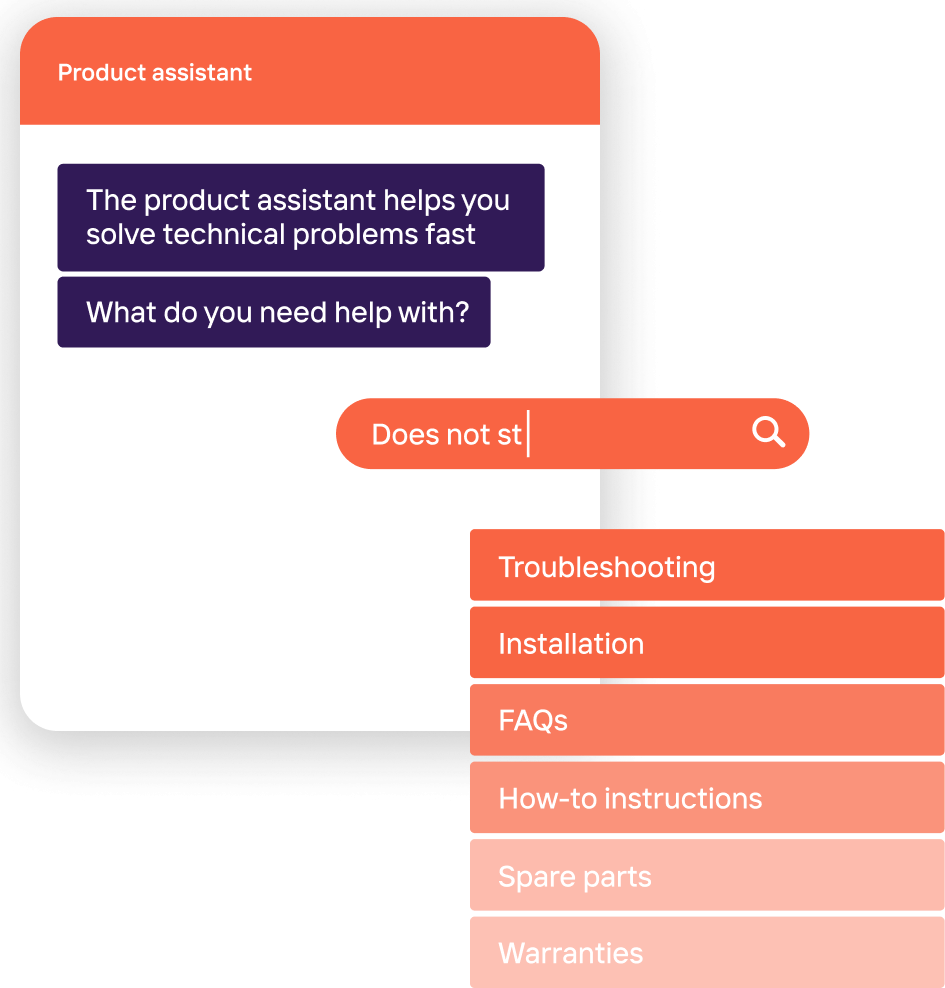
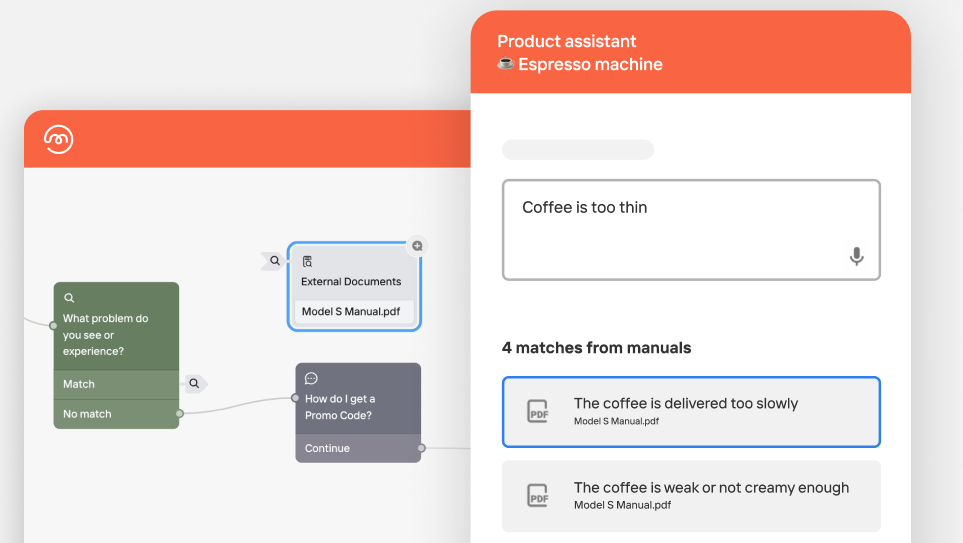
On the AI-guided self-service side, meanwhile, Mavenoid helps companies compile their technical documentation, FAQs, and how-to guides into a format that’s easy to access and query via a chatbot-style interface.

Mavenoid chatbot

To do this, Mavenoid combines Open AI’s GPT-3 language model and proprietary algorithms to create what it calls “high-quality support models.”

This essentially means that Mavenoid takes care of all the content-scraping (documentation, manuals, FAQs, etc), and optimizes the knowledge base structure specifically for automated hardware support. This is designed for more complex questions that traditional bot-builders would likely struggle with, and follows a non-linear model that considers the specificities of the problem while using natural language understanding (NLU) to identify the real intent behind a user’s support request.

In short, Mavenoid promises to truly understand a query, rather than simply finding and matching keywords. This increases the chances of finding a resolution to the problem, rather than simply deflecting queries and complaints away from customer support teams.

“Deflection often means that customers don’t get the help they need, and come back more angry than before — ultimately costing companies more in the long run, as they still have to respond to the query, but have hurt customer satisfaction and loyalty,” Lilia said.

It’s also worth noting that at the end of a human-led live support session, agents can suggest feedback that can be incorporated into Mavenoid’s machine learning models to improve the self-service product in the future.

“Over time, Mavenoid’s AI will learn from the implemented suggestions, as it does from all conversations, to improve the automation ability of the self-service assistant,” Lilja added.

In terms of deployment, companies can embed the Mavenoid engine into any website or application by copy and pasting a short piece of code. Then, they can publish links to their product assistants in emails, customer support tickets, social networks, and even QR codes — for example, a company might place a QR code sticker on a product, which directs a customer to a self-service setup guide.

Mavenoid can also integrate with customer relationship management (CRM) software, ticketing systems, ecommerce stores, knowledge bases, and more.

All change

Much has changed at Mavenoid since its $8 million series A round more than two years ago, with a new interface and myriad new features such as AI Retrieval, which enables companies to transform their product documentation into snippets of relevant answers that can be indexed and searched through the Mavenoid self-service product assistant — it’s a little like how Google surfaces answers to specific questions directly in search results.

Mavenoid: AI Retrieval

On top of that, Mavenoid has expanded into more than 50 languages and introduced a slew of third-party integrations including with Salesforce, Zendesk, Shopify, Zapier, and more.

Mavenoid had previously raised around $10 million, and with another $30 million in the bank, the company said that it plans to double down on its AI and product development, as well as scale its technology globally.

Mavenoid’s series B round was led by Smedvig Capital, with participation from Creandum, Mosaic, Point Nine Capital, NordicNinja and ABB Technology Ventures.


from TechCrunch https://ift.tt/wIVSuoJ
via IFTTT

Peter Thiel backs electronics marketplace PriceOye in maiden Pakistan investment

A Pakistani startup, which has taken inspiration from China’s JD.com and India’s Flipkart to build a managed marketplace of electronics products, said on Tuesday it has raised seed funding from scores of investors including PayPal founder Peter Thiel.

Launched in March 2020 — just two weeks before the COVID-19 pandemic ravaged the world — the Islamabad-based startup PriceOye offers a range of electronics products, including smartphones, TVs and home appliances.

Its seed funding round was led by JAM Fund, a venture capital firm by Tinder founder Justin Mateen. The institutional funding round also included participation of Beenext, DG Daiwa, Mantis VC, HOF Capital, Jet.com investor Palm Drive Capital and Atlas Ventures, among others. Angels including Thiel, Immad Akhud of Mercury Bank, and Asif Keshodia of Souq also participated in the round — alongside previous investors Fatima Gobi Ventures, SOSV, and Artistic Ventures. This is Thiel’s maiden investment in Pakistan.

PriceOye has served 45 million unique users in Pakistan in the last two years, covering 37.5% of the country’s total internet userbase, Adnan Shaffi, co-founder and CEO of the startup, told TechCrunch in an interview.

“We are the second most visited shopping website in the entire country, with over two and a half million monthly active users coming on the platform, doing research using our product recommendation engine, and then getting to know about different products,” he said.

After exiting two startups, Adan and his brother Adeel Shaffi got the idea of launching PriceOye when they were doing “a lot of island hopping” in Southeast Asia. The duo looked at several startups in Indonesia and India and found the Asian markets were seeing similar consumer internet trends play out — just at a different pace. They built a thesis that Pakistan will see similar adoption of consumer internet services in the next four to five years.

That’s the genesis of PriceOye.

The duo decided to go with the managed marketplace model, where only brands and their official representatives are allowed to sell products, to limit the instances of common frauds and errors that have proven to be painful to traditional online marketplaces, Adnan said.

“We realized that in a market, where trust is one of the biggest factors, and there’s a lot of trust deficit between the consumer and the brand, the only way a marketplace can work is the managed marketplace model, which originally started out of China from JD.com, then replicated by Flipkart, and a lot of other players in Southeast Asia,” Adnan said.

PriceOye sees 30% repeat users of its entire customer base who visit the platform regularly to purchase consumer electronics goods. The startup also claims to sell four smartphones to a single user per year on an average.

It is the largest online platform for selling mobile phones and accessories in Pakistan, claimed Adnan, adding that 35% of its overall orders come from tier-two and tier-three cities across the country.

“Within a short period of time, PriceOye has grown exponentially and has cemented its position as the leading national company in online consumer electronics. We are excited to join PriceOye in its mission towards changing the way people shop in Pakistan,” said Mantis VC founder and partner Alex Pall, in a prepared statement.

PriceOye is looking to deploy the fresh funding to expand its 97-member team by hiring new talent. It’s also planning to bring its platform closer to people in the country by starting offline experience centers — beginning with three centers in high-end shopping malls across Islamabad, Karachi and Lahore. More new products and categories are also in the pipeline for the eponymous platform.

Before the latest round, PriceOye had raised $450,000 in pre-seed funding from Fatima Gobi Ventures, Artistic Ventures and SOSV.

“It’s always a difficult choice for consumers to spend big amounts of money on high-value products while being unsure about their authenticity. I was inspired by the vision of PriceOye founders Adnan and Adeel of creating transparency and bringing convenience to customers when it comes to shopping for consumer electronics,” said Seamon Chan, managing partner of Palm Drive Capital, in a statement.


from TechCrunch https://ift.tt/xdJEPVe
via IFTTT

Does venture capital need a shot in the arm?

Hello and welcome back to Equity, a podcast about the business of startups, where we unpack the numbers and nuance behind the headlines.

This week Alex was back with Grace and our new producer Theresa Loconsolo to kick off the week. This Monday morning we recorded right before Garry Tan announced that he was heading back to Y Combinator as its President. Dang.

But we still had a good sheaf of things to talk about!

Equity is back Wednesday Thursday for a live show! Chat soon!

Equity drops every Monday at 7 a.m. PDT and Wednesday and Friday at 6 a.m. PDT, so subscribe to us on Apple Podcasts, Overcast, Spotify and all the casts.


from TechCrunch https://ift.tt/Fzx0hqW
via IFTTT

Learning from my failures: Lessons from a 2-time founder

I was ready to put my entrepreneurial hat to rest. I had spent years building what I thought was shaping up to be a fashion e-commerce giant for the Indian marketplace. We’d raised pre-Series A funding of $4 million, led additional rounds and saw four years of solid growth.

Yet, at the end of these four years, we swallowed the pill and shut down the startup for reasons I will soon explain.

Something unexpected and positive, however, was born from this experience. I launched another startup and bootstrapped it, because I had a strong crutch this time — the lessons from my first failed venture. Today, Squadhelp — my second business — is the world’s largest naming platform.

Here are the lessons I’ve learned that I believe can help any entrepreneur succeed:

Delay fundraising until you have a strong initial offering that has shown some level of success in creating happy customers with profitable marketing.

Early-stage funding can lend a false sense of security

With solid early-stage funding at Fashionara, my first venture, our leadership and marketing team became overconfident. Our mindset was that the funding was our golden ticket. With a strong team and money in the bank, we had what we needed. But the reality was just the opposite.

We stopped paying attention to cost per acquisition, and instead concentrated on increasing our month-over-month acquisition numbers. Once these numbers were strong, we focused less on essential startup success factors, especially creating differentiated experiences for new customers, which could have set us apart from our competition and increased customer loyalty.

On the other hand, bootstrapping my second startup has forced me to be laser-focused. For example, our development team handles critical tasks such as creating differentiation and ensuring customer satisfaction. And, we regularly review our marketing efforts to ensure that our spending goes into channels and strategies that bring customers in sustainably.

We also scale spending when we achieve strong return on ad spend (ROAS) and reduce or eliminate spending that is not driving customers at the right cost. We even have marketing strategies that we only use when the market is strong. Conversely, when our business slows seasonally or due to economic factors, we can cut back on marketing spending to keep our finances healthy.

I would advise any startup to delay fundraising until you have a strong initial offering that has shown some level of success in creating happy customers with profitable marketing, and you can strongly believe that more capital would allow you to scale in specific, pre-defined areas.

Let customer satisfaction define your product roadmap

I’ve learned that customer feedback should significantly influence your business plan. At my second startup, we have daily meetings to go over feedback from our customers. We then prioritize and implement changes to our product, customer service and even our marketing weekly based on this feedback.


from TechCrunch https://ift.tt/jYctdhl
via IFTTT

Instacart now lets you order same-day delivery for large items, including furniture and electronics

Instacart announced today that it’s launching “Big & Bulky,” a new fulfillment capacity that lets customers order same-day and scheduled delivery for large items. At launch, the new feature can be used to order items from Big Lots, Container Store, Mastermind Toys, Office Depot, Spirit Halloween and Staples. The new capability allows users to place orders for several different types of large items, including outdoor furniture, home office supplies and electronics.

The company also notes that the new fulfillment capacity gives delivery people on its platform an additional way to earn money. Shoppers who own a large vehicle may now be eligible to access what Instacart calls “Bulky Batches.” Instacart says batch payment will be based on the number and weight of the items in the order, and “will include heavy pay when applicable.”

Shoppers who have an eligible vehicle can opt in to receive Bulky Batches by tapping “Access More Batches” in the Shopper app. Instacart’s initial test zones showed that 97% of eligible shoppers opted in to deliver Bulky Batches.

Instacart is also introducing new delivery options in select regions for people who have an electric bike or moped. Shoppers who choose to deliver orders on an electric bike or moped will be given orders with shorter distances and fewer items. Although it would be difficult to use an electric bike or moped to deliver typical Instacart orders, which can include large items like cases of water and numerous bags, the new small orders option gives people who don’t have access to a car the ability to work with the company.

“We’re excited to introduce these new opportunities for shoppers to increase your earnings, whether you have a large vehicle or none at all,” the company said in a statement. “We look forward to bringing you new updates and product features that will improve your experience as a shopper in the coming months.”

Instacart will begin testing these new delivery options in select cities across the U.S. and Canada in the coming weeks.

Today’s announcement comes as Instacart has been building out its features over the past few months. Most recently, the company launched a new “OrderUp” feature that lets users add items from additional retailers to their original grocery order without having to pay an extra delivery fee. The company says the new feature gives users a way to complete their weekly shopping in one delivery trip.

The company also recently announced that Electronic Benefits Transfer and Supplemental Nutrition Assistance Program (EBT SNAP) can now be used to buy groceries online in 10 additional states through its app. With this expansion, grocers of all sizes can use Carrot Payments, an Instacart Platform solution, to accept EBT SNAP payments online across 49 states and Washington, D.C.


from TechCrunch https://ift.tt/Uvm2S5x
via IFTTT

Lily AI lands new capital to help retailers match customers with products

During the pandemic, retailers were forced to embrace e-commerce. But some found that they struggled to maintain customer loyalty as consumer expectations changed and purchasing patterns shifted. As a result of formidable competition like Amazon, they discovered, customers have low patience for sites that don’t present them with what they want. According to research from the Baymard Institute, for every 100 potential customers, 70 will leave without purchasing.

That’s why Purva Gupta launched Lily AI, an AI-powered platform that connects a retailer’s or brand’s shoppers with products they might be looking to buy. Co-founded by Sowmiya Narayanan, Lily provides algorithms designed to power web store components like search engines and product discovery carousels.

Lily today announced that it raised $25 million in a Series B funding round led by Canaan, bringing its total raised to $41 million.

“Different shoppers search uniquely, making it essential for retail ecommerce brands to build the right product taxonomy to capture both common and long-tail searches,” Gupta told TechCrunch via email. “Think of your own frustrating experiences on retail ecommerce sites and receiving irrelevant results or worse, no results at all, even when the product you’re looking for is clearly carried by that retailer.”

Prior to co-launching Lily, Gupta served in various roles at Eko India and UNICEF. Narayanan brought her experience developing software at Texas Instruments, Yahoo! (full disclosure: TechCrunch’s parent company) and Box, where she was a full-stack web dev for the product Box Notes

Lily began life as an app for retailers to help understand women shoppers’ personal preferences around fashion. But when traction proved hard to gain, Gupta and Narayanan pivoted to build a more enterprise-focused solution packaged as a plug-in, software-as-a-service subscription product. 

Lily now retains a team of “experts” in fashion, home and beauty who help to refine product taxonomies, which are then used to train algorithms for product search and recommendations. (The group also researches and develops ways to turn product attributes like “ribbed fabric” and “minimalist dressing style” into a mathematical “language” that the algorithms can understand.) Essentially, Lily captures details on products based on traits (e.g. “style,” “fit” and “occasion”) and uses customer data from brands tied to the item attribute data to create a prediction of each customer’s affinity to attributes of products in the catalog.

Lily.ai

Image Credits: Lily AI

Gupta acknowledges that there are other companies in the product attribution and automated product tagging spaces that rely on automation and AI. For example, Depict.ai provides a product recommendation tool that draws on data from across the internet. Black Crow AI is developing a platform to predict which products e-commerce customers will buy, while Constructor sells access to a framework that powers search and discovery for digital retail marketplaces.

Meta has also experimented with apparel attribute prediction for Facebook Marketplace, two years ago showcasing a system that could extract clothing attributes and fashion styles from photos of models on Instagram and Flickr.

But she argues that Lily is one of the more powerful options out there in terms of its configurability. Gupta also stressed that the platform is privacy-preserving to the extent it’s able to be, not using customer names, addresses or financial transaction information in favor of using anonymized user interactions on its customers’ ecommerce sites.

“The IT decision makers with whom we work are focused on the more concrete and tangible application of Lily versus being on the strategic frontlines. They are interested in the depth and accuracy of information Lily can provide; how we are training the models; and accuracy of output and confidence levels,” she said. “We win with the customization of our product to deliver on their needs and a dedicated customer success team available to take into account changes to goals or results over time.”

In any case, big-name customers have signed up for Lily’s services to date, including Macy’s, The Gap and its assorted brands, Bloomingdale’s and thredUP.

Lily is loathe to make its revenue figures public, and the 87-employee company says it doesn’t have a projection for the size of its headcount for the end of the year. Brushing aside questions about the secrecy, Gupta asserts that Lily is “well-positioned” to capitalize on new retail verticals in the coming months, even factoring in macroeconomic headwinds.

“Lily AI grew tremendously since the start of the pandemic, as the health crises rapidly intensified the retail shift to e-commerce and digital transformation,” Gupta said. “We’ll use the new funding to further expand into enterprise and mid-market retail e-commerce brands across home, beauty and fashion … We also plan to extend our solution much deeper to further applications within the retail stack, as well as further a suite of rich analytics for our customers.”


from TechCrunch https://ift.tt/j7PbSVg
via IFTTT

Yandex’s sale of media assets to VK includes yandex.ru homepage

Russian search giant Yandex has finalized the sale of its two flagship media properties to local rival VK, owner of the eponymous social network.

The deal to sell the products, Yandex’s algorithmically sorted news aggregator (News) and blogging recommender platform (Zen), was inked back in April. But today’s binding agreement goes further than that — also including the sale of the main page, Yandex.ru, which integrates content from News and Zen into the search page, turning it into a information-rich (critics say disinformation-rich) portal by featuring a number of infinite-scroll content feeds.

This means that, once the sale completes, visitors browsing to Yandex.ru will be redirected to a renamed version of the page, dzen.ru — which will be controlled and developed by VK, the incoming owner of Yandex’s two media products.

We also understand the VK version of the Yandex.ru portal will still feature Yandex’s search service — but just as a standard iframe integration (meaning it will not get access to search data). So for regular users of Yandex.ru the only immediately obvious sign of the change of ownership will be the redirected URL.

As we reported in June, Yandex has been signalling a looming shift of focus to an alternative local homepage, ya.ru — a bare-bones search portal it has owned for decades alongside the denser Yandex.ru page, where news content dominates the experience. The latter portal has, increasingly, become a major reputational headache for a business that prefers to claim it’s just a neutral tech firm so it’s easy to see the attraction for Yandex of switching to a plain, search-focused homepage.

“The Board and management of Yandex have concluded that the interests of the company’s shareholders, including its Class A shareholders, are best served by pursing the strategic exit from its media business (other than entertainment streaming) and shifting focus on other technologies and services, including search, advertising, online-to-offline transactional businesses and a number of b2b technology businesses, among others,” the company wrote in a press release today.

“The Board of Directors has approved the transaction. In line with this strategic focus, ya.ru will become Yandex’s main page and the key entry point into Search, Mail and other non-media services,” it added — saying the core service for the new main page, and for a new Android application it’s launching focused on its AI assistant tech, called Yandex with Alice, will be its search engine.

“Upon the completion of the transaction, Yandex’s current main application for Android will change its name to Yandex Start. It will then function as a browser and users will be able to choose the start page in their settings. The Yandex app for iOS will continue to work as before but without Zen and News.

“Following the completion of the transaction, the current main page with News and Zen will be renamed dzen.ru and will be further developed and controlled by VK (including control over the look and feel, content etc). The related News and Zen brands and technologies will also be transferred to VK.”

A source close to the matter told TechCrunch the sale of the content services has become “a strategic priority” for Yandex since the outbreak of war in Ukraine which has led to a sharp rise in censorship by the Russia state. “It has become very difficult to remain independent in the presence of services such as News and Zen,” they suggested.

Yandex has faced trenchant criticism over the role of its platforms in spreading and amplifying state propaganda from the likes of jailed Kremlin critic Alexey Navalny — who, in one public attack earlier this year, accused the company of “a solid shameless lie” in claiming to display ‘news’ on its homepage, given how its News feed amplifies state propaganda.

A number of senior Yandex execs have also been sanctioned by the EU — although the company itself has, so far, evaded formal sanction.

Whether selling off the two main online content conduits that the Kremlin has, through a regime of tightening media licensing and regulation, been able to appropriate to amplify its talking points will deliver the sought for reboot of Yandex’s reputation remains to be seen.

The price to Yandex for the media exit looks high as it’s essentially losing the ability to use its own trademarked brand name locally by handing control of the Russian portal (and all the traffic it generates) to VK, a Kremlin-linked rival — which only looks set to deepen the state’s take-over of the digital info-sphere in the country.

In return, Yandex is acquiring 100% of VK-owned food delivery service, Delivery Club “as sole consideration for these assets”, as its press release puts it — confirming there is no monetary payment attached to the transaction. (And on-demand delivery is hardly a poster-child for post-pandemic success, with meal delivery platforms hit by shrinking consumer demand as the global economic downturn and inflationary pressures bite.)

“Delivery Club, the leading food and grocery delivery service in Russia, will become a part of Yandex’s Ecommerce, Mobility and Delivery segment,” said Yandex. “Following the completion of the transaction, users will be able to continue to use both Yandex Eats and Delivery Club apps, while couriers, working with Delivery Club, will join the Yandex Pro technological platform. Yandex intends to maintain the Delivery Club brand.”

The sale of Yandex’s media properties still needs regulatory approval to complete — with the company noting it is subject to anti-monopoly approval in Russia but adding that it expects the transaction to close in “the coming months”.

“We couldn’t get rid of News and Zen any other way,” our source close to the matter told us, suggesting that a requirement for the Kremlin to approve major business changes has limited Yandex’s options.

Back in 2019, the Russian firm agreed to a corporate restructuring that increased Kremlin control over the business by granting a veto over key company decisions (including around IP) to a body with close government ties.

“This was actually the only way we can focus on tech. We have lots of people working at Yandex. We didn’t want the company to close,” the source added. “This decision was very hard for us to make but there wasn’t any other way to manage that.”

Early this year, in an interview with TechCrunch, Yandex’s former deputy CTO, Grigory Bakunov, told us the company’s leadership was naive to the risk of a Kremlin takeover of the algorithmically driven content-sorting technologies they were developing — and its execs passed up earlier chances to pro-actively shutter products that the state was able, through a combination of legislation, regulation/licensing and by installing state supporters on Yandex’s board, to ‘virtually takeover’ by 2017 (with the passing of a law requiring news aggregators to only use state-approved sites as news sources).

The strange prospect of a local Internet giant passing off its own brand-named search portal — and all the traffic it attracts — to a rival is just the latest ‘through-the-looking-glass’ moment for the Russian Internet since the Kremlin took the decision to invade its neighbor. In another example earlier this summer, Yandex opted to erase national borders from its Maps app in a bid to circumvent political pressure over where the software was drawing frontiers in Ukraine.

Tighter Kremlin regulation of search services inside Russia could yet bring more such painful passes to Yandex.


from TechCrunch https://ift.tt/1lwD4Mf
via IFTTT

Why the ‘last click’ in e-commerce matters — and how to get it right

What is the biggest and most obvious problem facing e-commerce retailers?

Checkout. By that, I mean customers who find their way to a retailer’s digital home, decide to buy an item, add the item to cart and press checkout — only to quit the last part of the transaction.

This seems like a small issue, but in fact, it is an enormous cost for retailers — to the tune of billions of dollars by some industry estimates. Yet, despite the size of the checkout problem, fixing the issue also ends up as the last item on many to-do lists.

That’s partly because checkout is at the bottom of the funnel. At the top of the funnel are the big-ticket, splashy items: Ad campaigns, paid traffic, product-market fit, media relations, and everything that feels weighty and important.

Companies spend time, money and energy getting people in the door, building meaningful products and services, and keeping those people in their e-commerce ecosystem. Generally, marketing teams control many of those aforementioned levers — they do paid social, SEO and SEM marketing, billboards and all the other campaigns that bring customers in.

Every dollar of marketing at the top of the funnel can be augmented by a focus on checkout.

At the bottom of the funnel are technical and product teams, and usually someone responsible for payment infrastructure. Those people tend to be graded on whether things work — not necessarily how well they work.

Thus, checkout becomes an orphan: Neither the explicit focus of the marketing team, nor a key area of interest for product and technical leads. And all the while, customers shop without buying — they exhibit high “purchase intent” but neglect to make actual purchases.

To put it more simply: You may have perfected the top of the funnel, but you very well could have missed the gaps in the bottom.

But in a world of scarce resources and scarcer time, how can you get senior leadership to rally around lost conversion and broken checkout as a key area of strategic focus?

The following five steps might help you fix the “last click”problem:

Reframe checkout as a marketing opportunity not a product problem

Think of checkout like this: The top of the funnel is low-performing marketing spend, and the bottom of the funnel is high-performing marketing spend.


from TechCrunch https://ift.tt/PSdDM8A
via IFTTT

eBay is acquiring trading card marketplace TCGplayer for up to $295M

eBay is acquiring TCGplayer, an online marketplace for collectible trading card games, in a deal valued up to $295 million, the company announced on Monday. The deal is subject to customary closing conditions and is expected to close in the first quarter of 2023. eBay says the acquisition furthers its commitment to trading card enthusiasts and also noted that trading cards are currently showing “substantial growth.”

Founded in 2008, TCGplayer has grown from Syracuse-based hobby stores into an e-commerce platform. TCGplayer, which currently employs more than 600 people, will continue to operate autonomously following the acquisition

“eBay continues to build on our 26 years of experience in trading cards, powering local hobby stores and Main Street retailers to deliver an online destination that collectors love,” said Dawn Block, the Vice President of Collectibles at eBay, in a press release. “eBay has always fueled our customers’ passion in this space and facilitated connections between buyers and sellers, and with TCGplayer, we can enhance the customer experience across categories, forge even more relationships, and cater to enthusiasts around the world.”

In a statement, TCGplayer founder and CEO Chedy Hampson said the acquisition will give the company a chance to benefit from eBay’s industry experience and resources while TCGplayer continues to operate independently. Hampson noted that he will remain in his position as CEO of TCGplayer. He also said the company will keep its headquarters in downtown Syracuse after the deal closes.

“With eBay’s support, we will advance our purpose, and expand our tools and services to improve the collecting experience online and in your favorite local hobby store,” Hampson said in the press release.

eBay has long been a place for trading card enthusiasts to buy and sell, and the company has recently been working to solidify its place in the market. In January, the company expanded its authentication service to include support for authenticating valuable trading cards worth at least $750. At the time, eBay said it saw the value in adding authentication support for trading cards due to the volume of activity in the category on its site. The company said the trading cards category is growing “significantly faster” than its total marketplace, and that the category saw $2 billion in transactions in the first half of 2021. That’s equal to all of the trading card transactions that took place in 2020, for comparison.

As eBay deals with increased competition from services like Facebook Marketplace and other local buying apps, the company has been working to better establish itself as a place where people can seek out collectibles. The company’s latest acquisition shows that eBay sees increased potential in trading cards, as the company notes that the agreement offers a way for it to “maintain its position as a desirable platform for trading card sellers.”

Today’s announcement comes two months after eBay said it was acquiring Manchester-based NFT marketplace KnownOrigin for an undisclosed sum. The platform enables artists and collectors to create, buy and resell NFTs. eBay said it’s acquiring the entire company, including IP and the team. Earlier this year, eBay launched its first collection of NFTs in partnership with web3 platform OneOf.


from TechCrunch https://ift.tt/HYeujpI
via IFTTT

4 ways founders can amplify revenue during hard times

Anyone who travels frequently will tell you that one of the greatest innovations of the past decade has been the TSA PreCheck.

It’s so simple and effective that it makes you wonder why no one thought of it before. This example can serve as adequate inspiration for businesses, especially as the markets show no signs of recovery: How can companies, hoping to retain revenue during the recession, do something similar?

Companies should be offering an express lane when times are tight so customers can get into the online store, check out and be done without any roadblocks or friction to mar their experience.

How do we create customer experiences that are equivalent to the TSA PreCheck to help us retain revenue?

The biggest stumbling block for repeat customers and retained revenue might come from an unlikely place — your security protocols.

Know thy customer: A password-less future

It is critical to understand if a visitor to your site is a new customer trying to create an account, a returning customer or a fraudster trying to steal your customer data. If you can determine whether someone is a legitimate customer up front, you won’t have to verify their email addresses or phone numbers during the account creation workflow — friction that security teams introduce to keep things secure.

I read a sobering statistic recently: While U.S. businesses will lose $95 billion to fraud this year, incorrectly identifying prospective and returning customers will cost those businesses almost $1.8 trillion.

About 58% of U.S. consumers abandon their cart due to difficulties managing their password, according to the FIDO Alliance. This shows us that you should grease the wheels of the sale in any way possible. In times of recession, you have to make things easier, not more difficult.

A business can very likely calculate the cost it incurs to get each new individual to create an account on their site or app. It should also know what the lifetime value (LTV) of a customer is and what impact its brand reputation has when things don’t go right. In other words, a company  should be aware of how many potential new customers complete the sign-up form but are then challenged to “verify their email” and never do so.

Parameter Calculated values
Number of monthly accounts created 50,000
Percentage of incomplete account creations 9.00
Number of accounts incomplete or churned 4,500
Customer LTV $50
Lost LTV due to churn $225,000
Percentage of LTV attributed to cost of acquisition 10
Monthly cost of acquisition lost $22,500
Percentage of LTV attributed to brand reputation damage 1
Total monthly brand reputation damage $2,250
Total loss per month $249,750
Annual loss due to account churn $2,997,000

Let’s say you see 50,000 accounts created per month, and 9% (the industry average) never complete the sign-up process due to the authentication step. If your LTV is $50 and your cost of acquisition is 10% of LTV ($5), and your brand reputation damage was 1% of LTV ($0.50), then your security measures are costing you nearly $2.5 million per year.


from TechCrunch https://ift.tt/8XpGB6I
via IFTTT

DoorDash is reportedly ending its delivery partnership with Walmart

DoorDash is ending its partnership with Walmart after more than four years of delivering the retail giant’s products to customers, according to a new report from Business Insider. Sources familiar with the matter told Insider that DoorDash decided to end its partnership with Walmart because it was no longer mutually beneficial and because the delivery company wanted to focus on “its long-term customer relationships.”

A spokesperson for Walmart told Insider that the two companies “have agreed to part ways.”

DoorDash is said to have sent Walmart a 30-day notice and a letter earlier this month to end their partnership. The termination will go into effect in September.

The termination will end a partnership that began in April 2018 as a pilot to deliver Walmart groceries to customers in the Atlanta metro area. Since then, the partnership expanded to states across the country.

Although Walmart has partnered with third-party delivery services like DoorDash, the retail giant has also been focused on building out its own delivery efforts. For instance, Insider reported on Thursday that Walmart is acquiring Delivery Drivers, which is the company behind Walmart’s Spark platform that sees gig workers deliver orders to customers. A Walmart spokesperson told Insider that the Spark platform has grown to become the company’s largest delivery service provider and that it accounts for 75% of Walmart deliveries.

DoorDash, on the other hand, has been building out its DoorDash Drive platform, its business-to-business service that provides drivers to merchants through their own website or app.

While DoorDash’s partnership with Walmart is coming to a close, the company has geared up to collaborate with another notable brand, Facebook parent Meta. DoorDash confirmed earlier this week that DoorDash Drive is now in the early stages of testing a service that will allow DoorDash drivers to pick up and drop off Facebook Marketplace items to customers. DoorDash and Meta are currently offering the test service in several cities in the United States.

It’s worth noting that DoorDash has also been testing a package return feature since March that allows customers to return items to the post office, UPS or FedEx.

DoorDash and Walmart did not respond to TechCrunch’s request for comment.


from TechCrunch https://ift.tt/vIZh3cS
via IFTTT

How Typewise got into YC after pivoting to b2b productivity

Swiss startup Typewise is showing the power of sticking at it: The team behind patented text prediction technology — whose fascination with typing productivity started off as a consumer keyboard-focused side hustle more than five years ago — has gained backing from Y Combinator and will be in the cohort pitching to investors during the accelerator’s Summer 2022 demo day early next month.

Typewise won a spot in YC (and its standard $500k backing) after pivoting to fully focus on the b2b market — aiming to serve demand for typing productivity gains in areas like customer service and sales, per co-founder David Eberle.

“Last year we realized where this makes most sense,” he tells TechCrunch. “Consumers type a few sentences here and there in WhatsApp and they don’t really care too much about being 20% or 30% faster or making one or two typos less. But businesses — especially where there’s a lot of writing happening, like in customer service and sales — that’s where even single digit percentages matter a lot and double digit even more.”

“Because it’s customer-facing communication then also quality matters a lot — because it can impact a brand’s reputation as well,” he adds.  “So that, in the end, got us into YC.”

Back in 2020, Typewise raised what it billed at the time as a seed — of $1M — but Eberle confirms it’s now classing that as more a pre-seed and will be looking to raise a fresh seed when it pitches investors in September.

Despite shifting full focus onto b2b, Typewise’s consumer app — which has gained some 2M+ downloads — was not wasted effort for the team. It helped them “fine-tune” their AI models, per Eberle — which in turn led it to be able to file a second patent, earlier this year, for technology that can predict entire sentences not just next words.

Sentence prediction is now a core selling point, underpinning efficiency gains which, in the case of one early Typewise customer — a parcel delivery/logistics company, which it’s been working with the longest — hit 35% (on average) a few weeks after the business started to use the technology.

Other early customers span a range of industries, including ecommerce, retail and insurance.

Typewise provides customers with its technology as a browser extension — which Eberle says works with a server-side API where the AI resides — but the whole package is designed to run on top of customer CRM systems, such as Salesforce or Zendesk, integrating Typewise’s text predictions into relevant client system, like email or live chat (i.e. places where business agents are talking, by text, to their own customers).

On average, the ten or so early users of its MVP — which launched this Spring — are seeing between 10% and 20% average gains from integrating the text prediction tech into their workflow, per Eberle. But he says he’s confident the higher figure (35%) will be the benchmark, not the outlier, as Typewise tweaks the parameters of its models or otherwise tunes it based on customer data and need (and as customer staff get accustomed to using the AI-powered text prediction tool).

Asked about the difference vs other text prediction technologies, Eberle points out that Typewise provides both a base language model (it covers 40 languages; though early customers are focused on English and German) — but also retrains and refines its model on real customer data. This means it’s able to offer customized predictions which he says are around 2.5x more accurate than a generic next word prediction AI, such as you might find baked into your mobile OS or email client, which is not trained on customer specific data.

“For example, we would look at all the customer service tickets from the past year or two and we would take those and there’s a complicated filtering process (because maybe you have to weed out bad quality language that you do not want to incorporate into your training sets),” he says. “And then after that the AI then refines itself on the customer data and… if you compare our prediction to like a Gmail prediction, where the sentences are very standard — we get actual content.”

Typewise may also segment its AI models depending on the linguistic context — since, for example, the language of a business’ email comms with its customers may be rather different vs live text chat (which is probably more fluid and informal etc). So it’s doing a lot of background structuring of customer data inputs and data-sets in order to be able to generate more contextually appropriate (and therefore productive) text predictions — which includes using machine learning technology to help it automate the necessary data structuring.

“It’s actual content because we narrow down the scope to a very specific use-case,” Eberle reiterates, suggesting this approach gives it a particular edge vs startups that are relying on a generative language model, like GPT-2 or GPT-3, to power text prediction for their own b2b play.

He also highlights that the product has been architected so the AI training process takes place within the customer’s systems — rather than requiring they upload reams of customer data. (NB: Analytics of the model’s performance may still entail data being sent back to Typewise but Eberle says it offers a few levels so this process may not have to involve actual customer content being uploaded if the client prefers not.)

“There are obviously now all the new companies working on language assistance, paraphrasing tools, trying to optimize the language, giving you suggestions [etc], and many of those use GPT-3 as their technology. They don’t have their own technology… and the downside is, for example, a [large telco] or insurance company is not just going to hand over all their customer communications for you to train the AI. So the way we do it is we can almost deploy an instance of the AI into the customer’s IT infrastructure and that way all the customer data stays with the enterprise but our AI becomes, kind of, part of their data structure,” he says, adding: “And that’s how we circumvent any IT security, data privacy issues that would probably otherwise make this pretty much impossible.”

Latency is one key challenge for Typewise, given its text predictions need to be able to update in real-time during live text chats in order to be useful (rather than frustrating) for the human agents the tech is imbuing with superhuman typing speed powers. Eberle says it has focused on optimizing latency and that also gives it an edge vs text generation tools that have not prioritized really shrinking the processing time.

“Right now our use case is that we’re interacting with a human being and that’s very different technologically from text generation,” he notes. “Because ours needs to have extremely low latency — we cannot wait 300 or 500 milliseconds, which also seems very low. But after each keystroke we immediately need to update the prediction. Otherwise it becomes un-usable for a human being. So the latency needs to be around 50 milliseconds or even lower.

“So in the background that’s one of the big constraints and one of the challenges in building this.”

From being able to predict whole sentences as a human is typing, could Typewise envisage further developing its technology to be able to entirely automate customer-facing comms for its customers — at least in specific segments, say like customer service emails for a parcel delivery firm or live chat for insurance sales?

Eberle responds to this question by saying one of the next features on its roadmap is “something towards auto-reply” — beyond the sorts of template-based, “pre-set” responses that can already trigger an automated email with a degree of contextual relevance but where “the answer you get is always based on a pre-written template”.

“What we hear from a lot of companies [is] that that’s what their clients don’t appreciate,” he says. “How we see the future is that with more maturity… for a certain type of ticket… eventually we will see that for certain inquiries we will see 99% or even higher accuracy reply to that and then you can just automate and say okay you don’t need a human being anymore once the threshold of certainty is above a certain number.

“But the difference is the way that we would generate those emails are not based on a pre-written text — we build it bottom up. We build it word by word. Like a human would construct it. That’s how the AI works — how we built it.”

“Right now with this one client that I mentioned we got to 35% automation — so 35%, on average, of the emails were automatically written by Typewise, and that percentage will go up hopefully. That’s what we’re working on,” he continues. “So right now it couldn’t yet complete an entire email with five different content messages on its own without a human input but obviously over time as those 35% go more up then that will be the case — and I think that’s also the goal in the end.”

On the competition front, tech giants like Microsoft and Google are of course doing technologically similar things around text prediction — but, typically, for their own products. Although that could change. “So that’s what we’re watching closely,” notes Eberle.

He also predicts (ha!) Grammerly might expand into offering text prediction. “They don’t have text prediction at this point in time but I’m quite sure as the most valuable language tool they will most likely move into that area as well,” he suggests. “And I see our differentiation, really, as customization and the ability to do this with all the data privacy concerns around it.”

Another rival product he name-checks is the well-resourced Wordtune (made by AI21 Labs), along with a Dutch startup, Deep Desk.

But he also points to “value add” features in Typewise’ pipeline as set to expand its differentiation — such as mapping customer satisfaction scores to language choices/styles to try to identify the best linguistic approaches that lead to happy customers.



from TechCrunch https://ift.tt/1t4UKEO
via IFTTT
TikTok launches new ad solutions with smarter targeting and amplified product discovery

TikTok announced today that it’s launching a new commerce ad suite called “Shopping Ads” to make it easier for brands to advertise on the platform. The company is currently testing three formats of Shopping Ads, including Video Shopping Ads, Catalog Listing Ads and LIVE Shopping Ads.

The new Video Shopping Ads allow advertisers to highlight one or more products in their in-feed video ads in a way that amplifies product discovery and purchase intent. TikTok says video Shopping Ads provide dynamic experiences based on the shopper’s intent to purchase, with smart targeting and optimized ad delivery. Video Shopping Ads essentially put brands’ shoppable videos in front of users who are more likely to buy them. The ads will also automatically create a landing page to better determine a user’s intent to purchase. Video Shopping Ads are currently available to select advertisers for beta testing.

The company says Video Shopping Ads combine the best of its current Dynamic Showcase Ads and Collection Ads solutions. Although Dynamic Showcase Ads and Collection Ads will still be available for the rest of 2022, TikTok plans to phase them out next year.

TikTok’s new Catalog Listing Ads allow advertisers to scale their product catalogs across the app and expand advertising reach beyond the For You Page. With Catalog Listing Ads, advertisers can promote their products across shoppable surfaces like “Recommended Products” or “Related Products” on TikTok, where users with relevant interests and higher purchase intent can discover and buy them. Catalog Listing Ads are currently being tested in the United States.

Lastly, LIVE Shopping Ads enable advertisers to direct users from the For You page to their LIVE Shopping event, so that they can join in and learn about their products. LIVE Shopping Ads boost traffic to a brand’s event and are designed to get their products in front of shoppers who are more likely to buy them. LIVE Shopping Ads are testing where TikTok Shop is available, which includes the UK, Indonesia, Malaysia, the Philippines, Singapore, Thailand and Vietnam.

“Shopping Ads is a simpler, smarter, and more advanced ad solution that helps brands meet shoppers wherever they are in the purchase journey, sparking demand and boosting sales,” the company said in a blog post.

As part of today’s announcement, TikTok revealed that 56% of users say ads on TikTok lead them to discover new products or brands, according to a global research study conducted with Material. The company also notes that 48% of users are interested in making a purchase on or from TikTok in the next three months. In addition, TikTok notes that 70% of users say it seems easy to purchase through the TikTok shopping-related ad they saw.

The launch of the new ad solutions come as TikTok has been expanding its ad products over the past several months. In May, the company launched an ad product called “Branded Mission” that allows creators to connect with brands and possibly receive rewards for videos. The product allows advertisers to crowdsource content from creators and turn top-performing videos into ads.

Also in May, TikTok launched a contextual ad solution called TikTok Pulse to lure advertisers to its platform by giving them the ability to showcase their brands’ content next to the best videos on TikTok. The ad solution ensures brands’ ads are placed next to the top 4% of all videos on TikTok.

Given TikTok’s interest in asserting itself as an e-commerce platform, it’s no surprise that it’s looking to woo advertisers and build out its advertising suite. However, it’s worth noting that not all of TikTok’s e-commerce plans are going according to plan, as the company has reportedly dropped plans to expand its live e-commerce TikTok Shop initiative to the United States and additional parts of Europe after seeing subpar performance in the UK.


from TechCrunch https://ift.tt/XSjEhuo
via IFTTT

Funding Circle cofounder unveils new Super Payments fintech venture with $27M investment

Funding Circle cofounder Samir Desai has unveiled a new U.K. fintech startup called Super Payments, a venture he founded back in February but which very little was known about up until now.

Reports emerged a few months back that Desai had raised around $30 million for this new company, and today this has been confirmed. Super has raised £22.5 million (roughly $27 million as of today) in a round of funding led by Accel, with participation from Union Square Ventures, LocalGlobe, and a slew of angel investors.

While Super isn’t opening for business until later this year, the company has now instigated a waitlist for consumers and businesses keen to be first-in-line for when things officially get off the ground — this will include an early-access program.

So what, exactly, does Super do? Well, on the consumer side, shoppers are promised cashback on purchases they make through the app, from clothes and electronics, to flights.

Super Payments in action

On the brand side, meanwhile, Super partners with businesses with the promise of increasing their sales, and these brands pay Super a commission, part of which is shared back to the customer.

So in effect, Super promises to help its customers (businesses) cut out the financial “middlemen” payments processors, who often charge up to 5% on top of every transaction.

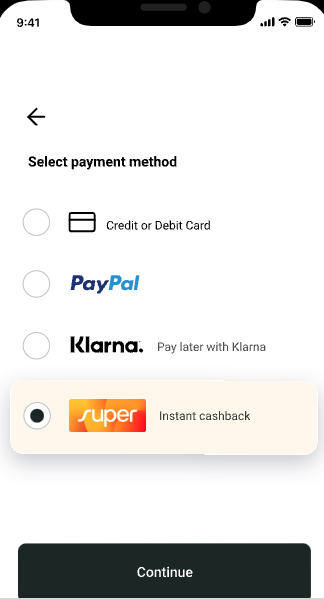
It’s worth noting that Super offers its own payments solution as an option which apparently has no fees, and if a brand decides to support this, Super gives cashback to the customer instantly. If the brand doesn’t offer Super as a payment option, or if the customer chooses not to pay with Super, then the customer may have to wait up to two weeks.

Presumably, the cashback and commission fees vary depending on what payment method the customer uses.

Super Payments: Payment options

On top of that, Super also promises to help brands avoid costly customer acquisition and advertising fees — they don’t pay for featuring their products in the app, they simply pay a commission for any sales that Super generates.

Desai cofounded small-business lending platform Funding Circle back in 2009, and remained CEO until he stepped down last September with the company’s shares sitting at more than half their IPO value. While he is still a non-executive director at Funding Circle, Desai said that he now wants to focus on helping businesses and shoppers avoid exorbitant ecommerce charges — this is particularly pertinent at a time when the U.K. teeters on the brink of a recession.

“Businesses and shoppers have for too long been stung by huge fees on the internet, in many cases without even knowing,” Desai said in a statement. “We believe that the simple Super app can save shoppers and businesses billions a year. At a time of high inflation and increases in the cost of living, redistributing the huge profits of payment and digital advertising companies back to customers, will significantly improve people’s lives.”


from TechCrunch https://ift.tt/YFTU3EV
via IFTTT

Walmart’s last-mile delivery service, Walmart GoLocal, tops 1M deliveries in year one

Walmart’s last-mile delivery service business, Walmart GoLocal, has topped 1 million deliveries in its first year, the retailer today revealed. The company offered a brief update on the state of its newer delivery business during its Q2 earnings call on Tuesday, where it noted that GoLocal had been growing its support of local merchants’ delivery operations and was also now on track to reach 5,000 pickup locations by the end of the year.

Announced in August 2021, GoLocal is Walmart’s attempt to leverage its own delivery platform to service the needs of other merchants, both large and small. Merchants can use the service for a variety of deliveries, including scheduled and unscheduled deliveries, and even same-day. The service itself is powered by those Walmart had developed for its own delivery needs, including its in-house Express Delivery service, which promises delivery in two hours or less. GoLocal deliveries, however, aren’t handled by Walmart’s own staff, but rather gig workers sourced through Walmart’s Spark Driver program — the same program that supports Walmart’s same-day delivery operations.

Over time, the retail giant aims to grow GoLocal into a larger business as more merchants shift to e-commerce. It’s also one of multiple initiatives underway designed to help Walmart generate additional revenue by meeting the needs of other retailers. Last year, for instance, Walmart announced it would sell its own e-commerce technologies to other retailers.

“We continue to sign up larger-scale customers, and we’re making strides on the bigger unlock, which are small and medium-sized businesses,” Walmart CEO Doug McMillon told investors, speaking about GoLocal’s growth. “Our technology and expertise will help so many of these businesses grow while contributing to our operating margins over time,” he said.

Little more was shared about the operation, like its contributions to Walmart’s bottom line, for example. But the exec did say the service was receiving “strong” client satisfaction scores and was continuing to sign up larger-scale businesses.

“We’re making strides on the bigger unlock, which are small and medium-sized businesses,” McMillon added. “Our technology and expertise will help so many of these businesses grow while contributing to our operating margins over time.”

The update follows recent news that Walmart entered into a deal with EV startup Canoo to buy 4,500 all-electric delivery vehicles to help it deliver online orders initially in the Dallas-Fort Worth area as well as help serve the retailer’s GoLocal delivery service business, it said at the time. In addition to helping Walmart achieve its own business goals, the deal also helped the retailer from a competitive standpoint as it could stop Canoo from selling its electric vans to Walmart rival Amazon. 

Walmart beat analysts’ expectations in its fiscal second quarter, driving shares up by over 5%. Driven by demand for groceries and other daily essentials as well as higher prices due to inflation and support from higher-income shoppers, Walmart pulled in $152.86 billion in revenue versus the $150.81 billion Wall Street had forecast.

Earnings per share were $1.77 versus $1.62 expected. Net income also grew to $5.15 billion, up from $4.28 billion in the year-ago quarter.


from TechCrunch https://ift.tt/TaEAIjn
via IFTTT

New Government – Labour Small Business Agenda

We’ve are all waking up to a new Government today, with the Labour party about to take control of the country and what should be top of your...