Showing posts with label Divante. Show all posts

Composable Commerce is what comes next after headless

One of our four key values at Divante is Next: “We don’t believe in novelty, we seek and utilize technologies that will shape the future”. In our domain, Composable Commerce is almost certainly what comes next

The dramatic market shifts we saw this year have made us all realize that the flexibility and speed of implementing enterprise software are more crucial than ever. The so-called headless approach is helping companies to innovate faster by separating backend from the frontend. It’s a genuine game-changer in software development and it leads the way to Composable Commerce. 

In the last couple of years, we have seen the growing popularity of Microservices, API-first, Cloud, and Headless. This year, commercetools started to promote the MACH Alliance (of which Vue Storefront is a member); its aim is to educate corporate clients about the benefits of using software which is Microservices-based, API-first, Cloud-native SaaS, and Headless.

We can use these MACH technologies to build with a more business-minded approach. MACH is something like a set of digital Lego blocks, where every block could be a separate business feature.

It also lets us look even further, beyond headless builds, to see what comes next. Composable Commerce connects all the dots and allows us to imagine a whole new way of building eCommerce Systems.


Read more articles about other technologies that are coming Next:

- No-code eCommerce platforms

- Building JAMStack and cloud-native commerce

What is Composable Commerce?

Composable Commerce is a commerce system built from Packaged Business Capabilities (PBCs). Each PBC is a software component that represents a well-defined business capability.

This way, Composable Commerce offers every business a selection of best-of-breed commerce components that are all connected—or composed—into a custom application built for specific business needs.

Packaged Business Capabilities allow organizations to create composable commerce.

Each Packaged Business Capabilities (PBCs) is a feature or capability of the application and is typically a third-party software component. A good example of PBC is a checkout or a search engine. The composable approach utilizes a whole palette of various vendors who offer dedicated solutions for specific business needs.

By 2023, organizations that have adopted a composable approach will outpace the competition by 80% in the speed of new feature implementation.

Gartner

Packaged Business Capabilities

Each PBC can be deployed independently which means you completely eliminate the risk of choosing the wrong component. Every component of your eCommerce System could be easily removed or changed with another one. This allows you to experiment with more vendors.

What are the differences between Microservices and PBCs?

Microservices are a relatively low-level and technical approach to building applications from independent components. PBCs are usually a whole set of microservices connected together to deliver a business value.

The ecosystem of Composable Commerce vendors

One of the biggest benefits of using Composable Commerce is the freedom of choosing the best vendor for every business aspect of your operations. This is why it’s important to be aware of what components are on the market already.

Composable Commerce is here already

We see a growing number of vendors of PBCs on the market. It’s already possible to buy or rent capabilities from dedicated vendors to address functions like: 

  • Product catalog
  • Shopping cart
  • Checkout
  • Promotions
  • Loyalty
  • Reviews and ratings
  • Search
  • Product recommendation
  • Content management
  • ID management
  • Analytics
  • Frontend

The list is getting bigger and bigger as the whole Composable Commerce concept is fueling a lot of new startups. In the future, integration among PBCs should be even easier, using a no-code or low-code approach. 

How to start with Composable Commerce?

With its recent publication on Composable Commerce, Gartner is giving clear recommendations for companies to move from monolithic architecture to a more flexible one.

Gartner Recommendations:

  1. Create a roadmap to strangle your digital commerce monolith by adopting an incremental, modular approach using packaged business capabilities.
  2. Secure the future of your digital commerce strategy by developing a composable commerce platform.
  3. Maintain business agility and control by selecting delivery options that retain business user control of presentation.

It’s a good idea to focus on capabilities impacting customer experiences such as search, personalization, new touchpoints, and mobile UX. This is where you can find quick wins and gather momentum.


At Divante, we are always looking for what comes next. Talk to us about Composable Commerce or about headless builds.

Headless eCommerce - Download FREE Book

The post Composable Commerce is what comes next after headless appeared first on Divante.


from Divante https://ift.tt/2GS4w31
via IFTTT

What is Click & Collect and how it can improve your business during coronavirus?

We’re all experiencing a lot of things for the first time in 2020. New health regulations, wearing masks, social distancing, lack of human contact, empty sports stadia… to name just a few. We’re also having to learn a lot of new vocabulary to fit this rapidly changing new reality. This is also true in eCommerce. “What is click & collect?” was a question that many of us asked the first time we heard the term and yet, as we go deep into the pandemic, it has become an essential element of shopping for many people. We’re going to take a look at what click & collect means and how it can vastly improve your business right now.

What is click & collect?

As consumer behavior has changed in the midst of the coronavirus pandemic, we have started to limit visits to the malls for safety reasons. High streets were closed in many countries but, even now that they are open, we spent less time in-store and more time online. Businesses have been quick to adapt to new regulations. 

One such response is the rise in click & collect, whereby customers order goods online and then only enter the store to pick up the pre-bagged and pre-paid goods. It limits in-store shoppers and eases the burden on stores as they try to help people keep social distance and keep stores hygienically clean. The introduction of local delivery, contactless delivery, and click & collect services have helped stores maintain sales and strengthen customer loyalty. For some companies, it has even been an opportunity to reach completely new clients and increase sales.

83% of new Click & Collect consumers stated they were using the service as a way to avoid crowds and maintain social distancing practices

The rise of click & collect services

Click & collect services were available before but the coronavirus pandemic has accelerated the usage of this sales channel. Some companies have taken it a step further with “drive & collect” services where staff members pack purchases directly into the trunk of the car.

Click & collect sales surged 63% once shelter-at-home protocols were announced

Existing users are one thing but this type of service has started reaching new audiences. The number of households using click & collect grew by 33%. And, just as crucially, 66% of new users say that they are likely to use click & collect in the future. 

This new customer base also includes seniors who strongly favor shopping in physical stores but are at greater risk of serious infection. The forced change in the approach to shopping manifested itself in a 25% increase of click & collect usage among this group.

Benefits of click & collect for customers and retailers

Aside from the previously-mentioned benefits of keeping people safe in trying times, there are notable benefits for both customers and retailers. 

For customers

Customers can place an order in a convenient way, on a computer or smartphone, whenever and wherever they want. They have more time to familiarize themselves with the products and make sure they have not forgotten anything. A visit to the store allows them to add something extra to these digital purchases, or they can avoid queues and receive the order with touchless transactions.

87% of existing customers are likely to use click & collect in the future.

For retailers

Retailers can integrate existing loyalty programs to online user accounts. Having all orders in one place allows retailers to connect the dots about user behavior and preferences. This opens up personalization and marketing possibilities that improve customer experiences and strengthen the relationship with the brand.

For employees

A minimum number of customers in-store allows essential workers in the retail industry to have less exposure to potential infection and allows them to handle orders faster, spend more time taking care of sanitary measures in the store, and work more efficiently. They can even work while stores are closed by offering curbside pick-up.

How we can help you?

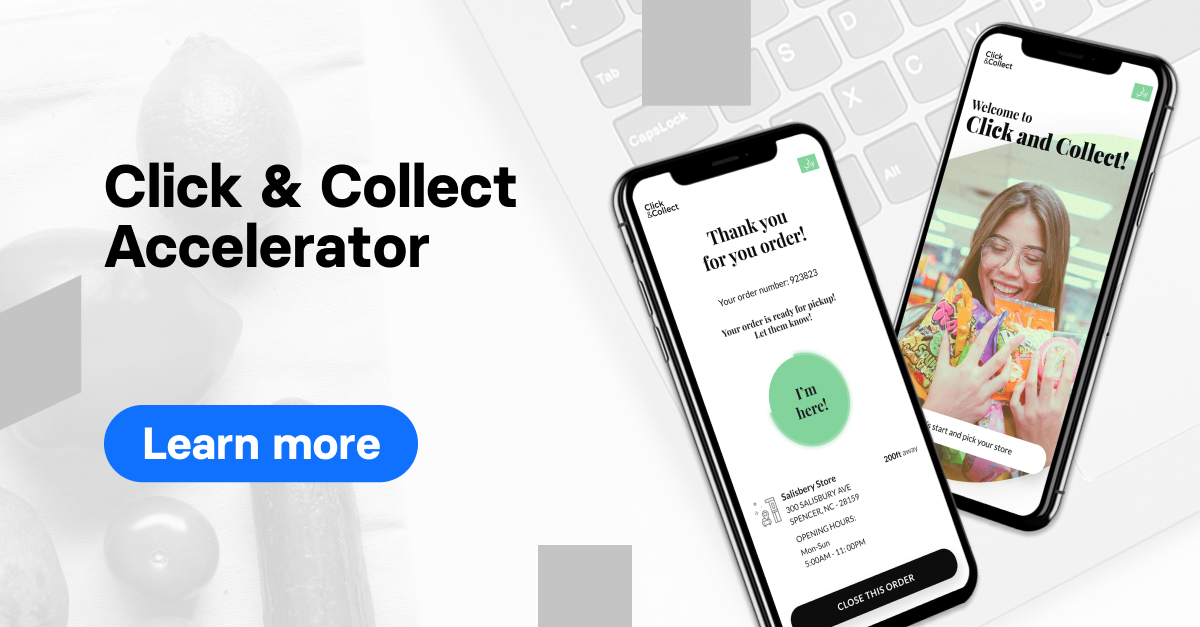
We can help you reduce the time-to-market of your click & collect implementation. We, as a vendor but also a producer of a variety of eCommerce-related solutions, decided to create a best-of-breed ecosystem focused on mobile operations.

Divante presents Click & Collect Accelerator

We decided to use Vue Storefront as a frontend and commercetools on the backend. Both are based on a headless approach and, with multiple built-on integrations (CMS, payments, and other third-party services), it’s a perfect basis on which to kickstart such a project. 

Flexible API enables us to connect new services with the currently-used eCommerce platform or we can build on top of that. There’s no need to change the whole architecture just to implement click & collect services.

42% of consumers are more likely to use click and collect services from grocery and pharmacy stores.

In this concept, we focused on medium-size retailers with a brick-and-mortar chain of stores. If you want to implement this in your eCommerce, you need to take care of the pick-up places: remember, the more locations you offer to your customer, the better. 

It’s worth noting that 23% of online shoppers prefer some form of click & collect over home delivery. Don’t lose out to competitors who are faster to offer the customer what they want and need.

Find out more about Click & Collect Accelerator. If you want to discuss a perfect solution for your business, leave us a message!

The post What is Click & Collect and how it can improve your business during coronavirus? appeared first on Divante.


from Divante https://ift.tt/2Iq2Jm5
via IFTTT

What qualities should a Business Development Manager have?

Focusing on customer success and engagement, a gift for sharing visions of success, working autonomously and with flexibility. These are just a few of the many qualities a Business Development Manager should have. If the description fits you, check what Divante has on offer. 

Divante is looking for a Business Development Manager

Business Development Manager in Divante will focus on searching for and acquiring new clients, and closing deals. He or she will analyze clients’ needs and prepare sales offers, as well as cooperating with delivery in the sales process by participating in workshops, preparing project estimations, negotiating contracts, and transferring the project. The Business Development Manager can count on the Outreach, Marketing, and HR departments to give support when needed. 

We are looking for a go-getter who is strongly focused on reaching goals. Somebody with an open mind who likes to learn and is not afraid to ask. 

What qualities should a Business Development Manager at Divante have?

Curiosity about technology 

A business development manager must, first of all, be a person who is interested in technology. This doesn’t mean a blind fascination with futuristic tech visions. It is about using technology on a daily basis as a tool for activities from shopping to banking and beyond. He or she cannot stand aside and look at technology. A Business Development Manager must be constantly looking and learning, closely observing the landscape of constant change. 

Focusing on customer success and engagement

A good business development manager at Divante must understand the client’s needs, offer sound advice, and focus on customer success and engagement. It’s all about business empathy determining what challenges are on the client’s side. 

Because we are a multi-tech partner, we set up the sales set from A to Z and not from A to P. This requires an understanding of the entire sales cycle and the needs and ambitions of the product on the market. eCommerce is not complicated but you have to understand that many aspects determine the solution. Such a person is supposed to do soft consulting, talking to the customer and bringing out their real needs

Piotr Maksim, Chief Growth Officer at Divante

An effective Business Development Manager can identify a situation when the client is treating Divante as a serious advisory partner and trusts the BDM enough to discuss real internal challenges. 

The business development manager should not be seen as a predator ready to pounce on the client’s budget. They should allow the client to make the best use of that budget. This is a difficult skill. The best salespeople make sure that there is a connection between the customer and the company. They build an offer that makes sense and make sure the client feels that his project is being realized by a whole team of people

Piotr Maksim.

Good communication skills in an international environment

Divante operates on the global market and is growing very fast. A Business Development Manager needs to feel comfortable in an international environment and understand how global partners and clients think. It’s a position for an extrovert who loves spending time with people, even if we meet mostly virtually these days. 

A high level of proficiency in the English language is a must as we work with international partners and clients.

Autonomy

Autonomy, for us, means drive and self-organization. Working as a Business Development Manager, you have to act alone much of the time but also know when to reach out for support instead of waiting for help. This is a very autonomous function. 

In Divante, you need to be independent, but also you can not be a lone wolf. There are too many things you cannot cover on your own. It is best to be independent with your tasks and self-motivated but to be a team player when it comes to project realization.
– Zelimir Gusak, eCommerce Consultant. 

Assertiveness 

A Business Development Manager has to have a sense of urgency and be assertive. Time passes quickly and it is essential to respond to the customer or deliver promised items from the offer on time. 

As a Business Development Manager, your task is to lead internal communication and coordinate the necessary stakeholders in the offer creation and negotiation process.

Sabrina Janssen, Head of Sales DACH at Divante

Such a person should keep an eye on the time and work to a plan. They also need to know when to let things go if the client is unresponsive or the proposed cooperation will not be profitable. People do not often have that sense of timing. They think it will happen tomorrow or the day after tomorrow. BDMs need to have the ability to make strong decisions and move forward without delay. 

The skill of painting visions

Divante does not sell finished products from the catalog.

We are painting visions of doing a project. This isn’t easy because we tell the customer something that will only work when the store is opened. A Business Development Manager has to be perfectly capable of doing this and selling promises skillfully. Arouse desire, explain well, and visualize.
– Piotr Maksim. 

Hunger for knowledge

When you come to Divante, you might be overwhelmed by the volume of information. 

There are so many sources to learn from. It’s great and you have so many opportunities to grow, but you have to be smart. You have to prioritize what matters right now. 

Zelimir Gusak

Flexibility

In IT projects, there is a rigorous calendar and a short time to market, but also there are many variables. You have to be resistant to changes when working in such an environment and taking on a lot of responsibility. 

It does not work here if you are a total control freak, a person who likes to have everything planned and arranged but gets lost if something happens out of control. You have to plan, both long- and short-term, but be aware of the changeability of the environment in which you work. When you see a specific business goal, you can spread out actions and identify things that have to happen during this time, but this road can be a winding road. It’s best if you can plan ahead but be willing to pivot at speed if needed.

Piotr Maksim

Why is it worth working as the Business Development Manager in Divante?

There are many reasons why it is worth joining Divante as a Business Development Manager. Let’s mention a few. 

Divante works for top tier, global players that create technology for the eCommerce industry. We have direct contact with the clients. Our culture is one of trying; nobody criticizes others for having ideas or looking for better solutions, and bottom-up activities are never stifled. It is a workplace in which people can develop quickly in many ways. Divante is a great place to grow and develop your career. Want to know more? Check the stories of Tomasz Anioł, Filip Rakowski, Artur Wala, and Stanley Świątkiewicz

Sounds like a dream job for you?

Don’t hesitate. Drop us a message. We are waiting for you. Help us to change the world for the better with powerful eCommerce solutions. 

The post What qualities should a Business Development Manager have? appeared first on Divante.


from Divante https://ift.tt/3k6DouN
via IFTTT

The power of a PIM system for B2B businesses

This blog is going to explain why you need a PIM system for B2B and how so many manufacturing and distribution companies are missing out on this simple technology. We often make vague statements like “many B2B businesses are lagging behind retail and B2C technologically” but where is the proof? 

Instead of dry stats, here’s a true story.

B2B companies can be decades behind the curve

My home town is what’s called a “new town” or an “overspill development” in the UK. Due to the devastation of the inner cities from World War II, the government identified satellite towns where industrial centers and huge housing estates could be quickly built. 

A factory of one of the world’s biggest car manufacturers relocated from London some time after the war and the population of our town immediately quadrupled as the entire workforce was relocated from the big city. 

My mum and dad met there. She worked in the factory; he was in the offices. She was a local; he was a Londoner. She was building car parts; he was building computer systems. In 1987, as part of a big modernization project, my father and his team implemented 6 new systems: a parts catalog, a POS system, a production line computer, an internal comms system, and an issue tracker for distributors to log cases and requests. I remember him taking me to the office and showing them to me when I was about eight years old. Black screens full of text and numbers. It was all very exciting. This was a massive step up from the Acorn Electron we had at home!

For my brother, who now works in that same office, these computer systems are not so exciting. In fact, they are the bane of his existence. Yes, that’s right, of the six systems that my dad and his team built over 30 years ago, my brother and his colleagues are still using four of them on a daily basis. They still don’t have a single, fully-integrated system. Communication with distributors is by email or telephone (however, right now, as they are all working from home and don’t have company phones, it is email-only).

Remember, this is one of the biggest automotive companies in the world. So, when we make statements like “B2B businesses are lagging behind”, this is what we mean. 

How a PIM system for B2B companies changes the bad old ways

One of the biggest problems for B2B companies is that they have often built non-connected computer systems for different parts of the manufacturing, distribution, returns, and customer service. This is because these feel like independent activities, but it fails to take into account that there is one thing that ties all of these together and is at the heart of every activity: the product. 

In the modern world, your systems need to speak to one another, and the best way to do that is with a central PIM (Product Information Management System). Of course, you can use a CMS system to do this same work. You can even use Excel spreadsheets and constantly update stock levels there. However, they are not all integrated and the business is essentially “coping with” not “managing” its own inventory. You are essentially duplicating all your work but still having to guess if the results you are seeing match actual stock levels in real-time. With a PIM, you control all the contention all distribution channels, meaning that all product information is updated in real-time from a single point of data entry.

A PIM is an interactive database in which you can store millions of different products, along with their pictures, descriptions, and other information. PIM is predominantly seen as a database for the marketing division, but it is also very appealing for eCommerce in terms of ERP integrations and the like. It actually becomes the hub that interacts with your other systems and allows you to:

  • Improve stock-taking and inventory systems
  • Create multiple sales channels with custom interfaces
  • Manage stocks and promotions
  • Oversee both supply and distribution
  • Import and export data easily to get a clear picture of the business

B2B PIM integration with Meetsales

What’s more, when you have a PIM system in your business, you can integrate it with Meetsales and allow your salespeople to immediately show your entire product catalog on video calls, using any device they like, and place orders directly in the system. The dual benefit here is that you can more easily place orders and confirm orders with the client, but also that those orders are immediately visible and accounted for in any other system that is integrated with your PIM.

CTA Meetsales website

The arguments against a PIM system for B2B

Prohibitive cost is usually the strongest argument that most companies have against any new technology. In the case of a global manufacturer using 4 or 5 different systems which are 30 years old, the argument becomes a vicious cycle. Everything needs replacing but replacing everything costs a lot of money. 

In reality, creating a PIM system is a cost-effective solution for businesses in the long-term because it is one platform that actually replaces at least a couple of those old DOS systems. You are not replacing old tech with like-for-like systems.

For the companies in SME sector, there is also the opportunity to build a PIM system for B2B built for free. Pimcore has a powerful version that is free for business, and our technology partner Akeneo offers the Akeneo Community Edition, which is an open-source edition of its leading PIM solution. 

Meetsales PIM Consultancy 

We have spoken to numerous companies that are desperate to get video sales off the ground to help their sales teams perform better while working remotely. But some businesses are running into the problem that they don’t have a PIM system for B2B with which to integrate the Meetsales app.

This shouldn’t be seen as a blocker. In fact, it’s an ideal opportunity to add two huge new valuable pieces of technology to your business at minimal cost. Meetsales is a SaaS application that works on a pay-as-you-go basis, with prices tailored to the number of sales reps in your organization. And if you don’t have a PIM solution set up and ready, our consultants will:

  • Show you how Akeneo Community Edition works
  • Help identify a usable structure for your database
  • Show how to make a CSV / Excel file for integration
  • Explain how to upload it to Akeneo and create a PIM
  • Demonstrate how to further empower your new PIM with Meetsales
  • Recommend a tech partner which can work on an enterprise-level integration, if needed

Don’t get caught in the vicious cycle of thinking that your systems are too old to replace. We can help you understand the value of PIM and then how to activate your sales team with Meetsales.


Meetsales is a conversational commerce tool that allows you to kick off the digital transformation of your business at low cost, and to present products and confirm sales directly in a video call. It integrates with major PIM systems to empower your product catalog. We are currently running a beta testers program, giving favorable rates to businesses that want to step ahead of the competition. Contact us now to ask about becoming part of the Meetsales beta program.

The post The power of a PIM system for B2B businesses appeared first on Divante.


from Divante https://ift.tt/3mWjeW9
via IFTTT

Headless loyalty software is a huge step ahead for the industry

An interview about headless loyalty software with Cezary Olejarczyk of Open Loyalty.

This might be the first time you’ve really heard about headless loyalty software. It’s a fundamental change to the industry narrative but Open Loyalty is now the first loyalty solution to market itself as being fully headless—and that is a significant development in an industry that has traditionally lagged behind areas like eCommerce and CMS with the adoption of new technologies. We spoke to Cezary Olejarczyk, CEO of Open Loyalty, about what headless loyalty software is and why it is an essential step to take right now.  

Why make the switch to calling Open Loyalty headless loyalty software?

We’ve always been headless to some extent, from the very beginnings of Open Loyalty. The solution was built around an API from the very beginning, with separated front and back ends. Like some other loyalty software solutions, we took an API-first approach but it was still one step away from being truly headless. We’ve now adjusted the API to make it more flexible and open to more frontends, so that is why we decided now is the time to really commit to that narrative.

Why is now the right time for that change?

We previously spoke about being open-source and then open-code. Both of these are quite accurate and had positive attributes for customers. They told people that it’s a flexible and open solution. But they have some drawbacks; some enterprises still struggle to understand the incredible value of open-source.

Now is the right time to start talking about headless loyalty software because it has “crossed the chasm” and everyone now knows what it means. Companies like Spotify, Coca-Cola, and Amazon are using microservices architecture, so we’re speaking the language of business right now.

Is the approach to headless loyalty software different to that of monolithic loyalty program systems?

There needs to be a change. The world has changed and software development needs to reflect that.

Up to now, companies were focused on features when building an MVP of a loyalty program. They were building a system that could do half a dozen things well when it was launched but were not considering how they might need to quickly adapt and expand that system in future.

Nowadays, businesses need to move away from feature-driven development and move on to architecture-driven builds. That means focusing on building the right architecture that can adapt fast and easily to new technologies, and even external disruptive events like the pandemic. A monolith does not offer that dynamic ability to change because the whole system is interdependent. With headless builds, you can switch how you use your API, changing a sequence or using API in the other parts of the frontend. Changes can be made by switching API endpoints, not rewriting whole swathes of backend code.

Is monolithic loyalty software capable of keeping pace with the changes?

If you have enough money and resources, anything is possible. However, time is critical because client needs are changing fast and competitors are innovating at speed. With like-for-like project resources, headless loyalty software will always be exponentially faster than a comparable monolith.

It’s not only slower to build a monolith; they also struggle to keep up with the pace of technological change. They were fine a few years ago, but brands have since started to integrate technologies like AI and AR into loyalty programs, to add new user devices, and to interact with customers via multiple channels. That makes for an incredibly complex matrix, so the owners of monolith-based loyalty programs are faced with two choices:

– Retain the monolith but fail to add new functionalities and touchpoints that customers expect

or

– Switch to a headless system and move with the times

Is the loyalty industry too traditional or slow to adopt new technology?

Yes and no. The industry is too traditional in the sense that companies still try to win out against one another’s loyalty offerings on a feature vs feature basis, instead of thinking about the big picture. 

However, the reason loyalty programs have not been built with a headless approach up to now is because there is a domino effect. First, the general eCommerce domain builds all these integrations and moves over to a headless approach en masse, then the loyalty industry follows suit because it is serving commerce, not vice versa.

However, once you’ve moved a loyalty program over to headless loyalty software, you can stop that lag. You can react to changes in eCommerce and other industries in real-time.

What are the biggest ongoing business advantages from headless loyalty software?

There are two main areas: consistent customer experiences and data-driven offers.

Firstly, you meet the customers in the space where they are shopping. With monoliths, you might only be able to offer your customers the benefit of your loyalty program if they shop in one place. But stores now offer a range of channels and on potentially dozens of devices. Customers shouldn’t only be able to gain and use rewards when buying on a desktop directly from your store. What about customers buying from a multi-vendor marketplace using a smartwatch one day and buying via mobile device on Instagram the next? 

Take social commerce, for example, one in four businesses now sell directly through Facebook, so the customer is not landing on the brand’s website when they make that purchase. Building with a monolith means your loyalty program misses that touchpoint and the customer doesn’t get any reward for their loyalty. What’s more, they also feel like they get an inconsistent experience from the brand across different channels. 

And let’s be clear here: a unified, consistent experience doesn’t mean exactly the same experience on all channels. Each channel is unique and the type of customers who buy through smartwatches will also be a different segment to those who use desktops. You need to adapt to what users expect on each channel. You can’t do that with a monolith but with a headless solution, you can separate the backend and create as many unique frontends as you need.

What’s more, as a brand, it’s a big miss if you are not covering all touchpoints with your loyalty program. Every purchase is data that you can use to calibrate and improve your offerings.

What makes data-driven loyalty programs better than traditional ones?

In a word: personalization. People are no longer distanced from brands. In fact, they are saying to brands “show me you know me!” They want offers that are unique to them, not a generic catalog of products that you can get by redeeming points.

Data is the difference. For example, John and Dave are both members of a petrol station loyalty scheme. John uses the car wash once a week but never buys a coffee in-store. Dave likes washing his car by hand at home but always buys a coffee when he fills up with petrol.

A great data-driven loyalty program would maybe send John a text message with a code for a free car wash (worth $10) if he puts 20L of petrol in his car, while sending Dave an offer of a free coffee (worth $5) for putting in 10L. And that is only scratching the surface. Like any system, it should learn and get better over time.

Traditional systems that are not data-driven cannot get better with time or make people feel a personal connection to the brand. They can only offer a wider range of generic rewards.

This is also why you need to be available on all channels. More touchpoints means more data… and more data means an endless calibration of your offers to clients.

Do developers prefer a headless approach to building software?

Perhaps some developers still love a monolith; after all, they are familiar and don’t require developers to think about all of the pieces of the puzzle. However, there are numerous reasons why businesses and software development teams, in general, prefer headless builds.

Speed is a factor for business. It is so much faster to get the system off the ground than building a clunky monolithic application. 

And developers and businesses both value the freedom. With a monolith, you must have a team of developers that use the same language that the original application was written in. This can be limiting and expensive, as you need to hire developers with specific expertise. With a headless approach, we expose the API and the developers can use whatever language they want. Originally, Open Loyalty was written in PHP with Symfony, but the in-house developers at the customer will have their own weapon of choice, and that is great.

Are there any disadvantages to headless loyalty software?

We love headless, but it isn’t a silver bullet. As with any system, the most difficult part of building is integrating one system with another. If you don’t do it right, you can end up with spaghetti architecture and a lot of issues. However, with a headless approach, this is something that can be solved by being aware and planning your next steps in advance. You can avoid it.

Also, small companies probably don’t need to use headless architecture from day one. It requires in-house or agency development teams and some understanding of building software—so it may be out of the scope of many small businesses. However, if you plan to expand, you will need your loyalty program to promote that growth, not stop it in its tracks. In that case, you’ll probably need to switch over to microservices anyway.

How do you make the switch from a monolith to headless loyalty software?

However you want! That is really the beauty of microservices. You can use one team or many, internal or external. You can choose one company that is an expert in CMS, one that specializes in the mechanics of loyalty, and another that builds beautiful frontends. The API works with any language and with any interface, so you can choose with whom you build.

You can also choose when you make the switch and how. You don’t need to build the whole headless system in one go and then pull the plug on the monolith and turn the new one on. In fact, the best way to reduce risk and spread cost is to switch one part of the system at a time. You can change the frontend, then the CMS, then the loyalty engine, turning off each part of the monolith in turn. That way, you eventually make the complete switch one service at a time. 

This is, essentially, the “Strangler Pattern” outlined by Martin Fowler in 2004, which is a tried and tested way of replacing a large system in increments. You kill the monolith slowly but you should see the benefits long before you have completed the entire system switch.

The post Headless loyalty software is a huge step ahead for the industry appeared first on Divante.



from Divante https://ift.tt/3erqGp3
via IFTTT

5 web security tips for Headless, PWA, JAMStack, and SPA

This blog post has been created based on the Headless Security eBook – which aims to give modern builders security tips for headless web-apps.

Single Page Applications, JAM Stack, Headless: the features these architectures provide sound all too good. We’re told that we can now develop apps at two different speeds and, thus, experiment with new shiny frontend features. These applications are faster than ever and even include some native-like features – so-called Progressive Web Apps

With all the buzzwords and benefits being talked about, we came to the conclusion that there is just too little discussion of best practices. This is especially regarding security. Frontend applications are very often developed by dedicated frontend teams that never previously had to worry so much about security before. With the shift towards headless architecture, more and more business logic—especially including integrations with third-party systems—is now taking place in the frontend.

The times where you needed to worry about SQL Injection are probably gone. Now you query some API from Amazon, Azure, Firebase, Elastic, or MongoDB. However, there is a whole new set of issues and vulnerabilities we need to be aware of, including: API authorization, session handling, exposure of sensitive information, SSR caching, and so on.

Security tips for headless architecture

Tip 1: Always use HTTPS

Progressive Web Apps, by default, must be served from SSL-certified servers, using HTTPS protocol. It’s the only way to make the Service Workers work and we can only be sure via HTTPS that the data passed back and forth between Browser and the APIs is securely encrypted. This is especially important because of passing the customer’s / user’s tokens via HTTP Headers or request parameters.

Tip 2: Use tokens for API authorization

With SPAs, you always need to query some kind of API for a user’s data. Authorization is a key feature of an enterprise-grade application. If you remember the beginnings of web 2.0 and Web APIs back then, a typical authorization scenario was based on an API key or HTTP authorization. There are some strings attached. Basically, these “static” (API key) and not strongly encrypted (basic authorization) methods were not secure enough.

This is where delegated authorization methods come into play. By delegated, we mean that authorization can be given by an external system/identity provider. One of the first methods of providing such authentication was the OpenID standard (http://openid.net/) developed around 2005. It could provide a “One Login” and Single “Sign On” for any user. Unfortunately, it wasn’t widely accepted by identification providers like Google, Facebook, or email providers.

The OAuth standard works similarly to OpenID. The authorization provider allows Application Developers to register their own applications with the required data-scope to be obtained in the name of the user. The user authorizes specific applications to use with their account.

Read more on JWT

Tip 3: Follow the Express.js Security Best Practices

Most headless frontends are based on an Express.js HTTP server. Please make sure that you follow the Express.js Security Best Practices. There are great modules, like helmet, which are available out of the box and can be easily installed into your frontend app.

Tip 4: Use the API to query authorized data sources

The config file and any configurable properties you embed are publicly available to users. They’re bundled within the JS bundles or stored some other way in the browser. However, the config files used by Server-Side API endpoints are usually secret. They’re guaranteed not to be served to the client devices in any form.

For example, the Magento2 secret API keys (OAauth2) are stored in the vue-storefront-api configuration files and all the Magento2 API requests are done ONLY by vue-storefront-api – which is kind of a proxy-layer over the authorized Magento API.

You shouldn’t query any data source that requires a private key-based authorization from the  Vue Storefront application directly. 

There are two exceptions to this general rule:

  • If the API key is public (e.g. it lets the user query only public information such as the product catalog)
  • If there is a dynamic API key / JWT Token / any other form of token which is acquired by the user from the authorization service based on the credentials provided by the user (e.g. password/login). This token, of course, won’t be stored in the config file. This is how Vue Storefront passes the user tokens for requests like order history.

Tip 5: Consider using a Web Application Firewall

It’s usually a great idea to use an external line of control/filtering over your web application. Web Application Firewalls are the best defense in such cases. You can find a whole variety of different on-prem and cloud solutions like AWS WAF, Fortinet, and Nginx WAF. You can also try the open-source ModSecurity solution as well.

Because the modern JavaScript apps are usually based on Express.js,  some features like request-throttling can be implemented by using just some Express middlewares

Get more security tips for headless builds

We love to talk about the benefits of headless, but we think it is important to discuss how to build safely while moving at speed and delivering great end-user experiences. Read more in the Headless Security eBook. It’s free to view and read right now and contains dozens of security tips for headless builds.

The post 5 web security tips for Headless, PWA, JAMStack, and SPA appeared first on Divante.


from Divante https://ift.tt/3mJCoyl
via IFTTT

Measuring sales team performance matters now more than ever before

Let’s start with a quick test connected to measuring sales team performance. Take a moment to note down what your sales team needs in order to achieve great results. Just a couple of minutes…

Okay… We’re done?

You probably noted down things like a solid client portfolio, high-quality leads, a clear team structure, ambitious targets, and good management. You maybe also listed things like good tools, a mobile phone, and a company car. However, just as important as any of these is internal competition… and it is something that sales teams the world over are struggling with in the new world of all-remote work.

We’re going to look at what drives sales results and explain why the metrics dashboard of the Meetsales application isn’t just something we added as a nice feature that lets you summarize sales calls. For us, it was one of the key elements when building the solution because it is where sales reps gain insight which motivates them to sharpen their competitive claws.

Who are the stars of your sales team?

Salespeople need certain character traits in order to be successful over a long period of time. Here are just a few:

Thick-skinned

You’ll hear “no” a dozen times for every “yes”. In fact, you’ll often hear a lot worse than “no”. A good salesperson doesn’t take it personally. 

Positive

You can’t let that feeling of rejection into the next sales call. Being upbeat in each communication, no matter what, is a skill that salespeople have more than most other professions.

Self-critical

Good salespeople don’t just remember the clients that say “yes”. You need to honestly appraise why people say “no” and try to make incremental changes to the way you work. 

Competitive

You need to want it more than others in your team. Competing against your peers is your strongest source of motivation. Nowadays, we probably call it ‘gamification’ but measuring sales team performance has traditionally been about throwing chunks of meat to the lions and seeing which feeds best. 

Competition has always been at the heart of sales

Salespeople need competition. This is not a new phenomenon. Imagine a marketplace a hundred years ago. There were fruit and veg stalls by the dozen. In order to earn enough to feed their own families, each trader needed to attract clients… and that meant working in direct competition with other stall owners (who might even have been their good friends).

The person with the best produce and the right prices was at an advantage. But it was just as important to smile wider and shout louder than other stallholders. All of these market traders were driven by competition that made them better.

Why are sales teams struggling for motivation right now?

Visible competition is so important in sales. The mass shift to remote work as a result of social distancing has been a huge issue for many sales teams as the individual members have lost one of their main sources of motivation and self-improvement. 

Sales managers need to find clear and easy ways of constantly measuring sales team results and letting team members know what the departmental sales leaderboard looks like and how close the team and individuals are towards reaching their targets. In times of limited technology and innovation budget, most sales managers are reaching for SaaS tools that allow them to cap costs while bringing clear value.

Measuring sales team performance as a motivational tool

It may seem counterintuitive to people outside sales that knowing where you are in a ranking can be highly motivational. In fact, science proves that the most motivational place to be is just behind the leader. In the best-selling book ‘When’, Daniel H. Pink describes how trailing by a small margin—such as a sports team being one point down at half time—can stimulate a huge boost in performance.

So, while other areas of the business often react negatively to monitoring and performance-tracking tools—especially when the results are publicly displayed—sales teams generally find them to be an essential part of the path towards meeting and beating sales targets.

Measuring sales team performance with Meetsales dashboard
Meetsales performances metrics dashboard

Using Meetsales for measuring sales team performance

When designing Meetsales, we spoke to sales representatives and team managers about what they needed from a conversational commerce solution for B2B sales. The general concept of putting the entire catalog into the sales call, by seamlessly connecting with any PIM, was the key. However, metrics were not just a nice-to-have feature; both managers and sales reps considered clear measurement and presentation of a range of KPIs to be fundamental for both evaluating the effectiveness of using Meetsales and for continually motivating team members to push themselves to achieve more. 

If you want to speak to us about reenergizing your sales team, get in touch. Meetsales is a SaaS solution that lets you get up and running in a single day, so you can start gathering those motivational metrics right away.

Join the beta program for extra benefits

Meetsales is sales-call-ready. We’re currently looking for beta testers who will enjoy preferential pricing as we engage in lean development and add more and more features to elevate sales team performance.

CTA Meetsales website

The post Measuring sales team performance matters now more than ever before appeared first on Divante.


from Divante https://ift.tt/3mzslvW
via IFTTT

Building a resilient eCommerce platform with a JAMStack and Cloud-Native approach

Losing orders during a sales peak is a merchant’s nightmare. However, it is tough to build a resilient eCommerce platform; it requires implementing 24/7 SLAs, processes, DevOps teams, and tons of redundant servers… At least, that’s how it looked like years ago. If you’re brave enough to put an end to your legacy tech stack, you can build an almost unstoppable, always-available eCommerce platform that requires virtually no maintenance or support. Here’s how.

JAMStack is for the frontend

Failures in the eCommerce industry often start with an unpredictable success that leads to scalability issues. They say you can never have too much of a good thing. However, if that good thing is traffic and your platform is not capable of dealing with it, then you’ve got big problems.

The application development paradigm has changed and we’re heading towards more application-oriented and service-oriented tech stacks. Lifestyle development is no longer a gadget, it’s a feature that leads to better, more predictable results.

We could elaborate on how to scale up the Magento, Java web apps, or any other on-prem platforms to handle the traffic. However, this post is all about hacking the problem. What if we don’t have to deal with the app scalability at all?

I wrote about JAMStack in a recent post. JAM stands for JavaScript, API, and Markup. It’s how you build the frontend. Usually, the frontend application itself, which is built with JS and is consuming the API, is super-scalable. They can be pre-rendered into static files (yes, HTML files + JS) and put on a CDN. There are plenty of solutions you can use for hosting such apps, like Vercel, Heroku, Netlify. Some of them have the CDN (Content Delivery Network) included, others can be accelerated using Cloudflare, Cloudfront, or even AKAMAI for app delivery. You don’t have to worry about scaling the frontend app when you have such apps, because they support auto-scalability straight out of the box. They provide users with <100ms response times thanks to distributed networks.

All these platforms are well integrated with Github, Gitlab, and all the modern CI-CDs. You probably won’t even need to have the DevOps inside your team because the one-time setup is a piece of cake. Everything is then automated.

Github private repo + Github Actions are perfect ways to deploy the JAMStack application to the delivery network.

There are plenty of frameworks and tools for building a JAMStack-based app, starting with the Vue Storefront Next, which is based on a more general-purpose framework: Nuxt.js. If you prefer React, you can take Gatsby or Next.js

SEO is not an issue. You can use services like prerender.io if you didn’t use any of the frameworks mentioned in the previous sentence to still have the Server Side Rendered in full HTML markup to be indexed by Google.

These frameworks I’m suggesting, however, can be used for partially-regenerating the site as it’s changed. If you want dynamic content in the Server Side rendered product or category pages, that’s not a problem.

Scalability issues come from dynamic content and on-demand computing. Avoid it at all cost, move the business logic to the client’s machines (client-side JavaScript)

Serverless is for the backend

If your eCommerce frontend has been successfully delivered, that’s just the beginning of the customer journey that should eventually end with the placement of an order. This is a crucial service that should be available 100% of the time. 

You can take a shortcut and just deploy commercetools, which provides you with a set of always-available APIs that can be successfully used as a backend for virtually any transactional platform.

However, there are a lot of different cases, including those in which you need to cover up some legacy OMS eCommerce systems with internet-scale ready services to work with the frontend. In that case, I’d suggest you consider the Serverless approach

There can be many different arguments for Serverless but, in the context of this blog post, I’ll just note three of them which are important to help build a resilient eCommerce platform. 

First, serverless deployments—using Amazon Lambda or Google Functions—are extremely easy. You don’t have to have DevOps skills; you can just write your function and deploy it. There is no infrastructure and you won’t run into scalability problems. You simply have a very straightforward CI that is integrated with your favorite code repository. 

Secondly, the functions can be deployed globally, using services like Lambda@Edge or Cloudflare Workers (more on this later). This means they’re unstoppable. Deployed simultaneously to different geo-locations, there’s no way it can go down in all locations at once. 

Thirdly, the pricing is flexible because you’re paying for the number of requests, or computing time, but not for the idle time! This means significant savings for the business.

Cloudflare Workers

When I found the Cloudflare Workers, I was shocked. Of course, they offer the famous CDN service, but they now also support dynamic applications. And they do it in almost the exact opposite way to other Super Cloud providers (Azure, GCP, AWS).

They offer an execution model based on V8 Isolates, not the classic container-based execution model. This means the response times are fundamentally lower—usually less than 50ms.

Cloudflare Workers response times are beating AWS results by up to 7 times. Source: https://blog.cloudflare.com/serverless-performance-comparison-workers-lambda/ 

The isolates work like you’ve got a one-time V8 process initialization cost (in the other providers, you pay this cost virtually every time the request is executed)

Cloudflare Workers architecture is quite unique. It ends up with much better response times.

Your code is automatically deployed around the world into all Cloudflare CDN locations. The service includes Key Value Storage and programmable Caching

These services might help you save all the orders users are placing; however, it doesn’t solve the problem with the transactions/stock management.

KV achieves this performance by being eventually-consistent. Changes may take up to 60 seconds to propagate. Workers KV isn’t ideal for situations where you need support for atomic operations or where values must be read and written in a single transaction.

In eCommerce, the most crucial part of the order process is stock management. If you’re using a cloud-native platform like commercetools, this isn’t a problem because the Worker can always fetch the stock within 50-100ms.

If you need to work around your legacy WMS, I suggest you check out Redis or CockroachDB as a backend for the inventory microservice.

Building a resilient eCommerce platform: The summary

High availability is now much easier to achieve using the available application delivery platforms and techniques. You don’t have to have heavy, ITIL or ISO processes for maintaining the SLAs. You can order a service for that. You don’t have to even maintain the infrastructure either. 

In fact, even when building the most resilient eCommerce platform, all you need to do is focus on the design and development of your application. And that’s a lot of fun!

Headless eCommerce - Download FREE Book

The post Building a resilient eCommerce platform with a JAMStack and Cloud-Native approach appeared first on Divante.


from Divante https://ift.tt/2JbqT4o
via IFTTT

New Government – Labour Small Business Agenda

We’ve are all waking up to a new Government today, with the Labour party about to take control of the country and what should be top of your...