Having a blog to support your ecommerce shop is a great way to create content for your audience, support your SEO efforts and help position your business as an expert in your field. But how and where do you start when it comes to creating a list of content to write about?
We’re going to look at some tips to help you pick relevant topics and content for your blog that will help both your customers and your business.
Research
The first thing you’ll want to do is a little research into the type of content that will help your readers and also content that will help your SEO efforts.
You’ll first need to know a little about who your customers are and what type of search terms they’d use to find what you sell online. Do they use a particular term for an item if you sell specialist eq for example. Are they looking for different items throughout the year? Asking these questions can help give you a better idea of what kind of things your customers would be searching for and thus inform you when it comes to writing down content ideas.
The type of content that can help your readers can be from a list of common questions you get about particular topics in your industry, for example ‘How to set up an online shop’ is a popular topic for EKM. If you perhaps sell make-up, a popular title for your readers may be ‘How to choose your perfect foundation shade online’ however, you’d need to look into the search volume to ensure this was something people searched for. Spend some time brainstorming some title ideas based on your own knowledge, common questions that are asked as well as specialist topics within your industry.
These should give you a good base of content to start working on but you’ll also need to do some keyword research too, not only to ensure that those topics can rank but also to see what other topics can be easily ranked for and are relevant to your industry.
There are some really useful tools out there that can help you with your keyword research such as ahrefs or Moz as a few examples. You could also open up an incognito tab and search single keywords relating to your industry such as ‘wedding dress’ or ‘furniture’ into Google and have a look at what kind of content is ranked on the first page. See what topics are ranking well and if there’s any opportunities for you to create your own version. Bear in mind that this content (ranked on page 1 of Google) may be hard to compete with or may be oversaturated from an SEO perspective.
You also need to consider looking at long-tail keywords that are more targeted to help you reach your ideal customer rather than casting the net wide with a short-tail keyword such as ‘shoes’. Long-tail keywords are used when someone is looking for something in particular for example, ‘black leather high heels’. This gives the searcher more accurate search results and helps them to find what they are looking for more quickly.
Categories
Like with any blog, you’ll want to look to separate your content into categories to make it easier for your readers to find the type of content they’re looking for. This can be anything from 2 categories to about 9 or 10 at most – any more than that and you’ll be over-complicating the experience for your readers.
Examples include categories like ‘advice’ or ‘news’, but this may differ depending on your business. You can see below that Nike has their own categories titled ‘community’, ‘partnership’ and ‘sneakers’ to name a few.
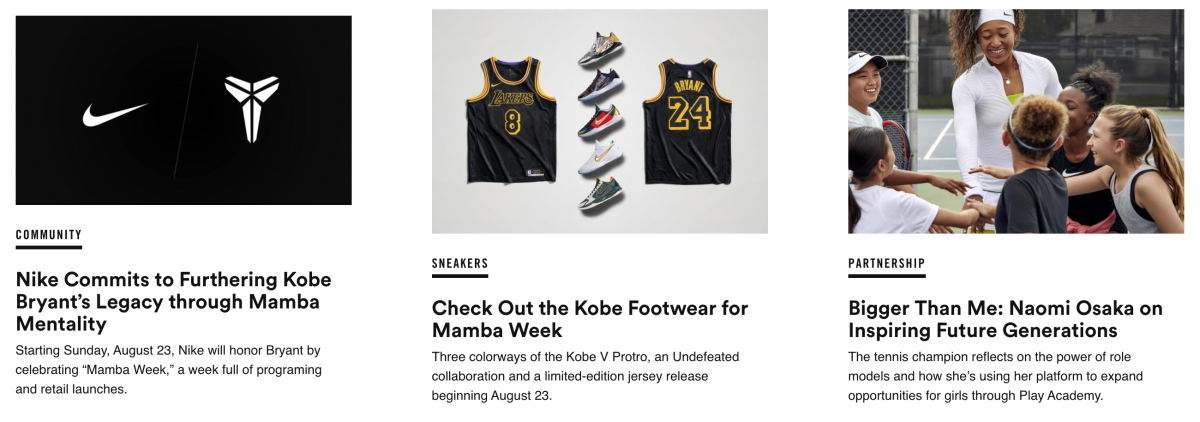
Your categories can be anything you like but just make sure to #keepitsimple and make sure the blog content you create is assigned to the correct category.
Diversity
The range and diversity of the kind of content you create doesn’t just stop at blogs, but also extends to PR (Public Relations) including press releases, videos, social media content and events. You can also look into doing some guest blogs both on your site and the business you’re working with and include backlinks and brand mentions to also help your SEO efforts.
Putting together a content plan may help you draft content for each of these channels for example when certain events or sales happen throughout the year, you know about beforehand and can prepare the content in advance, for example, ‘Top 5 Best Black Friday Deals in 2020’ where you can link to products that will be in your Black Friday sale to help increase the hype around the upcoming sale.
If you hire a new employee or open up a new location, or even release a new product line, make sure to write a press release about it and publish it on your blog. You can also look to reach out to your local newspapers to try and get some coverage and raise your brand awareness.
Videos are also a good way to support some of your blog content and can be posted on your YouTube and other social media channels. Video is fast becoming one of the more popular mediums as it’s easier for someone to watch a short video about something than to read a blog about it.
If there are also any major changes in your industry, being one of the first to write about it and publish on their social channels might help you gain more exposure and also position you as an expert in your field.
Having a blog and working to create content that helps both you and your customers is a great way to grow your business and in turn increase your sales.
The post How to curate content for your business blog appeared first on Ecommerce Blog.
 from Ecommerce Blog https://ift.tt/2Q8Nr64 via IFTTT


No comments:
Post a Comment