Facebook Pay rebrands to Meta Pay as Zuckerberg details plans to create a digital wallet for the metaverse

Meta CEO Mark Zuckerberg announced this week that Facebook Pay has officially been renamed Meta Pay. The current product features and overall user experience that people are used to with Facebook Pay will remain the same across across Facebook, Instagram, WhatsApp and Messenger. The change is rolling out in the United States and will then launch globally over time.

Zuckerberg says although the service will remain the same, the rename represents Meta’s first step toward creating a digital wallet for the metaverse. He says his vision for a digital wallet in the metaverse will let users securely manage their identities, what they own and how they pay.

“In the future there will be all sorts of digital items you might want to create or buy — digital clothing, art, videos, music, experiences, virtual events, and more,” Zuckerberg said in a Facebook post. “Proof of ownership will be important, especially if you want to take some of these items with you across different services. Ideally, you should be able to sign into any metaverse experience and everything you’ve bought should be right there.”

Zuckerberg notes that although this vision won’t come to fruition anytime soon, this kind of interoperability will deliver better experiences for people while also bringing larger opportunities for creators. He says the more places people can easily use their digital goods, they more they’ll value them, which in turn will create a bigger market for creators. He also noted that users’ ability to transact more easily will create bigger opportunities for creators.

Zuckerberg’s comments come a few weeks after Meta’s head of fintech, Stephane Kasriel, said Meta is in the “very early stages” of considering what a single wallet experience may look like. He said that in terms of its early thinking, Meta is looking at how you can prove who you are and carry that identity into different experiences in the metaverse.

“Our path forward is grounded in our mission to empower everyone, everywhere to access the world’s financial system to accelerate financial inclusion and economic empowerment,” Kasriel had said in a blog post at the time. “Designing products and infrastructure with the metaverse in mind today will help facilitate innovation that delivers greater access and real cost savings — before the metaverse even becomes mainstream. Now is the time to lay down the building blocks for the future. Because once that foundation is in place, the potential of the metaverse, and where it can take fintech next, will be limitless.”

Meta has been in payments since 2009 and says people use its platforms to make payments in 160 countries and 55 currencies, including person to person, business to business, and business to consumer payments.

Facebook changed its corporate branding to Meta in October to capture more of the company’s core ambition, which is to build the metaverse. Since then, Meta has started renaming its products to match the new corporate branding. For example, Oculus Quest is now Meta Quest, and Facebook Portal is now Meta Portal. It makes sense for Meta to make the change for its payments experience as well, especially as it gears up for the metaverse.



from TechCrunch https://ift.tt/kheF27q
via IFTTT

Ecommerce Cup 2022 Results – Oliver Bonas triumphant

Returning after a pandemic enforced two year break, the annual Ecommerce cup returned this month and was a traditionally hard fought contest. Today we publish the full Ecommerce Cup 2022 results with the headline news that Oliver Bonas triumphed to win the tournament.

Ecommerce Cup 2022 Results from the Group Stages

In Group A, Intersoft kicked off with a glorious 7-3 win over Nshift, but faltered against Seko Logistics in a 5-1 match. Seko Logistics also saw off competition from Trustpilot 2 and BigCommerce to progress to the quarter finals.

Group B saw Oliver Bonas win all their games with a notable 13-1 win over Tryzens, who lost with the same result against Spotler UK. Valiant players, Tryzens also gifted Ecommerce Cup regulars ChannelAdvisor a 13-2 win but recovered to slow down Just Eat 1 who won 5-3 but the goal difference meant Just Eat 1 didn’t progress to the quarters.

Optimizely topped Group C with wins over Tradebyte1, Just Eat 2 and Easyship. With Optimizely progressing, Just Eat 2 (previous winners) did enough to progress to the quarters.

Group D was dominated by Klaviyo, but a mention has to go to Wrap who lost 4-6 against Klaviyo but won their other matches against Perpetua and a high octane 12-5 win over Tradebyte 2.

The closest group stage matches came in Group E with no more than four goal differences in any of the results. Vouchercodes were unbeaten, closely followed by Trustpilot 1 with Loquate and Hullabalook scoring well but failing to progress.

Quarters, Semis and Final

By the time the Quarter Finals came alone, legs were tiring but the action was frenetic as the cup was in sight. Spotler UK kicked out Seko Logistics with Oliver Bonas finally seeing off previous champions Just Eat 2. Then in the semis, Oliver Bonas booked their place in the final triumphing over Spotler UK.

In the other half of the draw, Klaviyo beat Optimizely , but Vouchercodes who knocked out Wrap went on to progress to the final.

Finals are always tough but there has to be a winner and Oliver Bonas had enough wind left to claim victory when the final whistle blew, leaving Vouchercodes worthy runners up in the Ecommerce Cup 2022 results.

A huge thank you to everyone that took part and to the team at Play Football in Shepherd’s Bush for hosting the event. We’ll be back next year, so look out for the Ecommerce Cup 2023 announcement some time next spring.

The post Ecommerce Cup 2022 Results – Oliver Bonas triumphant appeared first on ChannelX - formerly Tamebay.


from Ecommerce Archives - ChannelX - formerly Tamebay https://ift.tt/SyuNIhl
via IFTTT

Picture proof FedEx delivery coming to U.S.

FedEx Express and FedEx Ground will be the first U.S. nationwide carriers to give their customers picture proof of delivery so that businesses can offer consumers a more transparent delivery process–for free. Customers will receive a photo showing the exact location of their package once it’s delivered to their doorstep.

Consumers are craving more convenient and secure ways to keep track of their parcels. By offering services that let them see detailed tracking information, businesses are showing customers that they are reliable, promoting brand loyalty and sales. Carriers are identifying this and providing ways to offer tracking solutions.

Today FedEx have announced that they will be providing a way to offer convenience and security at no extra cost. Picture Proof of Delivery will be free, easily accessible through FedEx tracking tools, and will not require enrolment, making it ideal for large retailers and small businesses to compete and win in today’s challenging environment.

This is something e-commerce merchants and customers have been asking for, and we are proud to be the first to announce this service will be available to residential customers, Receiving visual confirmation that the package has arrived gives peace of mind to both merchants and consumers, and we are thrilled to give them that confidence.

– Brie Carere, Chief Customer Officer, FedEx

Picture Proof of Delivery will be available soon to FedEx Delivery Manager users in select markets, followed by a general release in the United States and Canada just in time for the busy holiday shipping season. You can find detailed information at fedex.com/pictureproof.

The post Picture proof FedEx delivery coming to U.S. appeared first on ChannelX - formerly Tamebay.


from Ecommerce Archives - ChannelX - formerly Tamebay https://ift.tt/m7bnNj6
via IFTTT

UK consumers cut back on spending

According to GWI’s ‘The consumer dilemma’ report‘, the cost of living crisis has caused almost half of UK consumers to start spending less than they did in 2020 and 67% of consumers feel that inflation has had a moderate or dramatic impact on them.

Cutting back

Consumers are being more conscious about what they spend their money on, many are feeling less secure with their current financial situation. Luxuries are being cut down on which means things like, meal subscription companies, restaurants and travel agencies could feel an impact.

Another impacting sector, is DIY and home refurbishment. During COVID we saw an increase in buyer activity as more people looked for something to do whilst sat at home. Now that people are spending less time at home and dealing with the rise in living costs, home improvement is grinding to a halt.

Living well

Changes in consumer behaviour could still benefit some brands especially those selling second-hand or health and wellness products. Sellers of second-hand goods will appeal to consumers opting to spend less, especially on fashion. Buying used clothing is on the rise, especially within the younger generations.

Consumers are also taking more notice of their health and wellbeing. Health awareness is an increasingly important part of everyday life for consumers who are now more in touch with how they feel. 2 out of 3 consumers are more conscious of their physical and mental health and so, brands should see consumers making purchases that help them keep healthy habits on track.

Reliability and trust

The data also reveals that reliability and trust in a brand or product can be just as important as the price. People want to buy from brands they believe offer longevity and value for money. Consumers are willing to switch to alternatives that offer greater perceived value – even if they aren’t actually any cheaper.

The post UK consumers cut back on spending appeared first on ChannelX - formerly Tamebay.


from Ecommerce Archives - ChannelX - formerly Tamebay https://ift.tt/KlhcxtY
via IFTTT

Fintech Kasheesh wants financially strained customers to say ‘bye’ to BNPL

Buy Now, Pay Later (BNPL) products have become incredibly popular with users, and both startups and tech behemoths such as Apple have taken notice. But BNPL companies have attracted some controversy, too, for encouraging people who are less financially secure to take on debt without fully explaining the associated risks.

Kasheesh, a fintech startup that’s less than two years old, came out of stealth today with a product its founders say can benefit consumers by offering flexibility that’s similar to BNPL, but without taking on a loan. The company’s main product is a web browser extension that allows customers shopping online to split their payments across multiple combinations of debit, credit and gift cards without having to pay a fee or interest, co-founder and CEO Sam Miller told TechCrunch.

“You’re using your existing credit and your existing debit to actually facilitate the transaction rather than going through a credit pull and underwriting a loan that you don’t fully understand and then buying the same item and owing money over six to 12 months,” Miller said.

The platform itself launched in private beta mode in January and has already brokered over $10 million in user transactions and purchases, according to the company. Miller added that this number has consistently doubled each month since the launch.

Kasheesh targets two main types of customers, Miller said. The first group is the “paycheck-to-paycheck” consumer that uses the platform as a budgeting tool to avoid overdrafting their cards or overutilizing their credit. The second bucket, he added, is the customer who “has 10 credit cards and want[s] every card to be top-of-wallet.” Those customers can also use Kasheesh to split purchases with friends, for example. Miller said the company hasn’t gone after those users intentionally just yet because although the technology supports shared purchases, the company is still so early-stage that it hasn’t built out capacity on its customer support team to handle inquiries from numerous people about a single transaction.

In addition to its public launch, Kasheesh also announced it has raised $5.5 million in seed funding from institutional and celebrity angel investors. VC firms Tribe Capital, Anthemis and Courtside Ventures participated in the round alongside NFL player Odell Beckham Jr, investor Sahil Bloom and actor Robin Wright.

The company is able to offer its product to users at no cost because it makes money from interchange fees from MasterCard, which helps Kasheesh issue a single-use card on behalf of users to complete each purchase. That single-use card, Miller explained, pulls from the customer’s desired funding sources and allows the customer to choose how much money to use from each source when making their purchase. For MasterCard, he added, the value proposition makes more sense than BNPL, because Kasheesh’s average order value per customer is “well over $1,800” compared to the average BNPL purchase, which tends to be much smaller.

Sam Miller, Kasheesh co-founder & CEO

Sam Miller, Kasheesh co-founder and CEO Image Credits: Kasheesh

Eventually, Kasheesh plans to develop its technology so users can use the same card across multiple transactions rather than having to generate a new single-use card each time, Miller said. Miller also plans to grow the Kasheesh team, currently 12 people, by recruiting heavily for product and customer success roles.

The company says it’s also focused on security and keeping customer information confidential. Kasheesh partners with Stripe and Plaid to process transactions, so the company doesn’t store any credit card information on its own servers, co-founder and CTO Kevin Kim told TechCrunch.

“We’re big believers in the anonymous component of transactions. I kind of liken it to the day where there was always that one person in the grocery store line that had to write a check when they were checking out from the grocery store, and it’s the stigma that went along with that. For that reason, we don’t, we don’t cherry-pick. Everyone is viewed exactly the same — doesn’t matter what geographic location, demographic information, what cards you’re linking, none of that matters to us,” CEO Miller added.

While Kasheesh is serving many of the same consumers as BNPL would, Miller is confident its product is differentiated enough to stand out.

“We view the entire fintech world as one giant competition,” Miller said. “I think that alternative financing at checkout is the category we fall into, and that includes BNPL, that includes traditional forms of payment like credit and debit, it includes crypto, but. I think that we don’t have any direct competition in the sense of who’s doing exactly what we’re doing … But I do think that there’s going to be this huge wave where the consumers are looking for a little bit more power and transparency at the point of the purchase.”


from TechCrunch https://ift.tt/MNFH5bI
via IFTTT

Tiger Global backs SaaS omnichannel social commerce platform SleekFlow in $8M funding

Social commerce — the process of buying and selling products or services directly through social media platforms like Facebook, Instagram and TikTok — is becoming the most natural way for consumers to make purchases since people use social media and messaging apps almost every day.

SleekFlow, an omnichannel social commerce platform that helps businesses build customer flow automation from messaging and live video to transactions, has closed $8 million Series A funding led by Tiger Global Management. Transcend Capital and AEF Greater Bay Area Fund, managed by Gobi Partners GBA, also participated in the round.

“Consumers now spend 80 percent of their time on social platforms, and it is already a habit to discover and buy products directly from here,” said founder and CEO of SleekFlow Henson Tsai. “SleekFlow aims to drive this e-commerce revolution by being the top social commerce unified hub — merging conversations, product catalogs, payment solutions, and order management into one for businesses.”

SleekFlow

Image Credits: SleekFlow

Founded in 2019, SleekFlow now serves more than 5,000 businesses across the globe, including NARS Cosmetics, Bossini, Lalamove Hong Kong and PSB Academy. The company claims that it saw approximately 500% revenue growth after its recent pre-Series A funding backed by Alibaba Hong Kong Entrepreneurs Fund (AHKEF) in May 2021. (SleekFlow did not provide its baseline for that growth.)

The Hong Kong-headquartered startup will use the fresh capital for its market penetration into Southeast Asia, specifically Singapore and Malaysia, as well as the U.K. and other countries in Europe. In addition, the latest funding will enable SleekFlow to enhance its product development with fintech and data analytics functions, one-click checkouts via social media platforms, and easy in-chat payment integrations for online to offline (O2O) and e-commerce brands’ seamless workflow.

The startup has recently launched a fintech product social-to-payment feature to provide a comprehensive solution for both e-commerce and brick-and-mortar businesses. In Southeast Asia alone, about 90% of digital merchants use digital payments for profitability and survival, the company says, adding that the chat-to-checkout tool is significant in driving sales and conversions from various digital sales channels. SleekFlow also introduced a new sales and analytics and customer service performance tracking that helps users track and analyze consumer profiles and behaviors for personalized communications after its partnership with Shopify last November.

The global social commerce market is projected to rise to $6.2 trillion by 2030.

According to the company, one in five dollars spent on retail in Southeast Asia is transacted through social media, and more consumers are looking to businesses offering convenient communications. SleekFlow integrates multiple messaging channels such as Official WhatsApp Business API, Facebook Messenger, Instagram chat, SMS and Telegram to address the challenges of managing multiple messaging and social media platforms.

“Despite the economic downturn, the social commerce market is going stronger than ever, reaching $474 billion in 2021,” Chibo Tang, managing partner of Gobi Partners GBA said in a statement. “Eight in 10 U.S. businesses anticipate increased sales via social media within the next three years. SleekFlow’s innovative solutions will help these global commerce businesses meet the evolving needs of customers who are turning to social channels to purchase more than ever before.”

Slack now has a team of 60 members in Hong Kong, Singapore, Malaysia, Taiwan and the U.K.


from TechCrunch https://ift.tt/3riZ1mY
via IFTTT

Strapi lands $31M for its ‘headless’ CMS platform

Strapi, an open source content management system (CMS), today announced that it raised $31 million in Series B funding led by CRV with participation from Flex Capital, Index Ventures, and angel investors including former GitHub CEO Nat Friedman. With the capital, CEO Pierre Burgy tells TechCrunch that the plan is to launch a new product, Strapi Cloud, while bringing in additional tech and solution partners and further developing the Strapi project.

Strapi has it origins in software that Burgy, AurĂ©lien Georget, and Jim Laurie created together while working as freelance developers in college. Annoyed by the limitations of traditional frameworks and CMSes, many of which weren’t developed with mobile websites in mind, they decided to create their own solution, Strapi, to use for clients’ projects.

Burgy, Georget, and Laurie published Strapi on GitHub in 2015. “For us, making the project open source was a no-brainer,” Burgy said in an email interview. “We were using lots of open source software, and we were convinced that collaboration would lead to better software. Most of our clients wanted to host their CMS on their own servers; customization capabilities were only possible through source-code access.”

In the beginning, Strapi was a mix between a framework for building APIs and a CMS. The name “Strapi,” in fact, is a creative abbreviation of the phrase “Bootstrap your API.” Today, Strapi allows developers to connect and manage different databases, frontend frameworks, and static site generators. Users can run Strapi on a server and connect to Strapi’s admin interface, relying on the frontend to fetch content from Strapi using an API.

Strapi

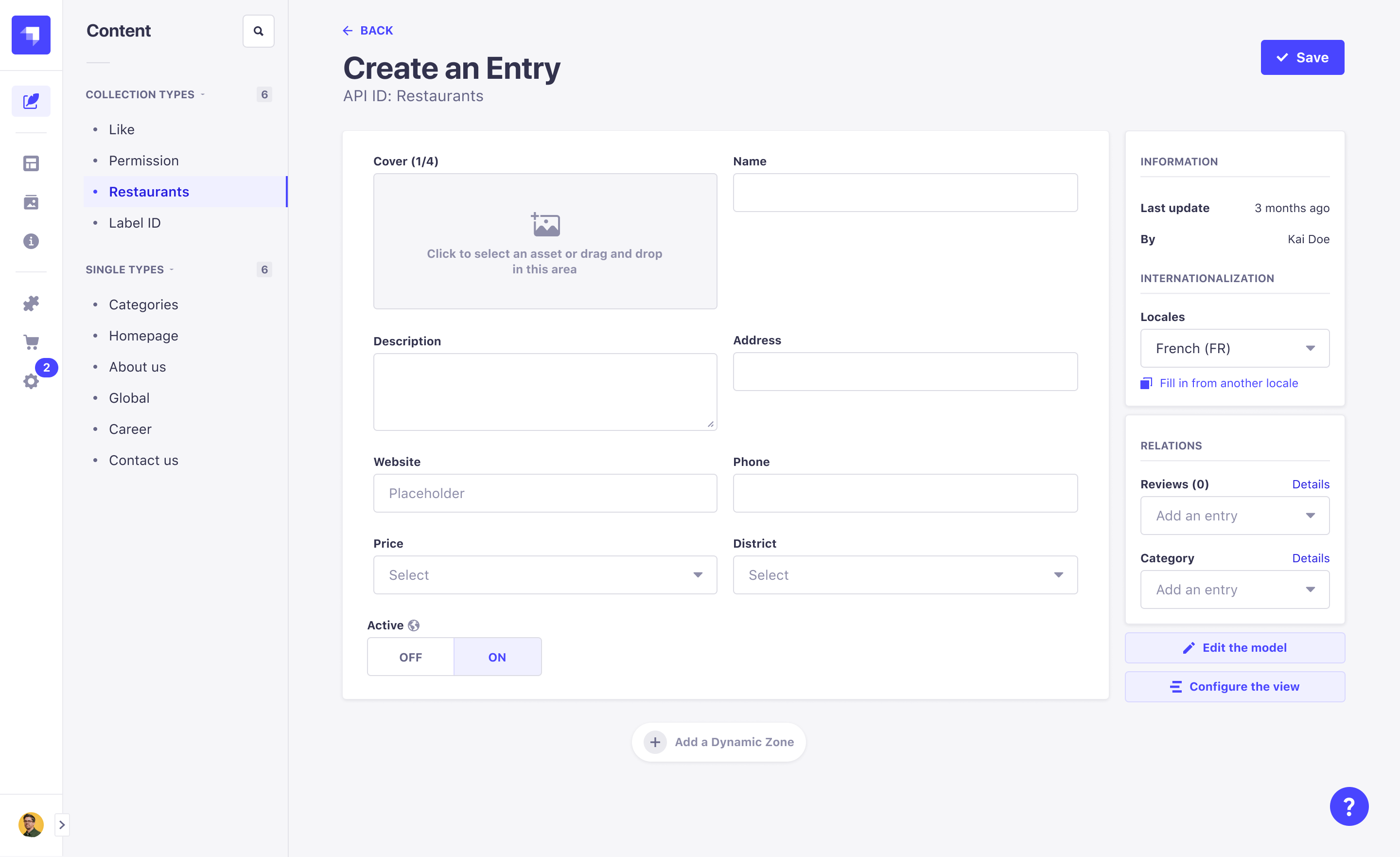
Strapi’s content management dashboard.

“There is a fair amount of confusion and overlap between CMS, knowledge management, and enterprise wiki software,” Burgy said. “These platforms were always viewed as separate solutions by users because of their distinguished technical architecture. They were perceived by what they were instead of what they accomplished. This is changing.”

From Burgy’s perspective, Strapi — competing with Contentful, Storyblok, and Sanity — solves some the major issues with legacy CMS software, like a lack of adaptability to custom use cases. To address other perceived limitations, the Strapi team has launched features in recent months like Strapi Market, which offers a library of integrations with third-party platforms.

Acknowledging that Strapi isn’t perfect, Burgy said that the near-term goal is to put resources toward the content editing experience, including pre-built templates, publication workflows, rich text editors, and custom fields as well as plugins for personalization, visualization, and ecommerce. Work is also underway on Strapi Cloud, a fully managed Strapi service that will let customers start a project locally, customize it according to their needs, and deploy it on the web.

Strapi Cloud is scheduled to become generally available next year. It’s currently in beta.

“WIth the pandemic, a lot of businesses facing uncertainty were forced to adapt by moving online. On the other hand, individuals are consuming more content online than ever before and also need to adapt to the reality of remote work,” Burgy said. “As a result, companies are focusing more and more on the holistic overall experience for all stakeholders. Strapi helps companies in that process by providing a more versatile and composable platform to help them future-proof their applications and deliver a consistent experience across channels for all users.”

In addition to thousands of open source users, Burgy says that Strapi has 450 paying customers including AT&T, eBay, IBM, and Toyota and government agencies in the U.S. and Europe. The company’s workforce stands at 70 employees; Burgy expects it’ll grow to 110 by the end of the year.

To date, Strapi has raised $45 million.


from TechCrunch https://ift.tt/4K87A3g
via IFTTT

New Government – Labour Small Business Agenda

We’ve are all waking up to a new Government today, with the Labour party about to take control of the country and what should be top of your...