Shopify allows merchants to sell NFTs directly through their storefronts

Shopify has made it possible for eligible sellers to sell NFTs (non-fungible tokens) via its platform, which opens up a whole new world for e-commerce merchants.

On Monday, the NBA’s Chicago Bulls launched its first-ever NFTs –– including digital artwork of NBA championship rings –– by launching an online store on Shopify. Instead of having to go to an NFT marketplace, Bulls fans can now purchase the digital art directly with the team’s online store using a credit or debit card. In its first day of making them available, the NBA team sold out of the NFTs within just 90 seconds, according to Kaz Nejatian, Shopify’s VP of merchant services.

“You could buy NFTs on credit cards before, but honestly the NFT buying experience outside Shopify isn’t awesome for anyone right now,” he told TechCrunch “That’s why we decided to do this work. Merchants and buyers shouldn’t have to take a course in crypto to buy things they care about.”

It’s also about giving consumers more options to buy NFTs – especially those who are not well-versed in cryptocurrency.

By making it possible for merchants to sell NFTs directly through their Shopify storefronts, the company says it’s creating access for merchants who want to sell NFTs. They will eventually be able to choose which blockchain they’d like to sell on based on their products and customer base since Shopify supports multiple blockchains, Nejatian said.

“By contrast, if merchants want to sell on an NFT marketplace, they need to choose based on the blockchain supported by that marketplace,” he added.

The Chicago Bulls selected the Flow blockchain for their NFTs, for example. But overall, Shopify merchants can today choose from Flow and Ethereum, but soon “will have more choice with other blockchains on Shopify,” according to Nejatian.

The move was also driven by demand from merchants asking for the ability to sell NFTs and the desire to give creators and artists another forum to grow professionally.

“Many creators are already seeing the value of selling NFTs to their fans, but we’re removing some of the friction for themselves and their buyers, allowing them to better monetize their work and their connection to their audience,” he added. “We’re opening up a world where their fans feel meaningful connection to their brands, and where NFTs just increasingly become part of how we buy and sell online.”


from eCommerce – TechCrunch https://ift.tt/3i91cRa
via IFTTT

Former Farfetch team launches online marketplace for gardeners

Former Farfetch team launches online marketplace for gardeners

A new online marketplace for gardeners has been launched in the UK by former Farfetch execs. Sproutl, as it is named is a new online marketplace that celebrates the best brands and businesses in the gardening industry. That’s not all, they’ve also announced $9 million of seed funding led by Index Ventures with participation from Ada Ventures.

Sproutl is not just an online gardening marketplace. It’s a platform that provides inspiration and advice to a new generation of growers, demystifying gardening, making it accessible and fun to fresh new audiences who may never have grown anything before, bringing plants and products seamlessly from phone to door.

The platform is designed to make shopping hassle-free for consumers and take the pain out of online selling for horticultural suppliers and integrate with their systems. Sproutl manages not only logistics, packaging sourcing, and delivery but also online marketing and customer services. Allowing local garden centres, shops and nurseries to develop their online presence and reach new national audiences, generating incremental sales.

“We built Sproutl to invite a new audience to take up gardening and give them the world-class eCommerce experience that digital natives expect. Our mission is to demystify growing plants and remove the barriers to getting started.” They continued, “We want to celebrate the UK’s brilliant horticultural industry and the network of family-owned and independent businesses, bringing their plants and products together in one place, generating incremental sales to new nationwide audiences.”
– Anni Noel-Johnson, CEO, & Andy Done, CTO

The launch of the online marketplace for gardeners and its expansion are supported by a $9m seed investment which will allow Sproutl to move a step closer to its ambition of changing the online gardening landscape in the UK.

If you’re a seller of all things gardening then you can find out more about becoming a seller on Sproutl here.

The post Former Farfetch team launches online marketplace for gardeners appeared first on Tamebay.


from Ecommerce – Tamebay https://ift.tt/2WfJdzJ
via IFTTT

Pinterest rolls out new features that let creators make money from Pins

Pinterest today is increasing its investment in the creator community by introducing new tools that will allow creators to make money from their content. Now, creators will be able to tag products in their Idea Pins — a video-first feature the company first launched this spring — to make their content “shoppable.” They’ll also now be able to earn commissions through affiliate links and partner with brands on sponsored content, much like on other social platforms like Instagram, YouTube and TikTok.

Despite its general focus on turning product inspiration into clicks and purchases, Pinterest has been slower to embrace the creator community which today is responsible for driving a significant amount of interest in new products among online shoppers. Over the past several years, brands have increased their influencer marketing budgets from $1.7 billion in 2016 to now $13.8 billion in 2021. However, Pinterest offered few tools for creators to tap into that market on its own site, until its more recent debut of Idea Pins in May.

These Pins are somewhat like Pinterest’s take on TikTok, mixed with Stories, as they offer a way for creators to produce content that combines music, video, and other interactive elements. The videos in Idea Pins can be up to 60 seconds per page, with up to 20 total pages per Pin. Creators can also add other features to their Pins, like stickers or music, and tag other creators with their @username.

Image Credits: Pinterest

While similar in some ways to TikTok, the videos can include “detail pages” where viewers can find associated content, like the ingredient list and instructions for a recipe, or a list of how-to instructions for a craft project.

Now, explains Pinterest, creators will be able to tag products in their Pins, as well. That means fans viewing the Pin content can now go from inspiration to purchase from the Pinterest app. However, the path isn’t as straightforward as it is on Instagram, where a tap on a tag leads you to a page where you can then add an item to a shopping cart. Instead, Pinterest’s product tags tend to take you to another Pinterest page for the product in question, and from there you have to click again to visit the retailer’s website to complete your order.

The company has been testing the feature before today with creators including Olive + Brown, Fall for DIY and UnconventionalSouthernBelle who have already made some of their content shoppable.

The new Idea Pins product tagging tool will roll out to all business accounts in the U.S. and U.K. and will then continue to roll out access over the coming months to international creators.
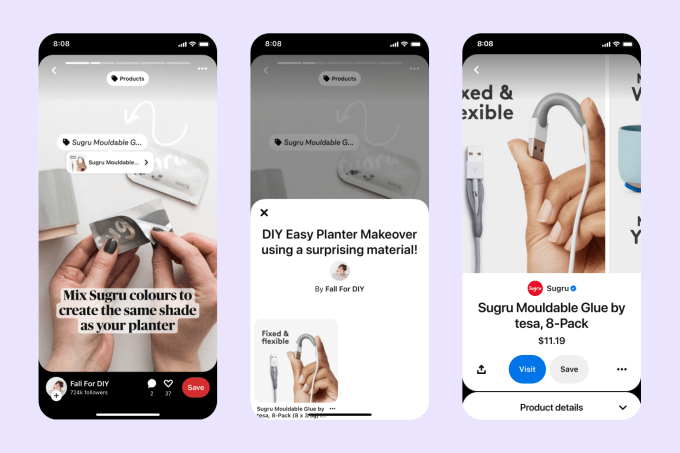
Image Credits: Pinterest

Other new monetization features rolling out now include support for affiliate programs and brand sponsorships.

Creators will now be able to integrate their affiliate programs for Rakuten and ShopStyle to generate additional revenue from their recommendations. Meanwhile, creators who come to the platform with brand partnerships will be able to use a new tool, still in beta, that will let them disclose those partnerships to their followers.

When they then produce branded content on Pinterest and add the brands to their Idea Pins, the brand will then be able to approve the tag, and the Idea Pin will feature a label that reads “Paid Partnership.”

This paid partnerships tool is now live for select Creators in the U.S., U.K., Canada, Australia, Ireland, New Zealand, France, Spain, Italy Germany, Switzerland, Austria, Sweden, Brazil, Argentina, Mexico, Chile, Colombia and Peru.

Image Credits: Pinterest

Most of Pinterest’s new monetization tools are not necessarily all that innovative or unique.

Instead, they represent a company that’s playing catch up to larger social platforms — like Facebook, Instagram, TikTok, an d YouTube — which have been better catering to creators in recent years by allowing them to build their own businesses on their respective platforms and expand their reach. Instagram, in particular, has moved in on Pinterest’s territory to such an extent that many users today start their shopping inspiration searches on its app first.

And Instagram has catered to this growing group of online shoppers by turning its platform into an online shop of sorts, compete with a dedicated Shop button, built-in checkout features, alerts about product drops, and numerous ways for creators to generate profits from their work.

Now that influencer shopping is the norm, the race is on among large platforms and startups alike to bring a similar set of shopping tools to live streamed video.

Given the significant competition, Pinterest’s pitch to the creator community is that its user base is already primed to shop.

By the end of 2020, the company says it saw a 20x increase in product searches on its platform. It also notes that Pinterest users are 89% more likely to exhibit shopping intent on products tagged in creators’ Idea Pins than on its standalone Pins. Plus, the company says that its focus will be more on inspirational content, rather than “influence and entertainment” — a seeming knock at social media and its influencer stars.

“Pinterest is the place where creators with inspiring and actionable ideas get discovered. With this latest update, we’re empowering Creators to reach millions of shoppers on the platform and monetize their work,” said Pinterest Head of Content and Creator Partnerships, Aya Kanai. “Creators deserve to be rewarded for the inspiration they deliver to their followers, and the sales they drive for brands. Creators are central to our mission to bring everyone the inspiration to create a life they love, and we’ll continue working with them to build their businesses and find success on Pinterest,” she added.



from eCommerce – TechCrunch https://ift.tt/3zG4UHQ
via IFTTT
Oova raises $1.2M to develop a better at-home kit for detecting a woman’s best time to conceive

Oova officially launched its Oova Kit Tuesday after receiving $1.5 million in seed funding led by BBG Ventures with participation by Company Ventures. The kit includes an at-home test that quantitatively measures two hormones, informing a woman — and her doctor — of her fertile days and confirming ovulation.

The New York-based company was founded in 2017 by Amy Divaraniya, CEO, who holds a Ph.D. in biomedical sciences with a focus on genetics. She personally struggled to conceive due to irregular menstrual cycles and was told by doctors to come back after she turned 35 to be evaluated then. Except that Divaraniya didn’t want to wait — she wanted something done right then.

She continued to pursue natural avenues for getting pregnant like peeing on sticks and taking her temperature, and after 18 months she conceived her son. However, Divaraniya realized that all of the tools available were hardwired for women who “have a perfect cycle,” and that was not the case for her. Not funding anything available for women with irregular cycles, she created Oova to provide a tool that would be personalized, non-invasive and done at home to address the personal hormone profile.

Amy Divaraniya, founder and CEO of Oova. Image Credits: Oova

Divaraniya founded the company in 2017 after completing her Ph.D. and has spent the past four years focused on getting the technology to work as accurately as possible, she said. Oova’s at-home kit comes with a handle holder, 15 disposable cartridges and a mobile app. Users will take a urine test, scan the results with their phone’s camera and receive actionable steps, including confirmation that the person ovulated and the best days for conception. The person’s physician can also see the data and talk to the patient.

She boasts that Oova is the only test on the market that measures luteinizing hormone and progesterone and that tracks hormones over time. The only alternative is for women to go into their doctor’s office every day for a blood draw, and they are only doing that if the woman is going through IVF, Divaraniya said.

Susan Lyne, co-founder and managing partner of BBG Ventures, has been focused on women’s health for a while and heard from other founders that she needed to meet Divaraniya.

“Seeing your cycle visualized is a transformative moment for a lot of women,” Lyne said in an interview. “Oova’s science is strong and enables consumers to understand their test results without having to go to an expert. The fact that you can get a personal hormone profile in the past only meant if you hit a certain level to tell if you are fertile. This one is quantitative, so it tells you yesterday, today, so you can track it and when you are about to ovulate.”

The company’s original goal was to launch direct to consumer, but after fertility clinics were shut down during the pandemic, Divaraniya received calls from physicians last year asking her to launch the kits early so that they could support their patients who now couldn’t come into their offices. Today, over 75 fertility clinics use the platform.

The global fertility technology market, which includes services like in vitro fertilization, genetic testing, egg freezing and reproductive donation, was valued at $33.1 billion in 2020 and is expected to be $47.9 billion by 2027, according to consultancy Precedence Research. That compares to the at-home diagnostics and digital health markets forecasted to be $7 billion and $551 billion, respectively, by 2027.

Other startups are focused on making similar fertility care more accessible — for example, this year, Future Family raised $9 million to make fertility costs and processes transparent, while digital health company Ro acquired Modern Fertility in May in order to add fertility testing and reproductive health to its suite of services. And Mate Fertility launched with $2.8 million in financing to create a network of family planning services.

To meet future demand, Divaraniya intends to use the new funding to add more features and get the hormone tests ready for market. She would also like to work on a rebrand and “make Oova into a company, not just a science experiment.” The starter kit is priced at $159.99, while refillable kits are $99.99 per month with a subscription.

“We started with fertility, but we want to expand into other areas of health, like chronic disease, letting data users and clinicians drive what the demand is,” Divaraniya added. “We are also working on adding estrogen to the panel, which with luteinizing hormone and progesterone will be the perfect trifecta for fertility.”


from eCommerce – TechCrunch https://ift.tt/3BEdGaW
via IFTTT

Shopware TV ecommerce VOD service launched today

Shopware TV ecommerce VOD service launched today

Shopware breaks new ground when it comes to infotainment: today the software provider released a video-on-demand service with content about all things ecommerce. In doing so, Shopware becomes the first company to launch such a project, making it a pioneer in the industry. The free streaming service Shopware TV gives viewers access to entertaining videos in addition to business-relevant information. Two elaborately produced series with up to five episodes are already available. More formats will follow gradually.

The Shopware founders Sebastian Hamann and Stefan Hamann in the series New Kid in Town Shopware TV“When people who aren’t familiar with us first come across Shopware, they might see us solely as an ecommerce company. And they would be right about that, of course. But there’s more to the story. We always think outside the box and like to surprise our community with unusual campaigns. This certainly includes Shopware 5 – the release that we promoted with its own motion picture and an accompanying tour. And also Shopware TV”, says Hamann. But Shopware TV is more than that. This service goes far beyond any particular software product and takes a much broader, more comprehensive approach to ecommerce.”
– Sebastian Hamann, CEO of shopware AG

Shopware TV launches two series from the start

Shopware TV aims to serve as an infotainment channel for ecommerce enthusiasts and promote openness and cooperation among all market players.

“We’ve always driven the growth of industries in the SME sector with our solutions and ideas. That’s exactly what Shopware TV is all about. We want as many people as possible to benefit from it.”
– Sebastian Hamann, CEO of shopware AG

Developer Evangelist Niklas Dzösch in the series Devinitely Shopware TVMore specifically, Shopware TV shares inspiration and insights into all areas of Shopware and far beyond using high-quality formats. Topics addressed include entrepreneurship, what makes retail companies successful, how Covid-19 impacted the retail sector, and much more. In addition to the “New Kid in Town” series, which was created in cooperation with the film production company Brandnew Entertainment and director Sebastian Moretto, shopware AG is releasing an equally informative and entertaining series for developers. It’s called “{DEV}initely Shopware” and was brought to life by Shopware’s in-house video production team. Shopware newcomer Ben Marks also plays a role in the series. The US American joined the company in the spring of this year as Director of Global Market Development, thus emphasising the international character and supporting our open source philosophy. Additional series formats are already in the works and will be gradually released.
The Shopware TV project is in line with the philosophy that the company has consistently pursued for years. “We have always believed in putting people at the heart of what we do and being authentic. And that’s exactly what we’re doing with Shopware TV. We share personal insights and are approachable. We provide our community and ecommerce enthusiasts with formats that share expert knowledge and business advice, but also portray varied, human experiences in a digital world,” explains Hamann.

You can access Shopware TV using the following link: shopware.tv

The post Shopware TV ecommerce VOD service launched today appeared first on Tamebay.


from Ecommerce – Tamebay https://ift.tt/3f3bfVU
via IFTTT

Amazon-backed Indian D2C beauty brand MyGlamm raises $71 million

MyGlamm, a direct-to-consumer beauty brand in India that sells most of its products through its own website, app and retail touch points, said on Monday it has raised $71.3 million in a financing round as the Mumbai-headquartered firm looks to scale its business across the South Asian market.

The startup had raised $23.5 million in its four-times subscribed Series C financing round from Amazon, Ascent Capital, Wipro in March this year. On Monday, it said it has added an additional $47.8 million as part of the round — which is now closed.

Accel led the investment in the new tranche while existing MyGlamm investors — Bessemer Venture Partners, L’Occitane, Ascent, Amazon, Mankekar family, Trifecta and Strides Ventures — also participated, Darpan Sanghvi, founder and chief executive of MyGlamm, told TechCrunch in an interview.

Sanghvi started MyGlamm in 2017 after pivoting his previous venture. He recalled the struggle he faced raising money for a direct-to-consumer brand, which were not as popular in the world’s second largest internet market just five years ago. To make matters worse, MyGlamm was also among the last direct-to-consumer startups to kick off its journeys at the time.

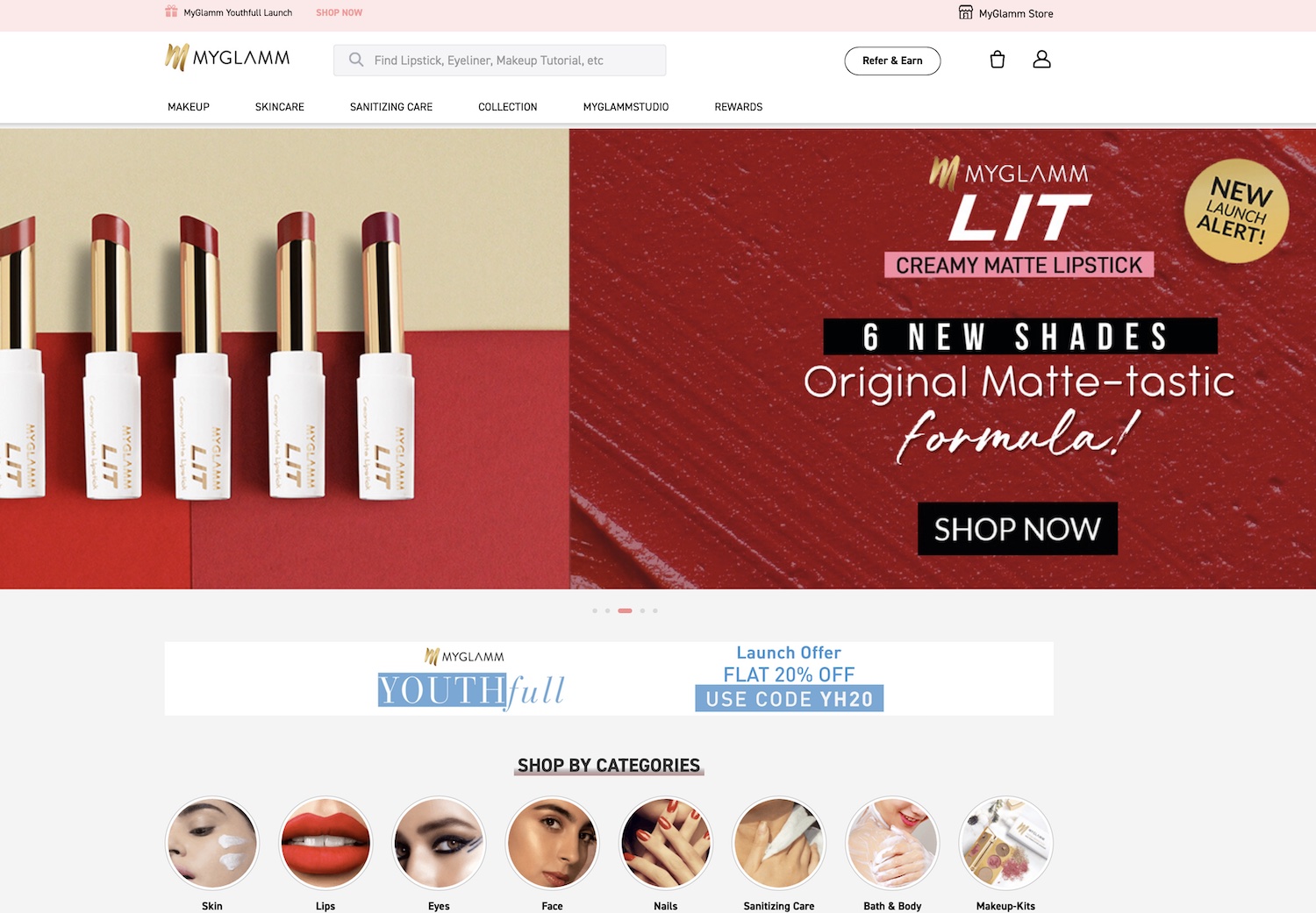
MyGlamm website

The startup today operates as a house of brands in the beauty and personal care spaces. “We operate across makeup, skincare, haircare, bath and body, and personal care. Unlike other brands, we have been able to successfully build a master brand across categories,” he said over a video call.

“The reason we have been able to build this is because we are truly direct to consumers. This allows us to communicate very directly with them,” he said, adding that most other firms in the industry are too reliant on third-party marketplaces for their sales.

He attributed the recent growth of the startup, which sells over 800 SKUs across categories (up from 600 in March), to its newfound user acquisition strategy. In August, the startup acquired POPxo, a startup that has built a community around content, influencers and commerce and serves over 60 million monthly active users.

“The content to the commerce engine has become our biggest moat,” he said. “We are acquiring 250,000 new users each month without spending any real money.”

POPxo, which is run by Priyanka Gill, engages with nearly 300,000 users each month, gathering their feedback and ideas for new products. Gill said in a video call that “in this line of business, CAC (cost of customer acquisition) is the game and POPxo has solved this problem,” she said, adding that POPxo, which is run like a fairly independent business, is on track to reach over 100 million users by March next year.

The startup also has 15,000 point-of-sale touch points in the physical world across India. The physical presence, which accounts for 40% of the revenue it generates today, “has been crucial to scale in the country,” Sanghvi said.

“We believe that the time is ripe for building out digital first CPG brands with a deep focus on content-to-commerce,” said Anand Daniel, Partner at Accel, in a statement.

“COVID has only cemented this belief. The unique combination of content coupled with a compelling product line gave us the conviction to lead this round in MyGlamm. We are excited to partner with Darpan, Priyanka and the MyGlamm team and look forward to building out the next generation CPG giant,” he said.

The startup plans to deploy the fresh funds to expand its product development, data science and technology research teams. It is also working to expand its offline presence and broadening the digital reach of POPxo.

The new investment comes at a time when Indian startups are raising record capital and a handful of mature firms are beginning to explore the public markets. Last week, Tribe Capital’s investment crowned BlackBuck as India’s 16th unicorn this year, compared to 11 last year and six in 2019. Food delivery startup Zomato made a stellar stock market debut last week and financial services firms MobiKwik and Paytm have also filed for their IPOs. Insurance aggregator service PolicyBazaar and online beauty e-commerce firm Nykaa are also expected to file their paperworks for IPO in the coming weeks.


from eCommerce – TechCrunch https://ift.tt/3kZ1qw2
via IFTTT

The era of ecommerce everywhere – Science-fiction becomes reality

The era of ecommerce everywhere - Science-fiction becomes reality

Cas Paton on The era of ecommerce everywhereIn this guest post today, OnBuy CEO Cas Paton discusses the new era of ecommerce everywhere which is dawning. What was once viewed akin to Science Fiction is now fast becoming reality he argues. He’s not wrong either, if you’d told someone a couple of decades ago they’d be talking to their watch and it would actually do things for them they would probably have thought you nuts. Now however, watches and phones can turn on our lights, send emails, check the weather, do our shopping and a host of other tasks simply by issuing a verbal command.

However, first we have to get omnichannel retail licked into shape and then we can embrace the era of ecommerce everywhere:

Although ecommerce is big business today, even the most advanced players in this industry know that online shopping is just one part of the potential. As physical retail bounces back from over a year of suppressed activity, the idea of a unified front as part of your retail business strategy is growing in appeal.

It’s not just breaking down the boundaries between online and in-person shopping. Social media giants and an increasing ‘always-connected’ mentality means that customers today seek to shop however and wherever they can – and with no borders in their minds, there should be no borders in your retail approach either.

It all makes it paramount that brands and businesses meet those buyers, wherever they may be – a truly omnichannel, total-commerce approach.

What is omnichannel retail?

Omnichannel retail means that both physical and digital retail work in harmony. ecommerce and bricks-and-mortars stores have classically been viewed as competing business models, yet nowadays that increasingly is not the case.

The way we both shop and sell has been transformed by the new decade, and it’s made trust and efficiency the key to success,” he advises. “After so much uncertainty, people trust those brands who are there when it counts, which is why a total commerce mindset is such a viable, winning strategy today.

While the convergence of online and physical shopping into one cohesive buyer journey has dominated the conversation in recent years, it’s just one facet of a far larger whole. For example, social media and ecommerce are converging more and more, with giants like Facebook, Instagram and TikTok embedding options to directly purchase products featured in photographs and videos in one seamless transaction.

Although social commerce is still in its early stages, it’s already a big part of the total commerce outlook – the idea that a customer, at any time and at their discretion, can seamlessly purchase a product as soon as they see it.

The era of ecommerce everywhere

Sitting down in your car, you can drive past something in passing, tell a smart assistant built into your vehicle that you want it, and potentially see it arrive on your doorstep within a day or two.

Once the realm of science-fiction, this is a key example of ecommerce everywhere – a total commerce solution where our digital and physical lives overlap, giving customers the power to buy anything, anywhere at any time.

Behind the scenes, of course, huge gears are turning in cybersecurity, customer confidentiality, shipping, logistics, fulfilment and aftermarket support – and it’s here that ecommerce retailers and physical premises alike are called upon to give their best work to a growing cause.

This doesn’t need to feel daunting – the key advantage at your side in this is feedback. At OnBuy, we always take comments onboard as a way to improve our processes and overall offering, and it’s the same for any ecommerce retailers looking to move into the total-commerce mindset. Gauge and measure where your customers are shopping, on which devices, and find ways to bridge the gaps so that nothing feels separated.

The post The era of ecommerce everywhere – Science-fiction becomes reality appeared first on Tamebay.


from Ecommerce – Tamebay https://ift.tt/3y8JjqW
via IFTTT

New Government – Labour Small Business Agenda

We’ve are all waking up to a new Government today, with the Labour party about to take control of the country and what should be top of your...