Meru.com takes in new capital toward its goal of being LatAm’s ‘Alibaba’

Sourcing and importing goods from overseas can go very wrong, leaving companies in a position of not receiving what they paid for or even getting nothing.

Manuel Rodriguez Dao, co-founder and CEO of Mexico City-based Meru.com, and co-founder Federico Moscato, learned this the hard way when they were sourcing goods for another company and faced problems, among them getting the items that were originally offered.

In 2020, they joined with Eduardo Mata, Virgile Fiszman and Daniel Ferreyra to start Meru to help small and medium companies avoid the same fate. Today, the company announced $15 million in Series A funding. The round was co-led by Valor Capital and EMLES Ventures and included individual investments from a group of founders. To date, the company raised $17 million.

Meru’s technology includes a marketplace and app that connects local and foreign manufacturers to the rest of the supply chain with a simple process and no price asymmetries, initially working between China and Mexico. It is working directly with quality certified factories, Rodriguez Dao told TechCrunch.

The traditional way of sourcing can make small businesses lose up to two days a week navigating through the process, which often includes up to five intermediaries. On top of that, 80% of transactions result in fraud, on average, he said. In contrast, Meru customers can select and purchase products in minutes with a guarantee from the company that they will receive those products and at the best market prices, Rodriguez Dao added.

The company was part of Y Combinator’s winter batch in 2021, and the new funding will assist Meru to become a one-stop shop for small businesses with the ultimate goal of becoming the Alibaba of Latin America, Rodriguez Dao said.

“We began working remotely in China and learned that among global transactions, the same pain points are happening across emerging markets,” he added. “We want to make sourcing and procurement safe through technology-enabled distribution, similar to Alibaba, so we connect parties across the supply chain and get them access to discounted prices.”

Just a year in and Meru already has more than 10,000 registered users and operates seven product categories. It also has fintech partners to assist with financing. It went from six employees last August, when Meru launched its marketplace, to now 210 employees in both China and Mexico.

The company will deploy the new funding into adding new verticals and categories, technology development and scaling its team. It is growing 40% to 50% in revenue monthly.

“Meru is building an integrated B2B marketplace that allows Latin American SMEs to acquire much more efficiently from Asia, all through a single point of contact,” said Antoine Colaço, managing partner of Valor Capital Group, in a written statement. “By providing access to thousands of products, taking care of all logistics, billing and follow-up processes and incorporating financial solutions, Meru will help strengthen the links between the global supply chains of LatAm and Asia.”



from eCommerce – TechCrunch https://ift.tt/3G73DwG
via IFTTT

Using WhatsApp’s free business tools to grow your businesses

Using WhatsApp’s free business tools to grow your businesses

WhatsApp and Enterprise Nation have announced a partnership to educate and support small businesses in the UK on how to connect with customers and grow their businesses using WhatsApp’s free business tools.

WhatsApp is the world’s most popular private messaging service, with over 2 billion users around the world, but many in the UK don’t know that WhatsApp also offers a free-to-use business app, specifically created for SMBs.

Already, two in three people surveyed globally say they have messaged a business, and the WhatsApp business app was built with the small business owner in mind. The app makes it easy for small business owners to connect with customers, highlight key products and services, take orders, and answer customer service questions, making customer interactions quick, personal and private.

WhatsApp’s free business tools

Businesses can create a catalogue to showcase products and services and use special tools to automate, sort and quickly respond to messages.The WhatsApp business app already has over 50 million users worldwide and 175 million messages are sent to a WhatsApp business account each day.

Recent research also shows that 35% of small business owners believe that a lack of expert advice is a barrier to them adopting tech tools in their business. The new partnership aims to provide training and best practice tips to Enterprise Nation’s members in the UK to help them grow their business and build loyal and trusted relationships with new and existing customers.

“Small businesses have faced unprecedented challenges in all areas of their business in the last couple of years,. Having a connection with customers is always important for businesses, but during the pandemic we have heard about so many examples in which WhatsApp has been described as an absolute lifeline for SMBs all over the world. WhatsApp lets customers talk to a business the same way they chat with their friends and family, allowing them to make orders, enquiries or browse products, and it gives businesses an easy way to stay connected to their customers, close sales and get business done. As the country looks to recover, maintaining meaningful customer relationships has never been more important for small businesses.”
– Akua Gyekye, Public Policy Lead, at WhatsApp

“We’re delighted to be partnering with WhatsApp, bolstering the support we already provide to small businesses across the UK. Looking after your existing customers is essential for every business, however it can sometimes get neglected in favour of winning new business. Technology has played a huge role in supporting small businesses over the last 18 months and WhatsApp is making customer service a great experience for both the customer and small business owners.”
– Emma Jones, Founder, Enterprise Nation

The post Using WhatsApp’s free business tools to grow your businesses appeared first on Tamebay.


from Ecommerce – Tamebay https://ift.tt/3oegIOs
via IFTTT

Rural areas top shoppers on Black Friday

Rural areas top shoppers on Black Friday

Royal Mail has revealed the top ten areas where shoppers made the most online purchases over the course of Black Friday weekend this year and it’s the rural areas that were most likely to log on to the Internet to buy. Savvy shoppers in Shetland Islands top the list of the UK’s top buyers in the biggest cyber shopping event of the year, followed by Kirkwall, Hebrides, Central London and North West London.

Central London tops the England list, Shetland Islands the Scotland list, Llandrindod Wells the Wales list and Strabane the Northern Ireland list.

This year, rural and remote locations dominate the top ten list. For many of these customers, online shopping has become central to their way of life as they have negotiated the impacts of the pandemic. Royal Mail domestic parcel volumes are up around a third compared to pre-COVID levels.

Online purchases made during Black Friday weekend and beyond will continue to be distributed by retailers and delivered by Royal Mail over the coming days, depending on consumer preferences.

“We’re proud to play such an important role in delivering Christmas. Given our unparalleled reach across the UK, we’re uniquely placed to reveal the Black Friday weekend online shopping hotspots for 2021. Customers across the UK continue to put their trust in the knowledge, expertise and reassurance of the Royal Mail brand.”
– Nick Landon, Chief Commercial Officer, Royal Mail

Royal Mail delivering at Christmas:

Parcel Collect

Royal Mail’s Parcel Collect service is a convenient way to send parcels or returns this Christmas. With this service, postmen and postwomen collect parcels and returns from customers while they carry out their daily round. As well as offering even higher levels of convenience, the move enables online sellers and online shoppers to mail or return a pre-paid item by post from the comfort of their own home. Royal Mail’s Parcel Postboxes are another option for sending parcels or return items.

Shop Early and Post Early for Christmas

Royal Mail is encouraging customers to order their online gifts and shopping well in advance, and to post their festive greetings early, to help its postmen and women deliver the bumper festive mailbag. Its latest recommended posting dates for mail to arrive in time for Christmas are:

UK latest recommended posting dates for Christmas 2021

  • Saturday 18 December
    • 2nd Class
    • 2nd Class Signed For
    • Royal Mail 48®
  • Tuesday 21 December
    • 1st Class
    • 1st Class Signed For
    • Royal Mail 24®
  • Thursday 23 December
    • Special Delivery Guaranteed®

Further information is available at wroyalmail.com/greetings

If you’re shipping via other carriers including Parcelforce, ShipStation have created a handy chart with last delivery dates:
Station-UK-2021-Shipping-Deadlines-Calendar (1) (002)

The post Rural areas top shoppers on Black Friday appeared first on Tamebay.


from Ecommerce – Tamebay https://ift.tt/3Ig5QYk
via IFTTT

Francophone African super app Gozem grabs $5M to expand and offer more services

Gozem, a super app that provides a host of services — including transport, e-commerce and financial services in Francophone Africa — has raised $5 million in Series A financing, the company confirmed to TechCrunch.

The Togo- and Singapore-based company received investment from AAIC, Thunes (TransferTo), Momentum Ventures (SMRT), Innoport Ventures (Schulte Group), CMC Ventures (National Express) and Liil Ventures (Mobility ADO).

It follows the $7 million raised in previous seed rounds via three tranches from investors such as U.S. firm Plug and Play Ventures, Launch Africa, BANSEA and Virtual Network. In total, the multi-vertical application has raised over $12 million.

Gozem was founded by Gregory Costamagna, Raphael Dana and Emeka Ajene. The startup kicked off operations in Togo in 2018 as a motorcycle ride-hailing service.

A plan to replicate the model of Grab and Gojek in Southeast Asia saw Gozem expand its transport verticals to include taxi and tricycle services across multiple cities in Togo and Benin.

As the pandemic hit, the platform halted its geographic expansion moves and went vertical. It introduced e-commerce and logistics plays, allowing merchants to list an inventory of products users want and get them delivered through its drivers.

Then the company launched an asset financing option for its drivers, employing a lease-to-own model for vehicles and associated equipment.

On a call with the founders, the chairman, Costamagna, said the three verticals work together to increase the disposable income of drivers. Gozem’s premise is that it creates a win-win situation wherein its drivers become the next middle-class population in Francophone Africa while its super app plans take effect flawlessly.

“So people [merchants, suppliers, companies] that find a lot of interest working with them [riders], will then work hard and provide a lot of different services to our customer base,” he said.

“And when we do this, we increase their disposable income by sending them more passengers, more delivery trips by adding more merchants on our platform and finding companies that want to use delivery services. We also reduce their cost of operation through asset financing because they have no formal alternative and it’s generally informal and expensive.”

Since Gozem started the lease model, it has provided up to 1,500 vehicles to drivers. Costamagna, in a statement, said the funding will help Gozem increase the figure to over 200,000 before 2025.

Gozem

Image Credits: Gozem

Now that Gozem is present across 13 cities, having moved to Gabon and Cameroon with over 800,000 registered users and completed more than 5 million trips, the founders say the company is setting sights on providing digital banking services and lending to its users.

It’s a model other super app companies across Africa have adopted in the past, such as Nigeria’s OPay (which has since shelved its super app plans to strengthen its financial services arm) and SafeBoda more recently. Other players like North Africa-focused Yassir are also looking to offer banking and payment services.

Gozem plans to use its existing network of marketplace users (drivers and merchants) as agents across all the cities it operates in. This way, individual users can exchange cash for mobile money via the Gozem app.

I think we have a fantastic differentiator. Generally speaking, our competitors are the telco, which offers mobile money services, and sometimes you have standalone digital wallets as well,” said Costamagna. “What we’re trying to offer is an integrated wallet solution that is included in a suite of different services. And so the key difference in the market is this.

Before Francophone Africa minted its first unicorn in the form of fintech startup Wave, which shed some light on the opportunities that abound in the market, Francophone Africa has been largely left out of the tech and startup disruption sweeping across other African regions, particularly in Nigeria, Kenya, South Africa and Egypt. It was the very reason why the founders started Gozem in the first place, they told me.

“Almost 95% of the money and the attention goes to always four, five countries in Africa … Nigeria, Ghana, Kenya, South Africa, Egypt,” said Dana. “But generally, Francophone Africa is a bit left on the side on all the significant traction. This is where we’ve seen the big opportunities in Francophone as a nice market.”

And having built companies in Singapore before Gozem, Dana and Costamagna brought Ajene on board, adding his on-the-ground African expertise to a team with vast knowledge of the Southeast Asian market.

Three years in, Gozem is now 250-staff strong in its four markets. The company will use the Series A financing to expand into more Francophone African countries, including the Democratic Republic of the Congo, Senegal and Ivory Coast. The company is also looking to improve its asset financing model while fully launching its financial services.

“Where we operate on the continent is kind of what some might call second-tier African markets. But we have an opportunity and believe in the model we’re pursuing. It’s really a wide berth where there’s lesser competition, as discussed across all our verticals. While we are operating in four countries, we want to be embedded across the region over the next year,” Ajene said.


from eCommerce – TechCrunch https://ift.tt/3oeqIr7
via IFTTT

Report claims Amazon collects over a third of seller revenue, bringing in $121B in 2021

A new study claims that Amazon makes far more from fees on its Marketplace platform than even the cash cow known as AWS. The report says that Amazon’s fees for participating effectively on its store have grown to the point where sellers now give the company about 34% of their earnings — and this has lately become Amazon’s primary revenue stream. The company disputes the report’s findings.

The report, “Amazon’s Toll Road,” by the Institute for Local Self-Reliance, makes two primary claims. First, the ILSR’s researchers say that in 2021 Amazon will bring in some $121 billion from sellers in the form of fees and advertising payments, about 34% of those sellers’ total revenue. That’s twice the estimated $60 billion from 2019, which at the time was 31% of seller revenue, according to the report.

Founder Jeff Bezos himself attempted to counter this narrative when he told Congress that the increasing amount of money going from sellers to Amazon is something of an optical illusion, due to more of them choosing to pay for add-on services like better placement on keyword searches and using Amazon’s own shipping and warehouse infrastructure.

In a statement to TechCrunch, Amazon called the ILSR report “inaccurate,” saying it “conflates Amazon’s selling fees with our optional add-on services” and that its selling fees are competitive with other online retailers — and certainly the report does combine those numbers.

But as its author, Stacy Mitchell, points out, the add-ons have gone from optional to must-have as Amazon has given advantage after advantage to sellers that use them. Reports over the last few years show that the number of ads and sponsored listings on common product searches have increased dramatically. And Amazon gives a score bonus to sellers using the “Fulfilled By Amazon” service, which contributes strongly to whether a product gets certain coveted spots in the listings. And this is without considering the shady business of duplicating successful products.

Amazon did not address the claim that sellers are spending 4-5 times as much on ads and placement today as they did in 2016, contributing to the huge increase in income. The company merely said there is a range of ad types and processes, and that it’s “a great way for sellers to help increase the visibility of their products.” It denied that it favors FBA users in search results, though as the link above shows, it seems to do so by indirect means.

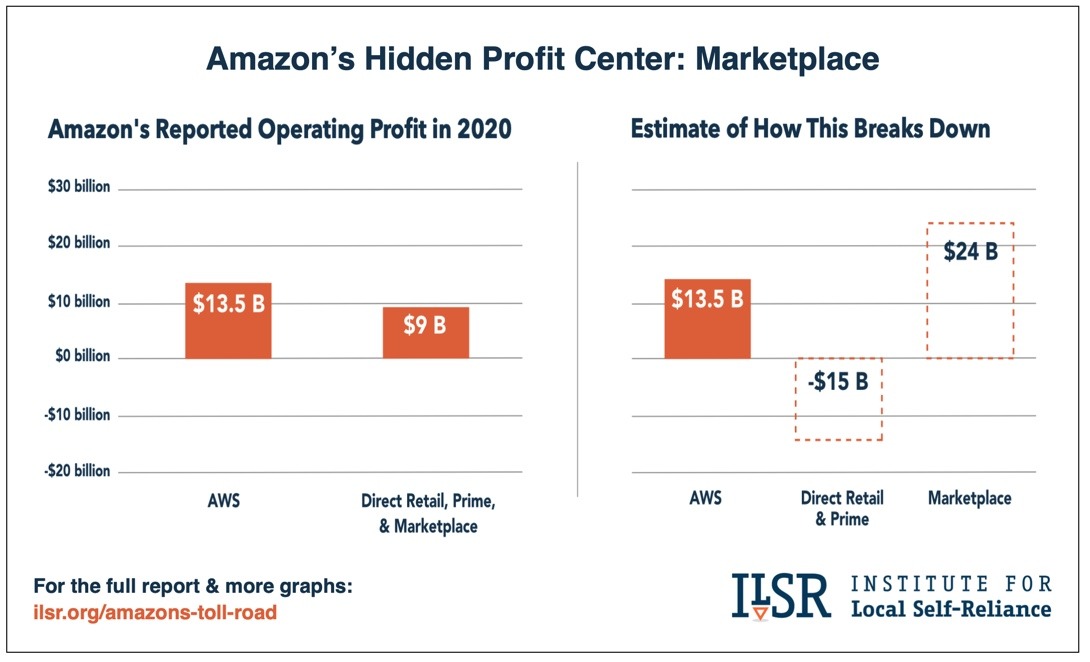
The other claim made by the report is that Amazon is using creative accounting to mask the enormous revenues generated by seller fees, grouping the huge profits of the Marketplace division with enormous losses incurred in building out their shipping infrastructure. Sure, they’re related — but it’s hardly forthcoming to present an aggregate of two wildly different numbers and claim it represents the business accurately. This is not a new allegation, but Mitchell puts specific numbers on it for 2020, making it more than a general idea.

A diagram showing how one aggregate number might misrepresent the actual profits and losses happening within Amazon.

Image Credits: ILSR

“We conclude that seller fees likely generate more profit than AWS. This contradicts conventional wisdom about the company; news stories commonly describe AWS as the source of most of Amazon’s earnings,” writes Mitchell in the summary. “Drawing on analysts’ estimates of the margins Amazon likely earns on seller advertising and other seller fees, we find that Marketplace may have generated operating profits of $24 billion in 2020 — significantly more than the $13.5 billion in profit that Amazon reported for AWS. AWS has long been seen as Amazon’s cash cow. But this report finds that the tech giant has a second cash cow, which it keeps quietly out of view.”

Amazon told me that it “cannot speculate” on 2021 revenue numbers during the year, but did not respond to a follow-up question asking whether the previous years’ numbers in the ILSR report were accurate.

Some of these practices are under scrutiny by various government powers, including an FTC led by perhaps now the world’s most famous questioner of Amazon’s business practices, Lina Khan. The ILSR report is merely informative and Amazon can wave it away, but if an FTC task force is looking into similar questions and drawing similar conclusions, the company may have reason to start sweating.


from eCommerce – TechCrunch https://ift.tt/3lorEYc
via IFTTT

Markai raises $4M from Pear VC, Sea Capital and others to buy Chinese e-commerce brands

China has attracted yet another e-commerce roll-up to enter its gargantuan e-commerce market. Markai, founded by two Stanford business school grads, has joined the fray to buy out Chinese brands seeking global consumers.

So-called brand roll-ups, or e-commerce aggregators, have cropped up in Europe and the U.S. over the past few years. Usually venture-backed, they acquire small e-commerce sellers and try to scale them with a greater pool of capital, supply chain resources, and operational know-how. China not only has a long history of export manufacturing but is also home to most of the world’s Amazon sellers. Naturally, it’s the ideal sourcing destination for Markai and its like.

Other brand aggregators that have recently landed in China include Boston-based Thrasio as well as Berlin Brands Group and Razor, which are both from Germany.

China is just Markai’s starting point, as the startup plans to hunt down brands from all across Asia and bring them to a global audience.

To fund its acquisition activities, Markai recently closed a $4 million seed round led by Pear VC, an early investor in DoorDash and Gusto. The company also raised several millions of dollars in debt but declined to disclose the amount.

Another notable seed investor in Markai’s seed round is Sea Capital, the new venture investment arm of Southeast Asia’s internet conglomerate Sea Group. Sea is the parent company of household names in the region, including e-commerce site Shopee and online games company Garena.

Signia Venture Partners, Western Technology Investment, Graph Ventures and other “prominent” angels across the U.S. and Asia also participated in the round, said Markai.

Markai’s co-founders Chenyu Ren and Tim Spencer, who were roommates at Stanford, both hailed from the corporate world. But their real passion, they told TechCrunch via a video chat, is “empowering small and medium businesses in emerging markets.”

Ren’s sense of mission to empower the underdogs is rooted in his childhood during which he saw his father, a small business owner, struggled to secure financing in China. Spencer’s drive, on the other hand, came from his privilege. Thanks to his parents’ work in the airline industry, Spencer traveled extensively early on but was reminded by his parents “one’s opportunities in life are primarily a function of the circumstances of one’s birth.”

“We want to help the small guys go against the big guys,” said Spencer. “We are taking the scrappiest sellers in China and giving them the best Silicon Valley tech.”

E-commerce makeover

For years, Chinese merchants on Amazon were doing fine with their old formula. A small team of SEO experts and supply chain old-hands, steered by a well-connected boss, could rake in millions of dollars in monthly sales. But Amazon’s recent crackdown on blackhat tactics like fake reviews led to the purging of hundreds of Chinese sellers. The ones who survive sense an urgency to reform and play by Amazon’s ever-tightening rules.

Many sellers feel that they can no longer compete on price; branding and operational efficiency are increasingly important to long-term success. They realize these are gaps that Western brand aggregators with a focus on data and methodologies could fill.

“Sellers in the U.S. and China have the exact opposite problems,” Spencer suggested. “U.S. brands often have great brands and reviews but they don’t know what they are doing on the supply chain side. That’s why aggregators have value for them.”

“Chinese sellers are great at supply chains and pricing but not so in marketing and branding, so we are coming in to clean things up,” he added.

Markai believes its roll-up approach in China is unique. Besides deal-sourcing employees, it has also hired a supply chain crew in China led by Ren. Having an on-the-ground team that can knock on factory doors is critical in an industry built on trust and relationships, said Ren, who grew up in a small manufacturing compound in central China.

In the U.S., Spencer spearheads a data team that analyzes marketplaces as well as direct-to-consumer brands. That consumer insight, in turn, will determine what its factory partners make in China and what channels to sell on.

Like many e-commerce operators these days, Markai looks to Shein for inspiration. The rising fast-fashion brand has impressed the retail industry with its demand-based model. With large swathes of real-time consumer data, Shein is able to forecast demand; thanks to its network of small and nimble suppliers in southern China, it can churn out new products faster than Zara.

Markai declined to share its acquisition progress in China. It has a team of ten now and aims to reach fifteen by next February. Despite the rush of foreign brand aggregators into China, the founders believe there’s ample room for multiple players.

“Most of the brands we met in China don’t even know selling their business is an option,” said Spencer.


from eCommerce – TechCrunch https://ift.tt/3oc1RnV
via IFTTT

HS2022: The next challenge for cross-border ecommerce

HS2022: The next challenge for cross-border ecommerce

Parcel shipments will be delayed at customs if postal operators, carriers and their customers are not prepared for the arrival of Harmonised System 2022, according to a cross-border data specialist.

In a month’s time, on January 1st 2022, the World Customs Organisation (WCO) will implement the 7th edition of its Harmonised System, bringing sweeping changes to how importers and exporters determine and assign HS codes to many of their products.

The Harmonised System serves as the international basis for customs tariffs and the compilation of international trade statistics in more than 200 countries around the world.

The new HS 2022 edition introduces over 370 new HS codes and more than 100 deletions, covering a wide range of goods across industries. Among the items affected are e-cigarettes and other vaping products, cameras, drones, lighting and antiques.

Martin Palmer, Chief Content and Compliance Officer, Hurricane Commerce - Cross-border data competency “can ease supply chain pressures” HS2022“This is the first HS update since 2017 so is a significant moment for anyone involved in cross-border ecommerce. For many retailers and shippers, the data requirements will change in areas including HS codes and duty and VAT rates, as well as having implications for prohibited and restricted goods screening. One of the biggest impacts will be around the accuracy of the landed cost of a product – the total amount of sale, transport and delivery to the end customer.”
– Martin Palmer, Chief Content and Compliance Officer, Hurricane Commerce

HS2022 follows a year of seismic regulatory change affecting cross-border ecommerce.

During 2021, there has been Brexit, the US STOP Act, the European Union’s abolition of the VAT exemption on low-value goods and the introduction of the Import One-Stop Shop (IOSS).

“Customs authorities in the EU and elsewhere around the world are now starting to fully enforce these regulations with tens of thousands of shipments being held up. The HS2022 changes will have customs clearance implications unless retailers, marketplaces and their logistics partners have ensured their commodity data is complete and accurate. The regulatory changes are making cross-border ecommerce a tougher business to be involved in, but for those who harness the best possible AI-driven, real-time data solutions the growth potential is huge.”
– Martin Palmer, Chief Content and Compliance Officer, Hurricane Commerce

Hurricane’s Aura data solution covers the three critical cross-border areas of duty and tax calculation, prohibited and restricted goods screening and denied parties screening. Its world-leading denied parties service accesses over 120 global lists including the UN, EU and OFAC.

Meanwhile, the company’s Zephyr bulk clearance data enhancement service provides the real-time checking of the match between an HS6 code and / or product description, the identification of invalid descriptions and the provision of the most likely description, HS6 code and import / export codes.

Hurricane is supporting customers with ensuring their data is aligned with the HS2022 changes, giving them the peace of mind that they are fully compliant and able to focus on their number one objective of growing their cross-border revenues and profits.

“Failure to prepare for HS2022 will inevitably cause pain for cross-border traders and, importantly, their customers who will be faced with their shipments being held and delayed by customs authorities, resulting in a poor experience and the likelihood that they will think twice about shopping with the same merchant or marketplace again.”
– Martin Palmer, Chief Content and Compliance Officer, Hurricane Commerce

The post HS2022: The next challenge for cross-border ecommerce appeared first on Tamebay.


from Ecommerce – Tamebay https://ift.tt/3loKMVZ
via IFTTT

New Government – Labour Small Business Agenda

We’ve are all waking up to a new Government today, with the Labour party about to take control of the country and what should be top of your...