Amazon expands same-day Prime delivery to 6 more U.S. cities

Amazon announced this morning it’s expanding its faster, same-day delivery service to half a dozen more U.S. cities. The service, which the retailer has been working to make same-day delivery even faster over the past year, now offers consumers in a number of markets the ability to shop up to 3 million items on Amazon.com, then receive their orders in only a few hours.

To do so, Amazon invested in what it called “mini-fulfillment centers” closer to where customers lived in select U.S. markets, initially in Philadelphia, Phoenix, Orlando, and Dallas. Those customers could then shop across a dozen merchandise categories, including Baby, Beauty & Health, Kitchen & Dining, Electronics, Pet Supplies, and more. As the pandemic continued to impact Amazon’s business, in November 2020, Amazon expanded its faster same-day service to more cities, to include Nashville and Washington, D.C.

With today’s expansion, Amazon is rolling out same-day delivery to Prime members in Baltimore, Chicago, Detroit, Tampa, Charlotte, and Houston, bringing the total markets served to 12. In these markets, shoppers will be able to place orders online throughout the day then have items on their doorstep in as fast as 5 hours, Amazon says. Customers can also place orders by midnight to have their orders arrive the following morning.

The service continues to be free with no additional charges on orders over $35 that qualify for same-day delivery. Orders under $35 have a $2.99 fee for Prime customers, and a $12.99 fee for non-members. Prime membership, meanwhile, is $12.99 per month or $119 per year.

The time frame commitments for same-day delivery are the same as those Amazon promised last year when it first announced its plans to speed up Prime delivery. Orders placed between midnight and 8 AM will arrive today by 1 PM. Orders placed between 8 AM and 1 PM arrive by 6 PM; those placed between 1 PM and 5 PM will arrive by 10 PM; and those placed between 5 PM and midnight will arrive overnight by 8 AM. That means customers can place orders fairly late and receive their items before they head out of the house the next day.

Faster same-day delivery has been one of the most significant services Amazon has used to challenge rivals like Walmart and Target, who both benefit from having a large brick-and-mortar footprint that allows them to more quickly serve their customers through same-day order pickup, curbside pickup, and same-day delivery services. While Walmart partners with third-parties on its same-day service, Express delivery, largely focused on grocery, Target acquired delivery service Shipt in 2017 to bring its fast delivery services in-house.

In response to the growing competition, Amazon has been recently acquiring smaller warehouse space inside major urban metros, including in these six new markets where it’s now announcing same-day delivery, as well as larger markets, like New York, and even suburban neighborhoods. It also acquired Whole Foods for $137.7 billion in 2017, not only to more fully participate in the online grocery business, but also in part because of its large retail footprint.

As Amazon has sped up the pace of what’s available under “Prime” delivery, it has wound down its older “Prime Now” business, which was retired Aug. 30 and will be fully shut down by year-end. The separate app had allowed customers to shop items that were available in one or two hours for an additional fee.

The news follows Amazon’s earning miss last week, when the retailer fell short of Wall St.’s estimates for revenue, and gave a weaker than-expected outlook for the quarter ahead, which Amazon attributed to difficult comparisons with a time frame that included Covid lockdowns during height of the pandemic in 2020. The company reported $113.08 billion in revenue and earnings of $15.12, versus expectations of $115.2 billion and $12.30.



from eCommerce – TechCrunch https://ift.tt/3fwYOSh
via IFTTT

Suma Brands Raises $150M Series A to grow Amazon FBAs

Suma Brands Raises $150M Series A to grow Amazon FBAs

US based Suma Brands, an ecommerce platform focused on developing Amazon FBA brands into household names was launched from stealth and have announced a $150M Series A led by Pace Capital and Material alongside a credit facility led by i80 Group.

The company which was founded a year ago will use the newly raised capital to continue accelerating their pace of acquisitions of Amazon FBA businesses and expand their diverse portfolio of ecommerce brands. The company will also continue investing aggressively in their operating platform for growing acquired marketplace brands into household names.

“We’re seeing founders of Amazon FBA businesses lay the groundwork for some amazing consumer brands and we’ve been really impressed with what they’ve accomplished. We’re thrilled to reward founders for what they’ve built and leverage our enterprise-level e-commerce platform to scale their brands to the next level.”
– Andrew Savage Co-founder and CEO, Suma Brands

One entrepreneur who found success from working with Suma Brands is Annalisa DeMarta, Founder of Lone Cone (the #1 selling kid’s rain boots on Amazon for the last three years and one of the brands in the Suma family)

“Working with Suma has been a completely different experience than what I imagined selling a business would be like. Prior to meeting Suma, I spoke with a few acquisition groups to hear what was out there and none of them acknowledged the potential of what I had built, which made the relationship highly transactional. Suma understood the brand’s goals and potential and had a strong desire to achieve mutually beneficial outcomes. I’ve always had big dreams for Lone Cone and I’m fortunate I found a partner who has the vision and resources to achieve those dreams”.
– Annalisa DeMarta, Founder, Lone Cone

The post Suma Brands Raises $150M Series A to grow Amazon FBAs appeared first on Tamebay.


from Ecommerce – Tamebay https://ift.tt/2TUP10X
via IFTTT

FullStory raises $103M at a $1.8B valuation to combat rage clicks on websites and apps

Even with all the years of work that have been put into improving how screen-based interfaces work, our experiences with websites, mobile apps, and any other interactive service you might use still often come up short: we can’t find what we want, we’re bombarded with exactly what we don’t need, or the flow is just buggy in one way or another.

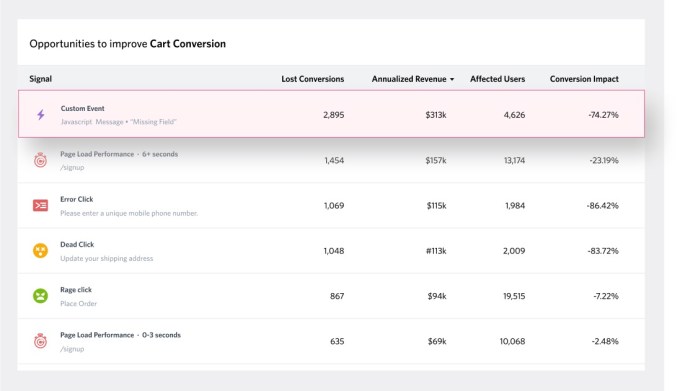
Now, FullStory, one of the startups that’s built a platform to identify when all of the above happens and provide suggestions to publishers for fixing it — it’s obsessed enough with the issue that it went so far as to trademark the phrase “Rage Clicks”, the focus of its mission — is announcing a big round of funding, a sign of its success and ambitions to do more.

The Atlanta-based company has closed a Series D round of $103 million, an oversubscribed round that actually was still growing between me interviewing the company and publishing this story (when we talked last week the figure was $100 million). Permira’s growth fund — which has previously invested in other customer experience startups like Klarna and Nexthink — is leading this round, with previous investors Kleiner Perkins, GV, Stripes, Dell Technologies Capital, Salesforce Ventures, and Glynn Capital also participating.

FullStory, which has raised close to $170 million to date, has confirmed that the investment values the company at $1.8 billion.

Scott Voigt, FullStory’s founder and CEO, tells me that FullStory currently has some 3,100 paying customers on its books across verticals like retail, SaaS, finance, and travel (customers include Peloton, the Financial Times, VMware and JetBlue), which collectively are on course to rack up more than 15 billion user sessions this year — working out to 1 trillion interactions involving clicks, navigations, highlights, scrolls, and frustration signals. It says that annual recurring revenue has to date risen by more than 70% year-on-year.

The plan now will be to continue investing in R&D to bring more real-time intelligence into its products, “and pass those insights on to customers,” and also to “move more aggressively into Europe and Asia Pacific,” he added.

FullStory competes with others like Glassbox and Decibel, although it also claims its tools have more presence on websites than its three biggest competitors combined.

Working across different divisions like product, customer success and marketing, and engineering, FullStory uses machine learning algorithms to analyze how people navigate websites and other digital interfaces.

If approved as part of the “consent gate” you might encounter because of, say, GDPR regulations, it then tracks things like when they are clicking in areas excessively over a short period of time because of delays (the so-called “rage clicks”); or when a click leads nowhere because of, for example, a blip in a piece of JavaScript; or when a person is just scrolling or moving their mouse or cursor or finger in a frustrated (fast) way — again with little or no subsequent activity (or activity from the customer ceasing altogether) resulting from it. It doesn’t use — nor does it have plans to — use eye tracking, or anything like sentiment analysis around data that customers put into, say, customer response windows.

FullStory then packages up the insights that it does collect into data streams that can be used with various visualization tools (having Salesforce as a strategic backer is interesting in this regard, given that it owns Tableau), or spreadsheets, or whatever a customer chooses to put them into. While it doesn’t offer direct remediation (perhaps an area it could tackle in the future), it does offer suggestions for alternative actions to fix whatever problems are arising.

Part of what has given FullStory a big boost in recent times (this round is by far the biggest fundraise the company has ever done) is the fact that, in today’s world, digital business has become the centerpiece of all business. Because of Covid-19 and the need for social distancing that have taken away some of the traffic of in-person experiences like going to stores, organizations that have natively or built experiences online are seeing unprecedented amounts of traffic; and they are now joined by organizations that have shifted into digital experiences simply to stay in business.

All of that has contributed to a huge amount of content online, and a big shift in mindset to making it better (and in the most urgent of cases, even more basically, simply usable), and that has resulted in the stars aligning for companies like FullStory.

“The category was so nascent to begin with that we had to explain the concept to customers,” Voigt told me of the company’s early days, where selling meant selling would-be customers on to the very idea of digital experience insights. “But digital experience, in the wake of Covid-19, suddenly mattered more than it ever has before, and the continued amount of inbound interest has been afterburner for us.” He noted that demand is increasing among mid-market and enterprise organizations, and something that has also helped FullStory grow is the general movement of talent in the industry.

“Our customers tend to take their tools with them when they change their jobs,” he said. Those tools include FullStory’s analytics.

The evolution of bringing more AI into the world of basically structuring what might otherwise be unstructured data has been a big boost to the world of analytics, and investors are interested in FullStory because of how it’s taken that trend and grown its business on top of it.

“We are very excited to partner with the FullStory team as they continue to expand and build a truly extraordinary technology brand that improves the digital experience for all stakeholders,” said Alex Melamud, who led the transaction on behalf of Permira Growth, in a statement.

“Traditional analytics have been upended by AI- and ML-enabled approaches that can instantly uncover nuanced patterns and anomalies in customer behavior,” said Bruce Chizen, a senior advisor at Permira, in a statement. “Leveraging both structured and unstructured data, FullStory has rapidly established itself as the market and technology leader in DXI and is now the fastest-growing company in the category and the de facto system of record for all digital experience data.” Chizen is joining the FullStory Board with this round.


from eCommerce – TechCrunch https://ift.tt/2TYO5Zu
via IFTTT

Suma Brands raises $150M to acquire more third-party brands for its Amazon roll-up play

Amazon has become a lynchpin in the e-commerce machine over the years in part because it’s a site we consumers can visit to buy just about anything we want — sold either by Amazon or its 5 million+ third-party merchants — and easily get it delivered to our homes. But the system is not completely efficient, and today, one of the startups looking to build more economies of scale is announcing some funding that it will use to roll up and consolidate some of these third-party merchants.

Suma Brands, which buys up what it sees as some of the more interesting and successful brands selling and fulfilling their orders via Amazon, has picked up $150 million in funding, a round led by Pace Capital and Material alongside a credit facility led by i80 Group.

As with other roll-up plays that have raised huge sums of money, the majority of Suma’s round is coming in the form of debt, which will be used for acquisitions, with a smaller equity tranche to continue building out its tech stack and core business. In this case, equity is $12.5 million and the rest is in debt. Valuation currently is not being disclosed.

Roll-up plays are rolling into town at a very fast pace at the moment — we’ve written about many of them raising money, including Elevate, Thrasio; Heyday; The Razor Group; Branded; Heroes; SellerX; Perch; Berlin Brands Group (X2); Benitago; Latin America’s Valoreo and Rainforest and Una Brands out of Asia.

In all of these, the premise is the same: Amazon has built its business on economies of scale, but that efficiency has not necessarily been played out at the marketplace level, where you still see the vast majority of sellers working as independent companies, facing all of the challenges they might face as they grow — these include the need for more sophisticated tech tools to manage areas like marketing, analytics, and supply chains; more buying power with suppliers; capital to grow; and more strategic talent succession plans.

This is where the roll-up plays step in: they provide a route for marketplace founders to potentially exit their businesses without giving them up, by giving them a chance to grow under the wing of a company looking to build the brands alongside others they are acquiring.

In the case of Minneapolis-based Suma, the startup is being led by co-founder Andrew Savage, who has a very interesting insight into the world of retail, and specifically online retail, by way of his background.

It includes years with Amazon itself, where he led teams in categories like toys, and also spearheaded the company’s push into targeting university students. Prior to that, he also worked for years at Target — where he was instrumental in building Target.com — and Best Buy.

Sidenote: these are also two Minneapolis companies, and one reason why this is such an interesting city in which to found an e-commerce startup.

He also spent time as an executive at hip, independent e-commerce company Dolls Kill, meaning he understands both the pain points of being a relatively small and indy brand, as well as the big behemoth that works to sell them on their platforms.

His two co-founders equally have interesting track records: Matt Salzberg was the founder and former CEO of Blue Apron; and Jon Dussel was the former CFO of Dolls Kill.

Savage told me he came to found Suma because he could see a clear opening to build a company to bridge the gap between small merchant and big platform better than it is today. While that might well spell economies of scale and economic opportunity — the two big motivators for other roll-up players — it feels a little more like Suma may be approaching that challenge from the operational perspective.

This will include helping manage supply chains and sourcing, running performance marketing, brand building and running multiple channels across Amazon and other properties, and providing working capital, Savage said.

“We vetted a number of potential investments in the space, but hadn’t found the right team until we talked to Suma,” said Jordan Cooper, General Partner at Pace Capital, in a statement.

“Winners are going to be exceptional operators, and the Suma team from the co-founders on down have e-commerce operations in their DNA. They’re a tested team who have proven their ability to rapidly scale e-commerce businesses,” Asher Hochberg, Managing Director at i80 Group, added.

Suma, like others in this space, declines to say how many brands it has acquired so far, nor will it spell out too many specifics on its strategy of what it wants to pick up. Some of the companies in its stable today include a children’s footwear brand Lone Cone, and Turmaquik, a turmeric supplement company.

Savage tells me that the plan is not necessarily to buy up brands and give founders an easy exit, or even to tie every star to Amazon’s rise: some who want to join Suma may stay on, and some brands might find D2C to be a better or supplementary option to Amazon. There is no winner-takes-all, nor is there a one-size-fits-all approach, simply because it’s too big, and so many brands need help.

“This is a $300 billion space, and growing at double digits,” said Savage. “It’s an ocean. And there are at least a couple of hundred thousand brands with more than $500,000 in revenues worldwide. It’s easy to get lost in that.”

Refreshingly, in a market full of a lot of the same stuff — Amazon is overpopulated with sellers who all buy the same wholesale goods, and it’s somewhat depressing when you realize that choice isn’t nearly as big as it looks on first glance — Suma is looking to forge something different simply by focusing on other things.

“What gets out of bed is not creating financial instruments but a stable that makes people feel better,” said Savage. “The thing that differentiates us is that we are very founder-focused and spend a lot of time considering this before buying a business. We are really trying to avoid the me-too businesses.”

I’ve spoken with a number of founders in this field, and one of my biggest takeaways has definitely been that it may not be a winner-take-all-market if the space is a long term winner, because each company is bringing something unique to the table that gives them a new angle for success.

The “if” in that premise is still debatable, however, not least because Amazon could easily also become a consolidator, and might be best one of all in terms of operational expertise and financial muscle.

Savage said he wasn’t sure if Amazon would ever look to repeat the roll-up approach itself, but it’s an area to watch. If the strategy is strong enough for Amazon to try to replicate itself, it’s a pretty strong signal that it is one to continue pursuing (even with that extra competition in the field).


from eCommerce – TechCrunch https://ift.tt/3ftLK0b
via IFTTT

5 types of malicious return fraud (and how to prevent them)

5 types of malicious return fraud (and how to prevent them)

A new Return to Sender report from Forter helps paint a better picture of how different types of return fraud can affect your business. There are several different types of malicious return fraud to watch out for. All of which are equally detrimental to your business’s bottom line. Here are some of the most common scenarios:

  1. Price tag switching

    Price tag switching is when a customer switches the price tag on an expensive item with one from a cheaper item, buys the item at a lower cost, and returns the item after switching the price tags back. This way, they end up pocketing the difference.
    How to prevent it: Price tags that aren’t easily removed (no stickers or interchangeable parts) can help with price tag switching. Staff should also make sure that the item on the screen matches what is being purchased when it’s scanned.

  2. Returning shoplifted items

    Returning shoplifted items is a fairly self-explanatory tactic. The customer steals items in hopes of returning them at a later date for a refund on an item they paid nothing for.
    How to prevent it: Simply requiring a valid receipt for any return should be enough to stop these fraudsters in their tracks.

  3. Receipt fraud

    Receipt fraud is similar to returning shoplifted items in the sense that it involves stolen merchandise.
    However, to avoid the problem of not having a receipt, the customer attempts to return it with an invalid receipt. This could be fabricated, stolen, or even an older receipt.

    How to prevent it: SKU’s on receipts can help with preventing receipt fraud. If the SKU doesn’t match the item, then the return should not be allowed. If SKU’s aren’t available, training employees to look for signs of a fabricated or invalid receipt can help, although it won’t entirely eliminate the problem.

  4. Shoplisting

    The fraudster obtains a receipt and uses it as a “shopping list”. By obtaining the items listed on a perfectly valid receipt, they can then attempt to return brand new items on the receipt for a refund.
    How to prevent it: Implementing a time limit in your return policy will stop fraudsters from using older receipts to return new items.

  5. Renting/Wardrobing

    A common tactic used by customers in the fashion space, wardrobing is when a customer purchases an item with the intention of using it a few times before returning it and passing it off as brand new.

    Think of someone purchasing an outfit specifically for an event. They have no use for the outfit beyond that event, so it ends up being returned despite being used. Wardrobing is often considered harmless by those who commit it, but it’s still fraud nonetheless.
    How to prevent it: Closely examining items when they’re returned for any signs of use can help here. Also, when talking about clothing, the use of tags that would make it difficult to wear the item without first removing the tag can stop fraudsters in their tracks.

Addressing the Types of Return Fraud

When it comes to return fraud, there are many tactics used by fraudsters that retailers and other businesses need to watch out for.
However, by taking certain steps and precautions, a significant amount of return fraud can be prevented.

Normally, return fraud prevention begins with a clear and easily accessible return policy. By updating and revisiting your return policy, you can ensure that you’re giving yourself the best chance of preventing these tactics from being used on you.

There are also services, such as Forter’s Policy Abuse Protection, which can help prevent return fraud by tailoring fraud prevention to your specific business and policies.

At the end of the day, these are the tactics to be on the lookout for along with some strategies to prevent them. Make sure you put them to good use and protect your bottom line.

The post 5 types of malicious return fraud (and how to prevent them) appeared first on Tamebay.


from Ecommerce – Tamebay https://ift.tt/3imQQx5
via IFTTT

Brazilian digital auto marketplace InstaCarro revs up with $23M in funding

InstaCarro, a digital marketplace that connects used car sellers to dealers in Brazil, has raised $23 million in a Series B round of funding.

Notably, U.S.-based firms co-led the investment, including J Ventures, FJ Labs and Rise Capital. Spain’s All Iron Ventures and Big Sur also participated in the financing, among others. With the latest round, São Paulo-based InstaCarro has now raised more than $56 million since its 2015 inception.

As we all know, the COVID-19 pandemic led to an increase in people all over the world buying and selling things online, with cars being no exception. InstaCarro plans to use its new capital in part to capitalize on the shift and “aggressively” expand its reach within Brazil.

Until this year, the startup operated only in São Paulo. In the first half of this year, it launched operations in eight new cities, and is now also live in Campinas, Curitiba, Joinville, Santos, Brasília, Goiânia, Rio de Janeiro and Belo Horizonte.

For context, the startup compares itself to Carvana in the U.S., Chehaoduo in India and Carro in Indonesia. 

CEO Luca Cafici started InstaCarro after having co-founded a car classified startup in Asia with Rocket Internet. That experience, according to Cafici, taught him that “car classifieds were not solving the problems people had when selling their own cars.”

Inspired by the early success of Auto1 in Europe, he decided to return to Latin America to build a similar model, with an exclusive initial focus on Brazil because it is the third largest car market in the world.

Today, InstaCarro is one of the largest used car buyers in Brazil, according to Cafici. Since its inception, the company has transacted more than R$1 billion, or US$193.2 million, working with over 35,000 people seeking to sell their cars to dealers. The startup has been growing 21% month over month since the start of COVID, and has been profitable since 2019. Profitability is up by nearly 10x compared to pre-pandemic levels, Cafici said.

Looking ahead, InstaCarro aims to become a “full-service” car trading platform after hearing from customers that they would be interested in buying a car directly through its platform as well.

Under its current model, the process seems straightforward. When a customer sells their car through InstaCarro, the company comes out to their home to inspect the car, taking more than 150 pictures, and then auctions the car through its network of over 4,000 dealers across Brazil. Customers receive a bid for their car in 24 hours, and InstaCarro pays out the customer the same day and handles all of the paperwork, according to Cafici.

“The auction is a key component to achieve a great price, as there is no agreement on what the true value of a used car is,” he added. “The more dealers you talk with, the higher price you get.” 

The startup also plans to use its new capital to “improve the coverage” of its home inspection model and improve the efficiency of its digital auction process, Cafici said. It, naturally, intends to also do some hiring. InstaCarro has 120 employees, and it plans to double that number by 2022.

Prior to the pandemic, the company had partnered with major supermarket chains to create inspection points. But with the onset of the pandemic, it began inspecting cars at the sellers’ homes, which has proven to help the company move and grow faster, Cafici said.

“The pandemic forced us to reinvent our business model. Before the lockdowns, most of our operations depended on central inspection sites, which we had to shut down overnight in March 2020,” he told TechCrunch. “For our customers, our dealers, and our team, last year was challenging and scary. Our team worked hard to reinvent our business model around home inspections, so that we could continue doing business in a safe way. We started going to our client’s driveway instead of having them come to an inspection site.”

Today, over 90% of the company’s customers choose to do everything online.

John Nordin of J Ventures said his firm was impressed by the way the company shifted its business model after COVID hit and is “now growing faster than ever.”

“We see digital car dealerships finding success in markets across the world, from the U.S. to the U.K., Indonesia and Mexico,” Nordin said. “The team or teams that build a digital car dealership in Brazil have a lot of work cut out for them, not only to figure out how to fit the model to Brazilian consumers, but also to handle the operational challenges of buying and selling a huge volume of cars every day. InstaCarro has the right team to tackle the challenges ahead.”


from eCommerce – TechCrunch https://ift.tt/3ftjnPC
via IFTTT

What Square’s acquisition of Afterpay means for startups

On Sunday Square announced it was gobbling up Afterpay in a deal worth $29 billion at the time of announcement. Alex followed up yesterday with more details on why the deal made sense for Square and Afterpay over here, but we wanted to ask some notable VCs what it means for the startup market.

For context, the Square deal follows a ton of money and interest flowing into the BNPL market. Just this year, VCs have invested in companies like Alma ($59.4 million, January 2021), Scalapay ($48 million, January 2021), Wisetack ($19 million, February 2021), Zilch ($80 million, April 2021) and Dividio ($30 million, June 2021).

Most of the investors we reached out to were generally bullish on the Square and Afterpay integration, but they were less excited about opportunities for other consumer BNPL businesses to emerge.

Then there’s Klarna, which raised $639 million at a post-money valuation of $45.6 billion in June, after raising $1 billion in March at a post-money valuation of $31 billion.

There’s also interest from some major public companies. After a slow start, PayPal is aggressively pushing BNPL services with merchants that offer it as a payment option. And there are reports that Apple is building its own BNPL offering through Apple Pay.

We reached out to Commerce Ventures founder and GP Dan Rosen,  Better Tomorrow Ventures founding partner Jake Gibson, Fika Ventures partner TX Zhuo, and Matthew Harris of Bain Capital Ventures to see what they thought of the deal, as well as what it might mean for the opportunity for other BNPL companies and startups.

The main takeaways? “Buy now, pay later” may be effective at driving retail conversion, but scale matters and long-term margins look slim for BNPL startups.

Now, let’s hear from the venture community.

The venture view

Why is the BNPL market so hot?


from eCommerce – TechCrunch https://ift.tt/3lpuBbG
via IFTTT

New Government – Labour Small Business Agenda

We’ve are all waking up to a new Government today, with the Labour party about to take control of the country and what should be top of your...