What Square’s acquisition of Afterpay means for startups

On Sunday Square announced it was gobbling up Afterpay in a deal worth $29 billion at the time of announcement. Alex followed up yesterday with more details on why the deal made sense for Square and Afterpay over here, but we wanted to ask some notable VCs what it means for the startup market.

For context, the Square deal follows a ton of money and interest flowing into the BNPL market. Just this year, VCs have invested in companies like Alma ($59.4 million, January 2021), Scalapay ($48 million, January 2021), Wisetack ($19 million, February 2021), Zilch ($80 million, April 2021) and Dividio ($30 million, June 2021).

Most of the investors we reached out to were generally bullish on the Square and Afterpay integration, but they were less excited about opportunities for other consumer BNPL businesses to emerge.

Then there’s Klarna, which raised $639 million at a post-money valuation of $45.6 billion in June, after raising $1 billion in March at a post-money valuation of $31 billion.

There’s also interest from some major public companies. After a slow start, PayPal is aggressively pushing BNPL services with merchants that offer it as a payment option. And there are reports that Apple is building its own BNPL offering through Apple Pay.

We reached out to Commerce Ventures founder and GP Dan Rosen,  Better Tomorrow Ventures founding partner Jake Gibson, Fika Ventures partner TX Zhuo, and Matthew Harris of Bain Capital Ventures to see what they thought of the deal, as well as what it might mean for the opportunity for other BNPL companies and startups.

The main takeaways? “Buy now, pay later” may be effective at driving retail conversion, but scale matters and long-term margins look slim for BNPL startups.

Now, let’s hear from the venture community.

The venture view

Why is the BNPL market so hot?


from eCommerce – TechCrunch https://ift.tt/3lpuBbG
via IFTTT

Christmas 2021 shopping starts this month for a 1/4 of Brits

Christmas 2021 shopping starts this month for a 1/4 of Brits

A quarter of Brits who celebrate Christmas say they will have started thinking about Christmas 2021 shopping before the end of August. That’s according to a new report from eBay Ads UK which suggests that greater consumer confidence in the return of the traditional Christmas could prompt people to start shopping sooner and spend more this festive season – and brands will need to act early to make the most of the opportunity.

The timing of this research is strangely apt as yesterday I was with some friends who delight in frustrating me at Christmas. Last year they gave me a Hanayama Huzzle Hourglass Puzzle which took me five frustrating days to solve… yesterday they said they’d already got an idea of what to gift me this year and I’m already dreading it! Christmas 2021 revenge gift ideas for them would be very much welcomed!

….and while we’re on the subject of Christmas 2021, that reminds me that my tree lights have a ton of broken bulbs that I couldn’t find replacements for as they are an odd size. I’d best be shopping for a new tree and new lights soon!

eBay Ads UK research, which surveyed 2,000 UK consumers who celebrate Christmas, reveals that people are feeling more optimistic about Christmas 2021 as they anticipate a more ordinary festive season than last year. Three in five respondents feel optimistic that they’ll be able to celebrate as usual this Christmas, while half think that this Christmas will feel traditional and plan to do what they always do. A quarter feel Christmas will be more exciting this year – up from just 16% in 2020.

This positivity could prompt people to prepare for Christmas earlier this year – with 27% of respondents planning to start Christmas shopping and preparations earlier than they did last year, and two fifths (41%)[1] saying they’ll have finished their Christmas shopping before December even starts. In comparison, when asked the same question in 2020, only 25% of consumers said they would plan to finish Christmas shopping before December.

And, while people report having spent slightly less, on average, on Christmas presents and celebrations in 2020 (£527.88) compared to 2019 (£551.34), this year many consumers are planning to spend more – suggesting greater confidence in their financial situation. According to the research, 30% of consumers plan to spend more, and only 15% plan to spend less. This is much more optimistic compared to 2020, when only 13% said they’d spend more, and 31% said they’d spend less.

However, despite this optimism, many people are still worried about further disruption due to Covid-19. Nearly half (45%) are likely to put off making plans for Christmas until the last minute, and 30% are so worried about more disruption that they might even celebrate Christmas early with friends or family.

“After so much stress and disruption over the past year and a half, and last Christmas especially, it’s brilliant to see Brits are finally feeling more hopeful about this year’s festive celebrations – albeit cautiously. To make the most of the opportunity this presents, brands need to start engaging with customers early on to ensure they are front of mind when it’s time to purchase. And, taking into account ongoing uncertainty, brands should also look to tap into the mindsets of their customers to make sure they are interacting with them in meaningful and relevant ways – however they are feeling this Christmas.”
– Harmony Murphy, GM Advertising UK, eBay

With a quarter of consumers planning to start researching Christmas gifts before the end of this month, it’s no surprise to find that Christmas-related searches on eBay UK started ramping up as early as August last year as well. Over the course of August 2020, the site saw a 66% boost in searches for the keywords ‘Christmas’ and ‘Xmas’ compared to July 2020.

The Sporting Goods category saw a particular surge in Christmas-related traffic, with searches up 262% in August 2020 compared to the previous month, while Christmas searches in the Clothes, Shoes and Accessories and Home & Furniture and DIY categories jumped 83% and 85% respectively.

“2020 brought us a Christmas like no other with retailers, brands and consumers having to flex and adapt plans at short notice. As we look forward to what we hope will be a less disrupted Christmas, this data from eBay demonstrates that it is even more important than ever to understand the mindset and behaviours of your audience in the run up to this crucial period.

The brands that will win this Christmas will be those that are able to use this insight to drive cultural relevance and to ensure that their campaigns reflect the diversity of their audiences. But if there is one thing that the pandemic has taught us, it’s that things can change quickly and that businesses need to be able to adapt and pivot in response, so flexibility will be key.”
– Pauline Robson, Managing Partner, MediaCom UK

The post Christmas 2021 shopping starts this month for a 1/4 of Brits appeared first on Tamebay.


from Ecommerce – Tamebay https://ift.tt/2ViyrZw
via IFTTT

4PX appoints Hurricane Commerce cross-border data partner

4PX appoints Hurricane Commerce global cross-border data partner

China’s leading cross-border ecommerce logistics provider has selected Hurricane Commerce as its global data partner. 4PX, which employs 10,000 people across more than 100 worldwide locations, provides a range of logistics, software and consulting services to over 1 million retailers selling to 200 million consumers around the globe.

Not so well known in the West, if you were based in China you’d definitely know 4PX as their expertise is rushing ecommerce purchases from China into the UK and Europe and injecting them into local delivery networks with delivery to the consumer in a matter of days.

The company aims to further grow its market share by maximising its status as the ‘ecommerce one-stop solution’. With an increasing amount of regulations governing cross-border trade, having the highest possible quality of product and shipment data has never been so important.

4PX is integrating Zephyr, Hurricane’s AI-driven, real-time data enhancement solution to ensure that product descriptions, HS6 codes and import and export codes are complete and accurate. Zephyr is lightning quick with the ability to process over 700 million requests per day with an average response time of 100 milliseconds.

Retailers, marketplaces and their logistics providers in China and the wider Asia Pacific are facing a range of regulatory challenges in 2021.

Following Brexit, the UK removed the VAT exemption on low value goods and, as of July 1, the EU followed suit in an effort to level the playing field between its own retailers and third country sellers.

The EU has introduced the Import One-Stop Shop (IOSS) to help third country retailers and marketplaces to streamline sales into the 27 EU nations, but to access the IOSS there is a need to meet the data requirements of the Super Reduced Data Set.

Chinese merchants are also having to meet a higher quality threshold for data provision on shipments into the United States as a result of the enforcement of the US STOP Act.

Cross-Border the easy way - Hurricane Tamebay White Paper for yourcross-border ecommerce businessDownload your free copy of Cross-border the easy way – The path to happy selling, shipping & returns today to learn more about cross-border data and why it’s essential to get your cross-border ecommerce data right.


“We aim to provide our merchants with an end-to-end cross-border ecommerce solution. Having the right data for your products is an essential first step in this process and becoming increasingly important as the EU, UK and other countries around the world take away the VAT exemption on low value items. Having accurate product descriptions and HS6 codes means ensures that you are calculating the taxes and duties that are applicable wherever you are shipping in the world. This will mean faster clearance through customs and the best possible consumer experience.

4PX is delighted to be partnering with Hurricane Commerce and to be able to make its best-in-class cross-border data solutions available to our merchants.”
– Derek Wang, Director Logistics Product and Network, 4PX

“4PX is recognised around the world as China’s number one cross-border ecommerce solutions provider. We are looking forward to enabling them to continue to innovate and enhance the services they are able to make available to their customers through the provision of our suite of industry-leading data solutions.”
– Martyn Noble, CEO, Hurricane Commerce

Hurricane is partnering with ELI Holdings, a UK-China business organisation, in helping Chinese companies involved in international ecommerce. ELI is led by its Chairman James Wang.

The post 4PX appoints Hurricane Commerce cross-border data partner appeared first on Tamebay.


from Ecommerce – Tamebay https://ift.tt/2Vi4pVM
via IFTTT

Demand Curve: Questions you need to answer in your paid search ads

Around 15% of website traffic comes through paid search ads. But to turn passive searchers into active shoppers, your ads should answer their question and entice them to click.

We’ve tested thousands of paid search ads at Demand Curve and through our agency Bell Curve. This post breaks down 14 questions your paid search ads should answer to ensure you’re only paying for the highest-intent shoppers.

Question 1: “What’s in it for me?”

An important distinction between paid search and organic search is that paid ads are an interruption. Users of search engines are simply looking for an answer to their question. The people who see your ads don’t owe you anything. Just because you’re paying to have your ad show up first doesn’t mean they’re going to pay attention to it.

To generate genuine interest in your paid ads, reframe your offer as a favor.

You can do this in two ways:

  • Describe the features of your product as the solution to your customers’ problem.
  • Emphasize the outcome your customer seeks.

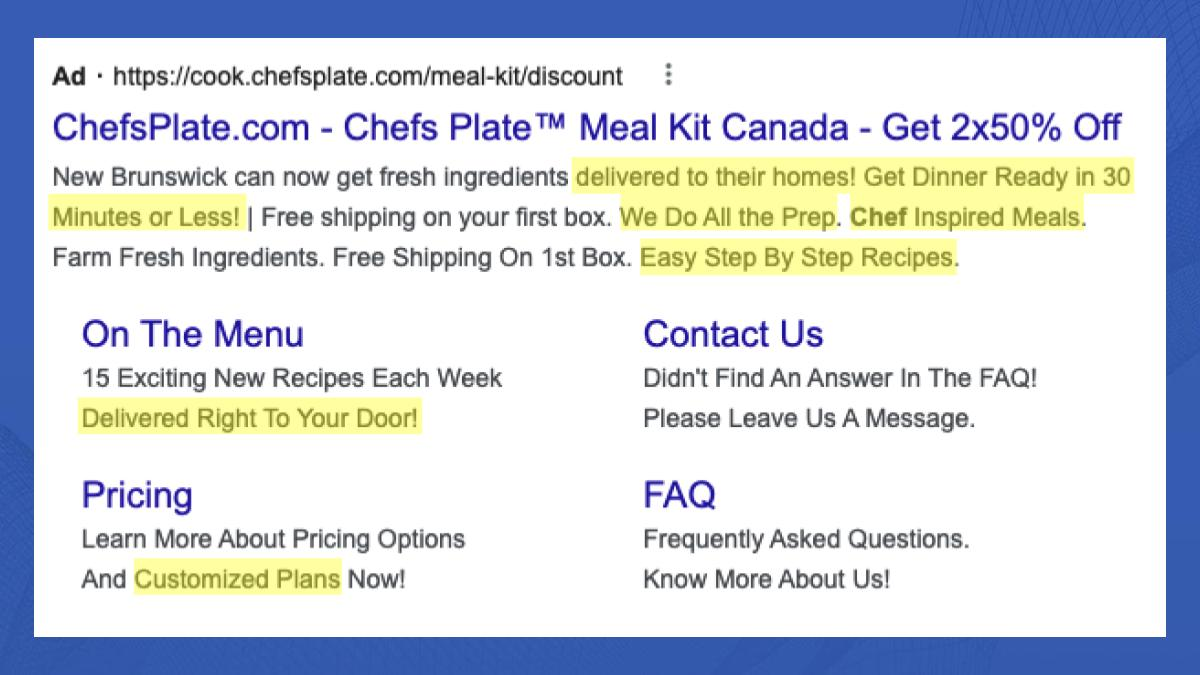
For example, reframing free delivery as an extra convenience makes the offer that much more attractive.

Use ad extensions by listing additional benefits in the description of the page. For example, including “customized plans” in the pricing extension page signals to your customer that they’ll have control over the cost. This will help to attract the curiosity of even the most cost-conscious buyers.

To capture genuine interest in your paid ads, re-frame your offer as a favor.

Image Credits: Demand Curve

Question 2: “Why should I buy now?”

Approximately 80% of e-commerce shopping carts are abandoned, mostly because shoppers don’t feel any urgency to complete the transaction. Online shoppers aren’t in any rush, as the internet is open 24/7 and inventory feels unlimited.

Use ad copy that bridges the gap between their problem and your solution. The easiest way to create that curiosity bridge is by asking a question.

To answer the question, “Why should I buy now?”, you’re going to have to create an incentive to get them to take action now.


from eCommerce – TechCrunch https://ift.tt/3xhMOKn
via IFTTT

Mixlab raises $20M to provide purrfect pharmacy experience for pet parents

Pet pharmacy Mixlab has developed a digital platform enabling veterinarians to prescribe medications and have them delivered — sometimes on the same day — to pet parents.

The New York-based company raised a $20 million Series A in a round of funding led by Sonoma Brands and including Global Founders Capital, Monogram Capital, Lakehouse Ventures and Brand Foundry. The new investment gives Mixlab total funding of $30 million, said Fred Dijols, co-founder and CEO of Mixlab.

Dijols and Stella Kim, chief experience officer, co-founded Mixlab in 2017 to provide a better pharmacy experience, with the veterinarian at the center.

Dijols’ background is in medical devices as well as healthcare investment banking, where he became interested in the pharmacy industry, following TruePill and PillPack, which he told TechCrunch were “creating a modern pharmacy model.”

As more pharmacy experiences revolved around at-home delivery, he found the veterinary side of pharmacy was not keeping up. He met Kim, a user experience expert, whose family owns a pharmacy, and wanted to bring technology into the industry.

“The pharmacy industry is changing a lot, and technology allows us to personalize the care and experience for the veterinarian, pet parent and the pet,” Kim said. “Customer service is important in healthcare as is dignity and empathy. We kept that in mind when starting Mixlab. Many companies use technology to remove the human element, but we use it to elevate it.”

Mixlab’s technology includes a digital service for veterinarians to streamline their daily medication workflow and gives them back time to spend with patient care. The platform manages the home delivery of medications across branded, generic and over-the-counter medications, as well as reduces a clinic’s on-site pharmacy inventories. Veterinarians can write prescriptions in seconds and track medication progress and therapy compliance.

The company also operates its own compound pharmacy where it specializes in making medications on-demand that are flavored and dosed.

On the pet parent side, they no longer have to wait up to a week for medications nor have to drive over to the clinic to pick them up. Medications come in a personalized care package that includes a note from the pharmacist, clear and easy-to-read instructions and a new toy.

Over the past year, adoptions of pets spiked as more people were at home, also leading to an increase in vet visits. This also caused the global pet care industry to boom, and it is now projected to reach $343 billion by 2030, when it had been valued at $208 billion in 2020.

Pet parents are also spending more on their pets, and a Morgan Stanley report showed that they see pets as part of their family, and as a result, 37% of people said they would take on debt to pay for a pet’s medical expenses, while 29% would put a pet’s needs before their own.

To meet the increased demand in veterinary care, the company will use the new funding to improve its technology and expand into more locations where it can provide same-day delivery. Currently it is shipping to 47 states and Dijols expects to be completely national by the end of the year. He also expects to hire more people on both the sales team and in executive leadership positions.

The company is already operating in New York and Los Angeles and growing 3x year over year, though Dijols admits operating during the pandemic was a bit challenging due to “a massive surge of orders” that came in as veterinarians had to shut down their offices.

As part of the investment, Keith Levy, operating partner at Sonoma Brands and former president of pet food manufacturer Royal Canin USA, will join Mixlab’s board of directors. Sonoma Brands is focused on growth sectors of the consumer economy, and pets was one of the areas that investors were interested in.

Over time, Sonoma found that within the veterinary community, there was space for a lot of players. However, veterinarians want to home in on one company they trust, and Mixlab fit that description for many because they were getting medication out faster, Levy said.

“What Mixlab is doing isn’t completely unique, but they are doing it better,” he added. “When we looked at their customer service metrics, we saw they had a good reputation and were relentlessly focused on providing a better experience.”



from eCommerce – TechCrunch https://ift.tt/3xnFGMx
via IFTTT
What are the barriers to long term ecommerce growth

What are the barriers to long term ecommerce growth

At Tamebay Live in May, Tony Kyberd, Head of Platforms at ecommotors, presented the results of a Tamebay survey in a session titled ‘Your long term ecommerce strategy – a ‘how to’ guide’, which examined the barriers to long term ecommerce growth. You can watch this session on the Tamebay Live website, but today we can also reveal the full results of the survey have been published and are available for you to download from the ecommotors website.

The key findings of the 2021 survey of Tamebay readers reveal lessons learned by ecommerce businesses, the blockers to their growth, and their focus areas for the future. 2020 and the first few months of 2021 ushered in a period of unprecedented challenges and opportunities for the world of retail. We’d like to thank all those who took the time to provide us with their responses which form the lessons, insights and priorities for all sellers.

In this report you will discover the survey findings as well as uncovering the ‘Big 7’ – the 7 areas that will be key to long term ecommerce growth:

  • Survey demographics
  • Activities online and cross-border
  • The story of 2020
  • Systems priorities
  • Reporting priorities
  • Biggest barriers
  • Looking forward
  • Future focus
  • The big 7 areas that will be key to ecommerce prosperity

Download the full report from the ecommotors website.

You can also watch the session in which these results were discussed on the Tamebay Live website or below:

The post What are the barriers to long term ecommerce growth appeared first on Tamebay.


from Ecommerce – Tamebay https://ift.tt/3C9hzVs
via IFTTT

Bloom & Wild kick off Royal Mail’s Sunday delivery service

Bloom & Wild kick off Royal Mail’s Sunday delivery service

Consumers across the UK can now have flowers delivered on a Sunday as Bloom & Wild become the first company to take advantage of Royal Mail’s Sunday delivery service.

“Royal Mail has been a trusted partner for Bloom & Wild for many years and we are very excited to launch Sunday delivery which allows us to respond to our customers’ needs and offer free delivery of our flowers, plants and gifts seven days a week.”
– Henry Mower, Director of Fulfilment & Delivery, Bloom & Wild

The introduction of a commercial, seven-day parcel delivery capability for major retail customers is one of the ways that Royal Mail is responding to the growth in parcel volumes as more and more consumers shop online and want to receive their purchases as quickly as possible after placing their orders. With some online marketplaces and couriers already offering sunday delivery options this implementation will allow royal mail to feed the consumer demand for Sunday deliveries. It also paves the way for a future where Sunday delivery options are much more feasible in all realms of ecommerce.

Royal Mail’s Sunday delivery service for Bloom & Wild is an extension of a positive ongoing business relationship between both companies. Royal Mail has been a delivery partner for Bloom & Wild since the business was founded in 2013. Bloom & Wild was the first customer to use Royal Mail’s later acceptance times to accept orders later in the day for next day delivery.

“Royal Mail has had a really strong working partnership with Bloom & Wild since they were founded. We love innovative customers and Bloom & Wild are always quick to adopt our new services, the latest of which is our really successful introduction of Sunday deliveries. Bloom & Wild were also the first customer to use our Later Acceptance network and now they are one of our first Sunday delivery customers. We look forward to introducing many more innovative solutions with Bloom & Wild in the future.
– Nick Landon, Chief Commercial Officer, Royal Mail

The post Bloom & Wild kick off Royal Mail’s Sunday delivery service appeared first on Tamebay.


from Ecommerce – Tamebay https://ift.tt/3yjXWHZ
via IFTTT

New Government – Labour Small Business Agenda

We’ve are all waking up to a new Government today, with the Labour party about to take control of the country and what should be top of your...