Wayflyer raises $76M to provide ‘revenue-based’ financing to e-commerce merchants

Wayflyer, a revenue-based financing platform for e-commerce merchants, has raised $76 million in a Series A funding round led by Left Lane Capital.

“Partners” of DST Global, QED Investors, Speedinvest and Zinal Growth — the family office of Guillaume Pousaz (founder of Checkout.com) — also put money in the round. The raise comes just after Wayflyer raised $100 million in debt funding to support its cash advance product, and 14 months after the Dublin, Ireland-based startup launched its first product.

With an e-commerce boom fueled by the COVID-19 pandemic, Wayflyer is the latest in a group of startups focused on the space that has attracted investor interest as of late. The company aims to help e-commerce merchants “unlock growth” by giving them access to working capital (from $10,000 up to $20 million) so they can improve cash flow and drive sales. For example, more cash can help these merchants do things like buy more inventory in bulk so they can meet customer demand and save money. 

In a nutshell, Wayflyer uses analytics and sends merchants cash to make inventory purchases or investments in their business. Those merchants then repay Wayflyer using a percentage of their revenue until the money is paid back (plus a fee charged for the cash advance). So essentially, the merchants are using their revenue to get financing, hence the term revenue-based financing. The advantage, Wayflyer says, is that companies make repayments as a percentage of their sales. So if they have a slow month, they will pay back less. So, there’s more flexibility involved than with other mechanisms such as traditional bank loans.

Co-founder Aidan Corbett believes that in a crowded space, Wayflyer’s use of big data gives it an edge over competitors.

Corbett and former VC Jack Pierse spun Wayflyer out of a marketing analytics company that Corbett had also started, called Conjura, in September 2019.

“Jack came to me and said, ‘You should stop using our marketing analytics engine to do these big enterprise SaaS solutions, and instead use them to underwrite e-commerce businesses for short-term finance,’ ” Corbett recalls.

And so he did.

“We just had our heads down and started repurposing the platform for it to be an underwriting platform,” Corbett said. It launched in April 2020, doing about $600,000 in advances at the time. In March of 2021, Wayflyer did about $36 million in advances.

“So, it’s been a pretty aggressive kind of growth,” Corbett said.

Over the past six months alone, the company has seen its business grow 290% as it has deployed over $150 million of funding across 10 markets with a focus on the U.S., the United Kingdom and Australia. About 75% of its customers are U.S. based.

Wayflyer plans to use its new capital toward product development and global expansion with the goal of entering “multiple” new markets in the coming months. The company recently opened a sales office in Atlanta, and also has locations in the U.K., the Netherlands and Spain.

To Corbett, the company’s offering is more compelling than buy now, pay later solutions for consumers for example, in that it is funding the merchant directly and able to add services on top of that.

“There’s a lot more opportunity for companies like ourselves to differentiate because essentially, we focus on the merchants. And when we underwrite the merchant by getting data from the merchant, there’s a lot of additional services that you can put in on top,” Corbett explained. “Whereas with buy now, pay later, you get information on the consumer, and there’s not as much room to add additional services on top.”

For example, if a business requests an advance and either is not approved for one, or doesn’t choose to take it, Wayflyer’s analytics platform is free to anybody who signs up to help them optimize their marketing spend.

“This is a critical driver of value for e-commerce businesses. If you can’t acquire customers at a reasonable price, you’re not going to be around very long. And a lot of early-stage e-commerce businesses struggle with that,” Corbett said.

It also can pair up a merchant with a marketing analytics “specialist” to analyze its marketing performance or an inventory “specialist” to look at the current terms and price a business is getting from a supplier.

“Our focus from the very beginning is really supporting the merchants, not just providing them with working capital,” Corbett said.  

Another way the company claims to be different is in how it deploys funds. As mentioned above, merchants can pay the money back at varied terms, depending on how sales are going. The company makes money by charging a principal on advances, and then a “remittance rate” on revenues until the total amount is paid back.

“We tend to be more flexible than competition in this way,” Corbett said. “Also, some competitors will pay invoices on merchants’ behalf or give them a pre-charged card to use on advertising spend,” Corbett said. “We always give cash into a merchant’s account.” 

Wayflyer recently inked an agreement with Adobe Commerce, a partnership it said would provide a new channel to further amplify its growth with the goal of funding 8,000 e-commerce businesses in the first year of the partnership.

For his part, Left Lane Capital Partner Dan Ahrens said that his firm was impressed by Wayflyer’s “nuanced understanding of what will drive value for their clients.”

“The team’s focus, specialization, and deep analytical expertise within the e-commerce market also drives superior underwriting,” he told TechCrunch. “Their explosive growth has not come about by taking on undue risk. We are big believers that their underwriting will only improve with scale, and that Wayflyer will be able to compound its competitive advantages over time.”

As mentioned, this is an increasingly crowded space. Earlier this month, Settle announced it had raised $15 million in a Series A funding round led by Kleiner Perkins to give e-commerce and consumer packaged goods (CPG) companies access to non-dilutive capital.



from eCommerce – TechCrunch https://ift.tt/2R0aofQ
via IFTTT

TikTok Shopping increases 553% during pandemic

TikTok Shopping increases 553% during pandemic

New research from Bazaarvoice’s Influenster community reveals that TikTok shopping has grown exponentially in popularity during the pandemic, with a 553% increase in the last 12 months – almost three times the growth of shopping on Instagram (189%) and Facebook (160%).

TikTok Shopping vs other Social Platforms

As a prime destination for visual content, Instagram is ahead in the social commerce game, with 64% of consumers shopping from the platform in the last year, followed by Facebook shopping (45%) and TikTok shopping (24%). The popularity of TikTok’s short-form video content sees it challenge the Facebook monopoly for consumer spend and attention. Another platform to watch out for is Pinterest, which has seen a 356% growth in consumers making purchases in the past 12 months.

Social commerce driving ecommerce

The research of 3,272 UK consumers finds that the influence of social media on consumers’ shopping preferences has grown significantly over the last year, with social platforms increasingly becoming the first port of call for shoppers looking to discover products and make purchases. There continues to be growing potential for social commerce, with over three quarters (79%) of consumers now more influenced to shop on social platforms than they were a year ago. This comes as the number of those ‘always’ shopping from their smartphone increased by a significant 214%, and those who ‘always’ shop from social media increased by 146%.

Ed Hill, SVP EMEA, Bazaarvoice on Tiktok Shopping“The impact of the pandemic on social commerce is significant. Over the past year, commerce has become a cornerstone feature for social platforms, as consumers have spent more time on social apps.
Brands that have realised this opportunity have succeeded, as consumers are now more likely to see – and be influenced by – brand advertising, user generated content (UGC) and influencer posts.”
– Ed Hill, SVP EMEA, Bazaarvoice

Out with the old, in with the new

The ability to browse and discover new products and brands online has often been stumbling block for ecommerce in recent years, however 70% of consumers indicated that they had used social media to shop for a new brand in the last year. In fact, almost half (49%) had actually opted for a new brand over their go-to-brand thanks to social media. The relevancy of a product (47%) is the top driver behind why consumers chose a new brand from social media, followed by a product’s benefits, features or ingredients (41%), the visual content produced by the brand (27%), and ultimately price (27%).

Brand loyalty has been knocked somewhat in recent months as demand overtook availability, and now over half of consumers (56%) noted that they are ‘sometimes’ influenced to buy from an unknown brand based on having seen it on social media. For unknown brands, a product’s benefits, features or ingredients becomes increasingly important (45%), ahead of relevancy (43%) and price (29%).

“Product and brand discovery on social media is growing, and while this provides retailers with new opportunities to reach consumers, it also makes it all the more challenging for brands to build and maintain customer loyalty. To stand out on these platforms, brands and retailers must distribute content to all the places shoppers find their products, from in-store to search to social.

By incentivising consumers to buy their products on social, retailers can take them from the point of product inspiration and discovery, all the way through to purchase without even leaving an app. Social commerce isn’t simply about making posts shoppable though, retailers need to take customers from just buying online to truly shopping online with an engaging and inspirational shopping journey”
– Ed Hill, SVP EMEA, Bazaarvoice

The post TikTok Shopping increases 553% during pandemic appeared first on Tamebay.


from Ecommerce – Tamebay https://ift.tt/34jKtCX
via IFTTT

Italy’s Commerce Layer raises $16M led by Coatue for its headless commerce platform

“Headless” commerce — a set of tools that companies can use with their own customized front ends to build apps for selling goods and services — have become a huge business, not just because companies are seeing a bigger demand than ever before for people buying online, but because those companies are generally more focused in their own strategies around how and what they want to present to the world.

Today, one of the companies building headless tools is announcing a round of funding as it continues to expand its business.

Commerce Layer, which provides a set of APIs for businesses to build e-commerce apps with their own, customized front ends, has raised $16 million — money that it will be using to continue expanding its business and adding more commerce tools into its API library.

Currently Commerce Layer provides tools to build your own mobile, wearable and voice apps, point of sale solutions, subscriptions, and multi-vendor commerce models (as you might have in a marketplace), along with services like building your own shopping carts and turning print catalogues into interactive, “shoppable” digital experiences.

Filippo Conforti, the CEO and co-founder, said it plans to bring in a lot of new features. On the roadmap are new developer dashboard, a command-line interface (CLI) and order management system, and a hosted checkout application, metrics API, a reporting application, and better support for subscription and marketplace models.

This latest Series B round is being led by Coatue Management, with general partner Caryn Marooney (who has led comms at Facebook, among many other high-ranking comms roles) taking a seat on Commerce Layer’s board. Previous investors Benchmark and Mango Capital also participated. Benchmark led Commerce Layer’s Series A about a year ago.

That round came at a very key moment for the startup. Based just outside of Florence, Italy, and coming just on the heels of the first rush of Covid-19 cases in Europe — where for a time Italy was the epicenter of the pandemic — it was an early sign not just of how startups were able to keep working, but how investors were willing to back the best of them, even in times of uncertainty.

It also turned out that e-commerce became one of the big stories out of 2020, as more consumers went to digital channels to shop at a time when they couldn’t go to stores as easily, if at all.

That has definitely had a knock-on effect for Commerce Layer. Conforti told me that the company saw its revenues grow 6x in the last year — albeit it was starting from a small place, with only six customers on its books back in May 2020. It now has around 26 businesses using its tools, he said, including Chilly’s, Brioni, SumUp, Paradox Interactive and Coca Cola Embonor (a company that works under a Coca Cola license to make and distribute drinks in Chile and Bolivia).

The interesting thing about “headless” platforms is that they are becoming a much bigger part of the equation whe it comes to building and running e-commerce experiences. That seems to be a sign not just of how the sector continues to mature in terms of retailers and how they are looking for more than a plug-and-play, one-size-fits-most approach in their own strategies. It also speaks to the growing range of permutations of how and where people sell today, and the need for tools to address that.

While Commercetools is one of the bigger “headless” commerce providers, and whose founder even coined the term “headless commerce”, there are a number of others now building tools to help companies build more unique e-commerce experiences, including the likes of Spryker, Swell, Fabric, Chord, and Shogun. Even Shopify has stepped into the fray with Shopify Plus.

“eCommerce has become core to our everyday lives. As a result, big brands and enterprises need better ways to shift from retail and build exceptional online storefronts. We believe that Commerce Layer is building the API platform for this new category, and we’re incredibly proud to join them in pursuing their ambitious and exciting vision,” said Marooney in a statement.


from eCommerce – TechCrunch https://ift.tt/3oSz6ep
via IFTTT

Brands risk losing customers after a bad returns experience

Brands risk losing customers after a bad returns experience

New research released by Klarna has revealed that over eight in ten (84%) online shoppers would turn their back on a retailer after a bad returns experience.

It’s no secret that in an attempt to avoid the Coronavirus people flocked online to do their shopping. Klarna’s data reveals that 39% of consumers have increased their online shopping habits since the pandemic which brings with it, increased reliance on returns and depending on how brands handle it, an increased risk of a bad returns experience.

With many big brands continuously expanding on their customer experience offerings and providing efficient and speedy services, the expectations of consumers begin to change. It’s clear that consumers expect brands to go above and beyond when they have a problem and when demand is high for the smoothest experience possible and some brands offering it without hesitation they begin to expect that across the board. Expectations can be the reason for patience depleting fast and frustrations rising quickly.

Consumers expect easy returns:

Consumers’ patience is waning when it comes to clunky or costly returns processes. 83% of online shoppers admit to getting frustrated by retailers which have an inefficient returns process, while 82% agree that retailers, in general, need to improve their returns capabilities.

Some of Brits’ biggest frustrations with returns stem from the inconvenience of slow, out of date or inflexible returns processes. Over a third (36%) cited slow refund processes as the most frustrating element of returning items bought online, highlighting the importance of flexible payment options. Other frustrations include having to print off return forms when they don’t have a printer (25%), the inconvenience of queuing to return at the post office (23%) and not being able to return items in store that they’ve bought online (21%). Some consumers will even keep an item they want to return because it is too much effort to return it, which also means they may avoid buying again from brands that don’t meet their needs.

Boost customer loyalty with easy returns

For those brands that get returns right, this can serve as a competitive advantage, helping to attract new customers, and boost customer loyalty. 84% of online shoppers agree they’re more likely to buy from and 86% are more likely to come back to online merchants who offer free returns. However, even a little added inconvenience can come at a cost: over two thirds (70%) of online shoppers state that if a preferred retailer stopped offering free returns, they might not shop with them.

“Nobody wants to be out of pocket as a result of items they don’t even choose to keep, so it’s no surprise that slow refund processes are the top frustration factor when it comes to returns. As reliance on returns grows, retailers need to ensure they’re offering a smooth, seamless process that meets the needs of today’s customers – considering everything from effortless logistics to flexible payment options. As our research suggests, those that fail to adapt will lose customers in the long term.”
– Alex Marsh, Head of Klarna UK

The post Brands risk losing customers after a bad returns experience appeared first on Tamebay.


from Ecommerce – Tamebay https://ift.tt/3ce3ZoP
via IFTTT

Instagram launches a new section for shopping product drops

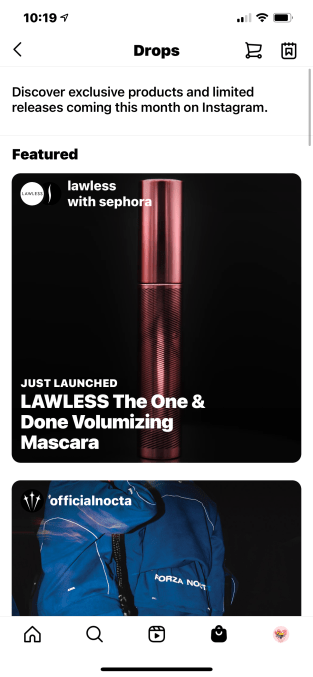
Instagram today announced it’s adding a new feature to help connect online shoppers to product drops through its app. Drops, which are a newer e-commerce trend, help sellers create buzz for forthcoming products in the days and weeks leading up to their availability. The products themselves are often only available in limited supplies or for a short period of time, increasing demand.

On Instagram, drops will now have their own destination inside the app at the top of the Shop tab, where consumers can discover, browse and shop all the latest product launches as well as view upcoming launches. Shoppers can also sign up to receive reminders about products they’re interested in from here, and look through products and collections from other drops that recently took place on Instagram.

Image Credits: screenshot of Drops on Instagram

Like other online shopping offered through Instagram, consumers can make their Drops purchases directly in the Instagram app itself via Checkout on Instagram, not by visiting third-party websites. This model will eventually allow Instagram to collect fees on purchases — something that’s become a more important part of Facebook and Instagram’s overall business model in the wake of Apple’s privacy crackdown on iOS apps that impacts Facebook’s ad revenues.

However, Instagram has temporarily waived its selling fees to both help businesses who are recovering from the last year of Covid. The move will also help it to gain ground in online shopping against new competitors, including TikTok.

Brands on Instagram had already been running drops before today, following Instagram’s release of a product reminders feature back in 2019 that allowed consumers to get notified when an item they were interested in became available for purchase. To date, brands across fashion, beauty, streetwear and others have leveraged the feature, the company says, including Hill House Home, Dragun Beauty, adidas, and others.

The new Drops location simply organizes the product launches in one place to make it easier to browse and shop. Instagram tells us it’s curating the featured drops in this section. To be considered, brands need to use the product launch feature which is available to businesses on Checkout with Instagram.

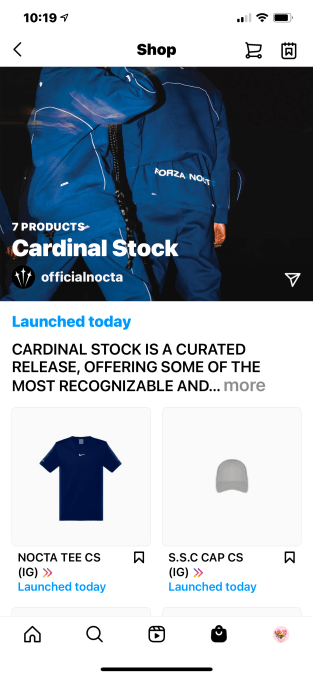
At launch, some of the drops available include today’s Drake x NOCTA ‘Cardinal Stock’ collection and upcoming drops like Wren + Glory hand-painted summer collection and Charlotte Tilbury Exclusive Pillow Talk Lips & Dreams Lashes Kit. This week, there are five total drops available. This number will vary from week to week as Instagram continues to test the new feature, the company tells us.

Image Credits: screenshot of Drops on Instagram

On an individual brand’s page inside Drops, consumers can view info like when the product became available, pricing, and other item details. They can also bookmark the item to add it to a wishlist or share the drop with a friend through Instagram’s direct messaging feature. From the top of the Drops page, users can return to their Cart or Wishlist at any time to complete the checkout — assuming they aren’t too late, of course.

In addition, the brand’s Live shopping can be scheduled to align with their product drop. When the brand goes live for a drop, there’s an on-screen countdown and confetti animation when the product becomes available.

The new feature is currently only available in the Instagram app in the U.S., and only on mobile devices (iOS and Android), not the web.


from eCommerce – TechCrunch https://ift.tt/3flmKbK
via IFTTT

Treet, with $2.8 million in seed funding, gets brands involved in the resale market

Treet, a company rethinking the resale retail market, announced the close of a $2.8 million seed round today. The financing comes from Bling Capital, Matchstick Ventures, Techstars, BABM Ventures, BBG Ventures, Green Meadow, Interlace Ventures, V1.VC, and Alante Capital.

Despite the fact that selling old clothes is the most sustainable, and most financially beneficial way to dispose of them, the process can be super tedious for both sellers and buyers.

Treet’s approach to simplifying its market and lowering consumer friction is to go through brands. Essentially, Treet helps brands set up their own resale sites where buyers and sellers can list and find items. Because Treet is tied in with the brand itself, sellers can easily list their items based on SKU and buyers can trust that the items they’re browsing are the real deal.

For brands, they get the chance to own their secondhand market and potentially gain new customers. The company says that 30 percent of buyers on Treet haven’t purchased directly from the brand before.

Involving brands benefits Treet in a big way, too. Brands are best positioned to know who has their items, and can send emails and messaging encouraging resale through Treet. They also have the distribution to put potential customers on to the resale site.

Treet gives sellers two options to redeem their funds. If they choose cash, a ten percent cut goes to the brand and a ten percent cut goes to Treet. If they choose to redeem via brand credit, only Treet takes 10 percent.

The startup’s customer list currently includes Boyish, Coclico, Altar, and époque évolution, with Goodfair and Birdy Grey launching soon.

“The greatest challenge is brands being hesitant about getting into resale,” said cofounder and CEO Jake Disraeli. “For a brand, promoting a used item with lesser margins is kind of a scary thought. We’re starting to prove out that they can expand their potential customer base and give brands the chance to participate alongside their customers who are reselling items on third-party platforms anyway.”

The clothing and fashion startup market has been active in recent quarters. The Real Real went public back in 2019, Poshmark went public last year, while fellow resale company ThreadUp held an IPO this year, and UK-based Lyst raised $85 million the other week. Treet’s funding fits neatly into the theme.


from eCommerce – TechCrunch https://ift.tt/3yAmehL
via IFTTT

Yalo raises $50M to build ‘c-commerce’ services for chat apps like WhatsApp

Facebook has long been working on raising WhatsApp’s profile as a channel for businesses to interact with (and sell to) their customers. Today, a startup that has built a suite of tools for retailers and others to build and run those services over WhatsApp and other messaging platforms is announcing growth funding to address that opportunity.

Yalo, which describes itself as a c-commerce (“chat commerce”) startup building tools for businesses to use messaging apps as part of their customer outreach and sales strategies, has raised $50 million, funding that it will be using to expand its services with a specific focus on emerging markets like Latin America and Southeast Asia.

Yalo already counts big brands like Unilever, Nestle, Coca-Cola and Walmart among the customers using its platform for sales and marketing efforts. In total that speaks to potentially an audience of 350 million, although Yaho doesn’t disclose how many people are actually using Yalo services as a part of that.

The funding is being led by B Capital, with participation from other, undisclosed, investors. Yalo, which recently rebranded from Yalochat, is on a funding roll at the moment: the company’s last round was in August, a $15 million Series B. B Capital’s investment is interesting, given Yalo’s focus on building tools for businesses to better utilize Facebook apps to interact with customers: the VC firm was co-founded by Eduardo Saverin, one of Facebook’s co-founders.

CEO Javier Mata said in an emailed interview that the reason for the swift funding was because of how fast business has been growing in the last year, part of the bigger boom for e-commerce overall.

“Covid fast forwarded us into the future and with it the need for conversational commerce increased significantly,” he said. “It went from being [one] digital commerce channel to becoming the main one.” He said that some of Yalo’s customers are seeing 80% of their sales happening on top of (and inside) messaging apps, a huge shift when you consider how reliant some brands in the consumer packaged goods sector have in the past been on more physical retail channels, whether that was a supermarket, a corner shop or a vending machine. “The market demand increased and we raised to continue overdelivering to customers.”

He added that Yalo wasn’t looking for more funding, “but then we saw an opportunity to accelerate our growth, so we did it. Everything we do is to provide value to our customers and in this case we decided to accelerate our product development so that customers would get conversational marketing, payments, and the world would get no-code builder to create all kind of conversational app sooner.”

Yalo is not disclosing its valuation with this round, CEO Javier Mata said in an email interview. The startup has raised $75 million to date, with other past investors including NXTP from Argentina and Sierra Ventures.

Founded in Mexico, now based in San Francisco, and currently active in Mexico, India, Brazil and the U.S., Yalo’s strategy is to play into the role messaging apps have taken on for consumers in many markets, but especially emerging markets, where many people “live” when on their phones, using them not just to chat to friends, but to interact with a wide range of services.

This is also something that messaging companies like Facebook, taking a page from companies like WeChat and Line in Asia, have been looking to cultivate. Over the years, WeChat and Line have leveraged their success as basic messaging apps to build out wider “super apps” covering all kinds of other forms of communication, as well as a plethora of services like payments, shopping, entertainment and news, both build by the apps themselves as well as by third parties, and now used by hundreds of millions of people.

WhatsApp is Yalo’s biggest platform “by a lot,” said Mata, with SMS in second place, so this is where a lot of its focus is right now.

While WhatsApp has been building out the facility to provide more services, Yalo has built a platform that sits in between brands and the apps themselves in order to use them. Its service — which works with other apps as well (it describes itself as platform-agnostic and able to be embedded in any messaging app) — lets agencies or the brands themselves plan and run marketing and sales campaigns, offer helpdesk services and take payments, giving customers the option to create “micro apps” to live in various messaging environments.

The emerging market focus for Yalo seems to mirror the role that messaging and mobile have taken in these markets overall. In many cases, consumers in developing economies skipped straight over using traditional computers and went online for the first time with cheap smartphones. As a result, that paved the way for consumers, whose digital consumption was more focused on mobile screens, to being more receptive and likely to use messaging apps for more than just messaging.

Mata believes that while emerging markets may have paved the way, though, more developed economies will follow.

“We went from brick and mortar to desktop apps, from apps to web apps, from web apps to mobile apps, and now the future/present is about conversational apps,” Mata said. “Conversational apps are the future because they take advantage of the messaging app that people have already downloaded and they do not need users to install or learn a new ux. It is easier to adopt a new technology when you do not need to replace a lot of legacy technology and you can just leapfrog. That is exactly what emerging markets are doing.”

He believes that “the US and other markets will get there but they will take longer, and eventually the lines between e-commerce and c-commerce will blur. You are starting to see that with text marketing, which is only a tiny fraction of conversational and it is already huge. It’s not a surprise that China is further ahead in digital than the US and conversational commerce is the predominant way of commerce through WeChat. Emerging markets leapfrog when it comes to adopting new tech.”

In the meantime, BCG estimates that c-commerce is already a $35 billion market, and will grow to $130 billion by 2025 in emerging markets alone, accounting for 60% of all digital commerce.

The question will be, then, that if this really takes off, whether the likes of Facebook will try to own the integration experience as much as owning the platform itself, or whether those who have helped to build more interesting commerce experiences on the traditional web — companies like Shopify and Magento, but also Amazon — might try to own this space too, presenting more competition down the line for Yalo.

Not an issue for now, investors say.

“Yalo has become the leading conversational commerce company, revolutionizing the way large enterprises engage with their customers and enabling them to transact through chat applications. We have been impressed with their execution and are very pleased to expand our relationship with them by leading their Series C round.” said Saverin in a statement.


from eCommerce – TechCrunch https://ift.tt/3vpF9K7
via IFTTT

New Government – Labour Small Business Agenda

We’ve are all waking up to a new Government today, with the Labour party about to take control of the country and what should be top of your...