Greece’s Viva Wallet raises $80M for its neo-bank targeting small business merchants

Challenger banks continue to make significant waves in the world of finance, with smaller outfits luring customers away from incumbents by providing an easier way for them to not only engage with basic banking services, but to tap into a wave of technology that brings more personalization and often better deals into the equation. In the latest development, Viva Wallet, a Greek startup building banking services aimed at small and medium merchants, has picked up financing of $80 million, money that it will be using to expand its footprint and the services that it is offering to users, in particular expanding its Merchant Advance loans business.

The company is already live in 23 European markets and plans soon to expand that to Croatia, Hungary and Sweden.

The funding is notable in part because of who is doing the investing. Tencent — the Chinese technology giant behind Wechat that is also making major inroads into financial services — is in the round, alongside the European Bank for Reconstruction and Development (EBRD) and Breyer Capital.

Viva Wallet is not disclosing its valuation right now, but it means business. Yannis Larios, the company’s VP of strategy and business development, confirmed to us that it’s in the middle of closing a large Series D — last August sized at €500 million ($603 million) — that will value it at €1.5 billion ($1.8 billion). This is a big leap: he also noted that when Viva Wallet closed its Series C in the second half of 2019, it was valued at €305 million.

“We are excited to onboard Tencent, EBRD and Breyer Capital to Viva Wallet,” said Haris Karonis, Founder and CEO of Viva Wallet, in a statement. “We are confident that our investors’ extensive know-how and network of partnerships will accelerate Viva Wallet’s plan to unify the fragmented European payments market. The technology innovations that we are bringing forward to European merchants will help them provide a frictionless, localised payment experience to all their clients, and liberate them from the hassle of maintaining legacy card terminals.”

The round is notable for coming at a time when Europe is slowly, hopefully poking its head out from under the weight of the Covid-19 pandemic, which has shaken and knocked over many an economy already wobbling even before the public health crisis. Focused primarily on merchants, Viva Wallet is a prime example of the kind of tech business that might help some of these critical businesses recover.

If you think that the world of neo-banks is very crowded — and that specifically neo-banks focussed on the SMB opportunity is also getting crowded — one reason why Viva Wallet is getting some attention is because of its traction and track record so far.

Larios says that the startup has been profitable as of Q1 of this year, on the back of a business that has grown by more than 40% in the last year, with 60,000 merchants currently active on its books. It’s on track, he said, for that number to be 100,000 by the end of this year.

One reason for its success, he said, is that it’s taken a very localized approach to growth, setting up operations with physical branches in each of the countries where it is active — somewhat of a retro idea in today’s market where banks are regularly shutting down their brick-and-mortar locations and going virtual. “Viva Wallet is proving the resilience of its business model,” he said.

The funding will be used in part to build out its loans program but also to expand areas where Viva Wallet is already strong. One of these is its point of sale Tap-On-Phone solution, which turns any Android device (smartphone, tablet or enterprise device) into a card terminal, to accept both contactless and PIN payments without the need for separate hardware. (Most POS systems use small, separate terminals that will connect to a tablet or phone.)

He also said there will be some M&A in the future to expand to more markets more quickly.

One area where the company will not expand is into the consumer space. Other neo-banks like Revolut and Atom have leveraged their traction with younger consumers to move into providing services for the enterprises that they found, but Larios that that is not a strategy that Viva Wallet will take in the reverse, not least because the consumer market has so far proven to be a tough-margin (or even bad-margin) game.

“Viva Wallet focuses on businesses only and will continue to do so!” he said (exclamation his!). “The consumer segment is not providing any space for profitability and we are seeing that all competing neo-bank business models focusing on consumers are mostly burning money away.

“We are focusing on the SMEs of Europe, providing a pan-European payments solution which however is very much localized to address merchants’ true local needs in terms of local payments acceptance, local IBAN accounts, local BIN business debit cards etc.” But while Viva Wallet may have a lot of SMB customers — and the EBRD investment is definitely being made to endorse that — he points out that it also includes medium businesses and some enterprises — larger merchants like supermarket chains, for example — and that will be an area it will continue to expand in.

This gives Viva Wallet enough specialization and differentiation, alongside its profitability in targeting those areas so far, to bring in the big name investors keen to tap into economic recovery, both to help that along and to ride the wave of that as it pays dividends.

“We are very excited to help Viva Wallet unify the fragmented European payments ecosystem across 23 countries. Viva Wallet is at the forefront of a paradigm shift for fintech and together, we expect to transform the payments industry in Europe” said Jim Breyer of Breyer Capital, in a statement.

“Tencent shares Viva Wallet’s aspirations of creating value for users and partners through innovation. We look forward to supporting Viva Wallet in its expansion across Europe,” added Danying Ma, MD of Tencent Investment.



from eCommerce – TechCrunch https://ift.tt/3tVihkO
via IFTTT

aisle 3 successfully raises £250,000 and why you should care

aisle 3 Logo

Ecommerce startup aisle 3 has completed a successful follow on funding round, raising £250,000 via Angel Investment Network, the world’s largest online angel investment network. Aiming to become ‘the Wikipedia of product search’ the business secured the funds in just six weeks with the company’s valuation more than doubling in the past five months. Experienced angel investors have backed the founders’ vision for a new, disruptive ecommerce marketplace offering truly personalised experiences for large networks of engaged shoppers.

ecommerce startup aisle 3 has completed a successful follow on funding round, raising £250,000 via Angel Investment Network, the world’s largest online angel investment network. Aiming to become ‘the Wikipedia of product search’ the business secured the funds in just six weeks with the company’s valuation more than doubling in the past five months. Experienced angel investors have backed the founders’ vision for a new, disruptive ecommerce marketplace offering truly personalised experiences for large networks of engaged shoppers.

This raise is the second completed successfully in just five months, with the company being backed with almost £500,000 in pre-seed funding. It represents an impressive trajectory for a startup born during the height of the pandemic that has been built entirely remotely. Founded in March 2020, aisle 3 aims to give shoppers the complete view of all of their buying options on a single screen, so that they can make purchase decisions based on their personal values such as price, delivery, locality, sustainability or brand loyalty.

What’s the big deal with aisle 3?

Having launched initially within trainers, aisle 3 aggregates retailer offers and rich product information by deploying machine learning and AI algorithms. The team has developed their proprietary web crawler, software and product aggregation algorithms from scratch. The funds will be used towards further developing the brand’s product, tech build and scaling the team.

This is actually a really interesting business – while there is a certain tranche of shoppers who always start their search on Amazon, there is another who always start on eBay. You’ll often find products on one site priced differently on the other. That’s just the two ecommerce giants in the UK – when it comes to shopping your favourite independent website how often do you compare prices and how easy is it?

Say you’re after DIY tools, do you go to eBay, Amazon, B&Q, Jewsons, Wickes, Screwfix and any number of a myriad of other DIY suppliers to check prices, or do you just check one or two sites and press the buy button? Products from manufactures like Draper or Stanley will appear on all of these sites so how do you get the best deal? aisle 3 reckon that they have the solution.

aisle 3 are also a vehicle where smaller retailers, without the budgets for paid search that the mammoth ecommerce giants have, can compete and that’s where it gets really interesting – It’s early days as trainers is a niche but vibrant category, as aisle 3 build out their platform this will be one to watch.

The co-founders Thomas J. Vosper and James Valbuena have 30+ years of collective ecommerce experience at retailers including Amazon, Tesco, Lastminute, VASHI. In a short space of time they have grown to serve 2,000 organic shoppers each day, have a waiting list of over 600 signed retailers, and 20+ Digital Agencies with more than a million products.

“We are thrilled to have conducted our second successful raise in just five months backed by our current investors who saw our progress as well as gaining the trust of significant new investors. Raising investment in any climate is very difficult and takes hours of meetings, calls and late nights; so having subject matter experts buy into our vision of building a scalable, disruptive business and cleaning up the standard of product information is a huge validation of our mission and the team we have put together.
 
We believe shoppers are short changed in getting the best deals despite the illusion of choice on the internet. Whilst it is incredibly easy to book complex products such as car insurance or flights through comparison sites it still remains impossible to find the best deal for the right size trainers without opening multiple tabs and checking a myriad of retailers.
 
We’re trying to crack the three fundamental issues in online shopping. Product comparison, product discovery and a fair marketplace for brands and retailers. Unlike the closed shop of other platforms this is a win/win for shoppers and retailers and offers a huge, positive network effect.”

– Thomas J. Vosper, co-founder, aisle 3

The post aisle 3 successfully raises £250,000 and why you should care appeared first on Tamebay.


from Ecommerce – Tamebay https://ift.tt/3xtZhvW
via IFTTT

Stripe acquires TaxJar to add cloud-based, automated sales tax tools into its payments platform

Stripe, the privately-held payments company now valued at $95 billion, has made an acquisition to expand the range of tools (and services) that it provides to online businesses. It has acquired TaxJar, a popular provider of a cloud-based suite of tax services, which can be used to automatically calculate, report and file sales taxes.

One key point about TaxJar is that it works across a number of geographies and the many different sales tax regimes that each uses — a complex area for a lot of companies that do business online.

Financial terms of the deal are not being disclosed but for some context the company was valued at $179 million post-money when it last raised money, in January 2019, according to PitchBook data.

Stripe has confirmed that all 200 employees of Woburn, MA-based TaxJar are joining the company.

Stripe will be integrating TaxJar technology into its revenue platform — where it will sit alongside Stripe Billing (its subscription tools) and Radar (its fraud prevention technology), and potentially build new services using AI and other technology to automate more functions — but businesses can continue to use TaxJar directly, too.

Launched in 2013, TaxJar today has around 23,000 customers. Stripe didn’t comment on how much of an overlap the two companies have in terms of users, but both have over the years gained a lot of traction with startups and other online businesses, which is likely one reason why TaxJar caught Stripe’s attention.

“There’s a reason TaxJar has been a top choice for businesses: their software tools make it incredibly easy to handle sales tax,” said Dhivya Suryadevara, Stripe’s CFO, in a statement. “With TaxJar, we will help millions of internet businesses running on Stripe with their sales tax and make it easier for them to sell internationally. And as a CFO, I’m delighted to welcome so many new colleagues who care deeply about tax calculation and reporting!”

When TaxJar last raised money — a $60 million round led by Rincon Venture Partners and Daher Capital in January 2019 — it said it had 15,000 customers, so that base has been growing (specifically, 53% in two years).

Stripe has actually made some moves in the area of tax before, buying Payable back in 2017 to help with 1099 reporting for customers who pay contractors and partnering with Intuit to help on-demand workers manage their finances. The TaxJar acquisition, however, is filling a noticeable gap in its native product set, as well as a pain point for its customers, specifically in the area of sales tax.

Stripe says that adding in sales tax collection and remittance — a complex system that covers as much as 11,000 tax jurisdictions in the U.S. alone — was one of the most-requested features among users, a fact that users themselves have lamented openly:

Ironically, if you link through on the above Tweet, you’ll see in one thread, TaxJar comes up in the conversation.

Indeed, TaxJar was already “fully integrated” with Stripe as a partner, meaning businesses could use TaxJar to calculate and manage sales taxes on transactions powered by Stripe. But using the two together required logging into TaxJar, creating a separate account, and then getting a unique URL to paste into your Stripe Orders settings to run the services together: not the picture of simplicity that Stripe generally presents to users.

Some of that will now become smoother for Stripe customers as part of its bigger push for more automated tools to cover the more repetitive aspects of the online sales transactions process. (Other automated areas include algorithms around payment rejection, billing methods, and so on.)

“Like everyone at Stripe, we think every day about how we can help startups and multinational companies alike remove barriers to growing their business,” said Mark Faggiano, CEO and founder of TaxJar, in a statement. “And what that means is making the complicated work of sales tax compliance as straightforward as possible. We know that to grow the GDP of the internet, compliance is critical. We couldn’t be more excited to join Stripe and help power millions of businesses around the world.”

Stripe noted that the sorts of services that TaxJar covers includes providing accurate, localized sales tax rates at checkout, submitting tax returns to local jurisdictions and remitting the sales tax collected, producing itemized, local jurisdiction reports to show sales and sales tax collected, and suggesting the right product tax code based on a company’s products.

That TaxJar is coming into the deal with its own customer base and revenue model is important for another reason: it’s a sign of more diversification for Stripe — key as the $95 billion company continues to grow and inch potentially towards a public listing, now being considered for late 2021 or early 2022, according to rumors. Other signs of that diversification strategy include Stripe’s acquisition of Paystack last year out of Nigeria to help it break into payments in Africa, a deal it made for over $200 million.

(TaxJar’s SaaS pricing starts at $19/month and goes up from there, including an enterprise tier that will be handy for Stripe’s platform product.)

Stripe made revenues of $1.6 billion (or as much as $7.6 billion!… Stripe declined to comment on both numbers) in 2020, according to this profile in the WSJ, but it was also buffeted pretty significantly by the Covid-19 pandemic. Some sectors where Stripe has played strong, like travel, saw a big drop in transactions, while others, like e-commerce, saw a much bigger surge.

One takeaway from that might be: regardless of what our “new normal” will look like, it seems that e-commerce in one form or another will continue to grow, so offering a wider range of services, like automatic sales tax calculations and reporting, around its core business of payments will help Stripe grow revenues per user to offset the ups and downs of specific business lines when and if they arise again.

The area of tax-tech sits somewhere between e-commerce and fintech and has found its own steam in recent years, following both the growing size of the e-commerce market, and the evolution in fintech, where startups are building the complex processes that are not the core competency of their target customers and putting them into products that are easy to use and integrate. Others in the same space as TaxJar include Avalara, Vertx and Sovos among a wider field of startups.


from eCommerce – TechCrunch https://ift.tt/3gIcQSH
via IFTTT

Mailchimp moves into e-commerce

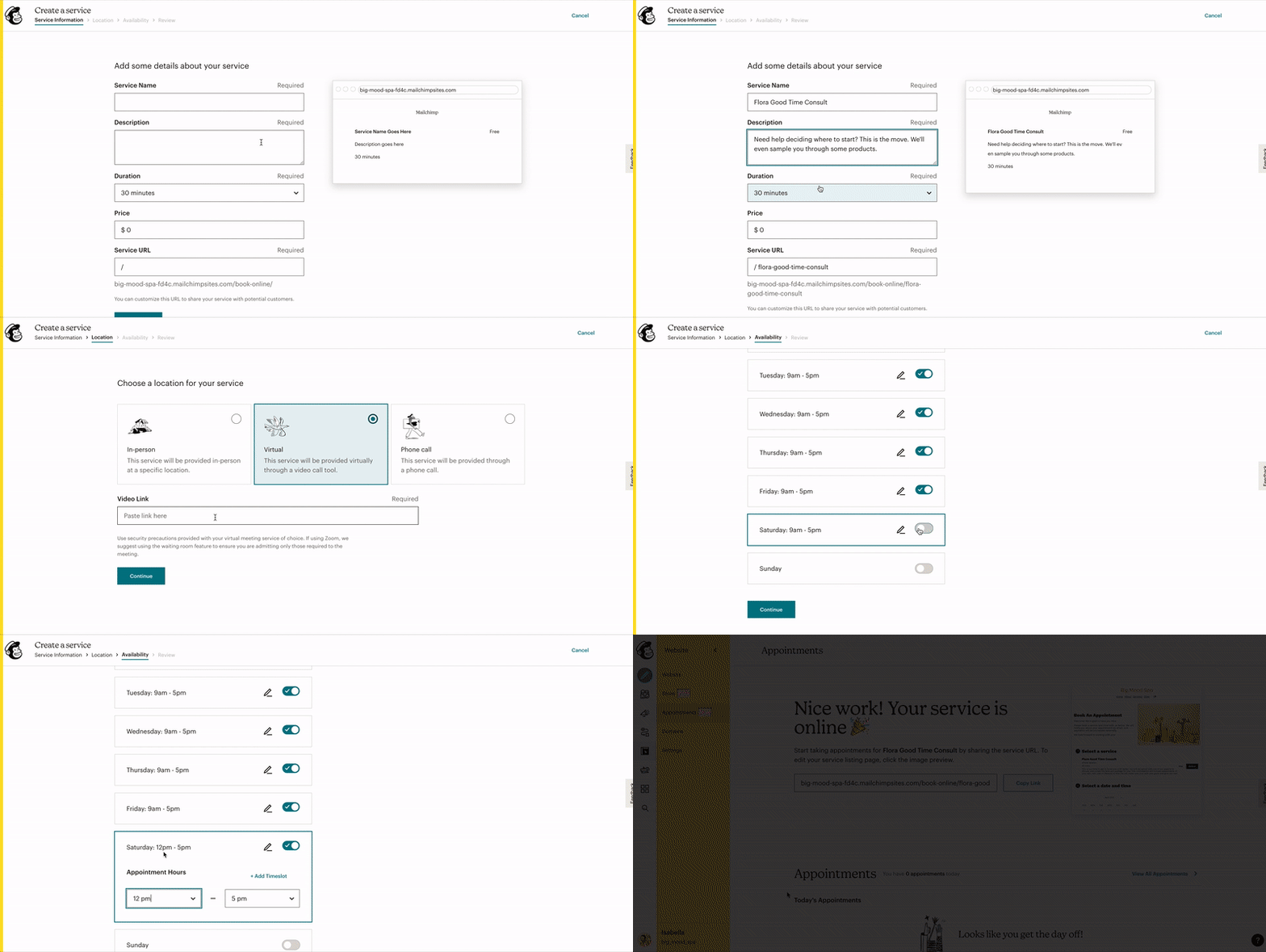
Over the course of the last few years, Mailchimp morphed from a basic newsletter platform to a fully-fledged marketing company. And while the service already offered integrations with a number of e-commerce sites, it is now launching its own online stores for small and medium businesses, as well as a new appointment booking service.

These new services will be part of MailChimp’s new ‘Websites & Commerce’ plans, which starts with a free tier that offers most of the basic functionality. Users on the free plan will pay a 2% transaction fee. For $10/month, Mailchimp will remove its own branding and users will get access to email and chat support and only pay a 1.5% transaction fee, while those who opt for the ‘Plus’ plan at $29/month will only pay a 0.5% transaction fee per order.

All plans will let users build sites with unlimited pages and without bandwidth restrictions, and include SEO tools and integration with Google Analytics. As for the stores, users will be able to build their product catalogs and manage their orders, taxes and shipping configurations. All of this, as well as the appointments functionality, is obviously deeply integrated with the rest of the Mailchimp stack.

Image Credits: Mailchimp

These new plans are currently in beta and the new e-commerce features will become available to all Mailchimp customers in the U.S. and UK by May 18, while the appointments booking feature will go live for all users on April 27.

This addition of built-in commerce features marks a major step in Mailchimp’s evolution. But it also makes sense. The company says about 40% of its customers over fourteen million customers are in the commerce space already and many of them have been asking for more native commerce features. Almost 30% of its users are also using its existing commerce features and integrations and the company saw its revenue for e-commerce customers grow 61% from 2019 to 2020.

Since Mailchimp already offers websites, domains and other adjacent services, adding these new features feels like a natural next step, whether that’s selling directly from a Mailchimp store or taking appointment bookings for a service business.

The company stresses that while it is entering a new space, it is not walking away from its existing products and customers. “Rest assured, we’re not abandoning our smart marketing solutions,” Mailchimp CEO and co-founder Ben Chestnut writes in today’s announcement. “In fact, our goal is still to have the best email marketing in the world. We know our customers and partners demand consistency and continuity as much as they demand new features and functionality, so we’re refining and nurturing existing tools, too. We continue to work on making the process of designing emails as easy as possible, and in a few months we’re adding new beautiful email templates.”

Image Credits: Mailchimp


from eCommerce – TechCrunch https://ift.tt/3gVpzSb
via IFTTT

Ushopal looks to charm China’s beauty lovers with niche Western brands

What will China’s answer to Estée Lauder look like in the digital age?

According to Ushopal, it will provide a seamless online and offline shopping experience, where China’s savvy beauty shoppers get to discover niche, tasteful brands and learn their stories.

Ushopal was founded in 2017 by J&J veteran Lu Guo as an “omni-channel” partner for luxury beauty brands at a time when online and offline consumption were increasingly merging in China. Unlike traditional import distributors, which simply puts goods on the shelves, Ushopal offers a holistic solution that helps brands develop their digital and brick-and-mortar retail channels as well as marketing content through its network of 2,500 influencers.

Ushopal felt that patnerships weren’t enough, so in 2019, it took a step further by adding a strategic investment arm to seek deeper operational influence on brands. Check sizes range from $10 million to $100 million, and for the larger rounds, Ushopal says it can leverage its own investors such as Cathay Capital, a private equity firm focused on global companies.

For instance, Cathay Capital bought a minority stake in the Paris-based, high-end fragrance brand Juliette Has A Gun. As its investor and partner, Ushopal helped the brand, which was founded by the grandson of the legendary couturier Nina Ricci, grow its gross merchandise value in China from zero to over 70 million yuan within a year.

To boost its capital pool, Ushopal raised $100 million in March that lifted its total fundings to $200 million. Aside from Cathay Capital, its past investors also include FountainVest Partners, a Chinese private equity firm that recently acquired the Canadian premium outdoor clothing label Arc’teryx, and Chinaccelerator, SOSV’s China-based accelerator focused on cross-border businesses.

Chinese consumers are hooked to e-commerce today, but there is still much of the shopping experience that Alibaba’s marketplace and WeChat mini-stores can’t offer. As such, Ushopal opened its first multi-brand store in an upscale mall in Shanghai last year, carrying brands that are normally found in Neiman Marcus in the U.S. and Le Bon Marché in Paris. The goal is to showcase treasures from around the world, an idea that is captured by the chain’s name — Bonnie&Clyde — the names of a Depression-era crime couple who is often depicted as chic and rebellious in popular culture.

Customers don’t pay at B&C’s brick-and-mortar store; instead, they order through its app and can have the order delivered to their doorsteps within four hours if they live in Shanghai. The delivery time is much shorter than China’s standard e-commerce import practice, which normally takes three to seven days for goods to arrive from their overseas distribution centers.

B&C, on the other hand, stockpiles in its own warehouse in a free trade zone in Shanghai, which allows for much quicker delivery. And since it holds exclusive and selective distribution rights to the brands it works with, it has a good grasp over how much inventory to keep.

A promotional short video made by Ushopal for Juliette Has A Gun in China

At China’s beauty stores targeting the mass market, shoppers are often seen moving from one busily stocked shelf to another while their eyes are fixated on their phones, browsing product reviews on content commerce apps like Xiaohongshu. B&C wants full attention from its customers by limiting its in-store product number and statinoing a team of beauty advisors. The demographics it targets are also quite different.

“When they are traveling in the U.S., they are going to Barneys, Saxs Fifth Avenue and whey they are in the U.K., they are going to Harrods,” Lau, vice president of brands at Ushopal, told TechCrunch in an interview. “They are familiar with the experience, and they are not here to line up.”

Last year, B&C generated over $200 million in gross merchandise value through the products it bought from a dozen of brands and subsequently sold in China. The average ticket size of its sales was over 5,000 yuan ($770), with shoppers often spending over 10,000 yuan per order, according to Lau. Many of the customers were what he called “second-generation rich,” roughly China’s equivalent to trust fund kids, as well as “well-to-do wives.”

Ushopal doesn’t limit its portfolio to overseas products. It doesn’t distinguish the origin of a brand, said Lau, whether it’s Chinese, Japanese or European. Though the company mainly works with Western brands at the moment, Lau said Chinese brands are becoming more sophisticated and often understand the local market better.

“For us, it’s just about creating great brands. It’s like Estée Lauder, which has brands from all over the world. We are a China-based company but a global luxury business.”


from eCommerce – TechCrunch https://ift.tt/2Qs7YGF
via IFTTT

Do your customers want fast and free delivery?

Life After Lockdown – What will your customers want from online delivery & returns?

RegisterWhat do your customers want from delivery? Fast and Free is what we’ve all been told for for years but that’s not the case, join our webinar with GFS this Thursday the 29th of April at 11am to find out what your customers really want.

With the high street open again, customers once again have choice and if you don’t offer both the product and the delivery and returns experience that they demand then they won’t be shopping with you. On the plus side, if you figure out what your customer really want then 60% of them would buy from you again if they have a good delivery experience.

Research shows time and again that last-mile delivery options directly influence consumers’ decisions to purchase – and purchase again. Register now for Thursday’s webinar for a heft dose of reality and to discover how you can delivery a world class delivery and returns experience and bridge the gap between expectation and reality.

If you concentrate on one thing this year, it’s to recognise that the free ride ecommerce has had during the pandemic is over. When consumer had no choice but to buy online they did… and to be honest convenience for many wasn’t a problem as they were either working from home or on furlough at home. Now they’re out and about again, the pubs are serving drinks having opened in Scotland this week and in England for outside drinking in the sun earlier in the month. Your customer is no longer sitting at home happy for packages to turn up whenever they happen to arrive, now they want and demand service and if you excel then so will your business.

The post Do your customers want fast and free delivery? appeared first on Tamebay.


from Ecommerce – Tamebay https://ift.tt/3aJNJeh
via IFTTT

How to utilise paid adverts to explore new international markets

How to produce a winning digital strategy for international success paid adverts

Are you looking to use digital channels to make the most of opportunities for growth across global markets? If so, this webinar from DIT is for you, which will cover how to utilise paid adverts to explore new opportunities in international markets and how to connect with people who are already looking for your kinds of products or services on search engines.

In the second half of the session, DIT will look at what Conversion Rate Optimisation (CRO) is and how it helps you achieve the fastest and most radical results. We will discuss which elements are important from a user experience perspective and what makes a good test, how to set one up, and what to do with the results.

This session will help you understand how you can increase conversions from paid adverts regardless of the amount of traffic coming to your website.

Join The Department for International Trade and Footprint Digital at 10am on the 20th of May to learn how to utilise paid adverts to explore new international markets and Conversion Rate Optimisation (CRO) to turn visitors into customers.

The webinar will cover:

  • How to get the most out of Google Ads (PPC)
  • How to turn visitors into customers with Conversion Rate Optimisation (CRO)

To make the most of this webinar, you will ideally have previous online experience with either an existing marketplace or your own online site.

Your presenters will be Michael Scanlon, Head of PPC, and Josef James, Head of Content at Footprint Digital.

Department for International Trade and Footprint Digital Drop-In Series

This is the third in a series of “Digital Drop-In” events hosted by the Department for International Trade and delivered by Footprint Digital. Register to attend more events from this series.

The post How to utilise paid adverts to explore new international markets appeared first on Tamebay.


from Ecommerce – Tamebay https://ift.tt/32Sah8o
via IFTTT

New Government – Labour Small Business Agenda

We’ve are all waking up to a new Government today, with the Labour party about to take control of the country and what should be top of your...